 AI-generated analysis published under the editorial responsibility of Rohit Sinnas. How it works →
Press quoted
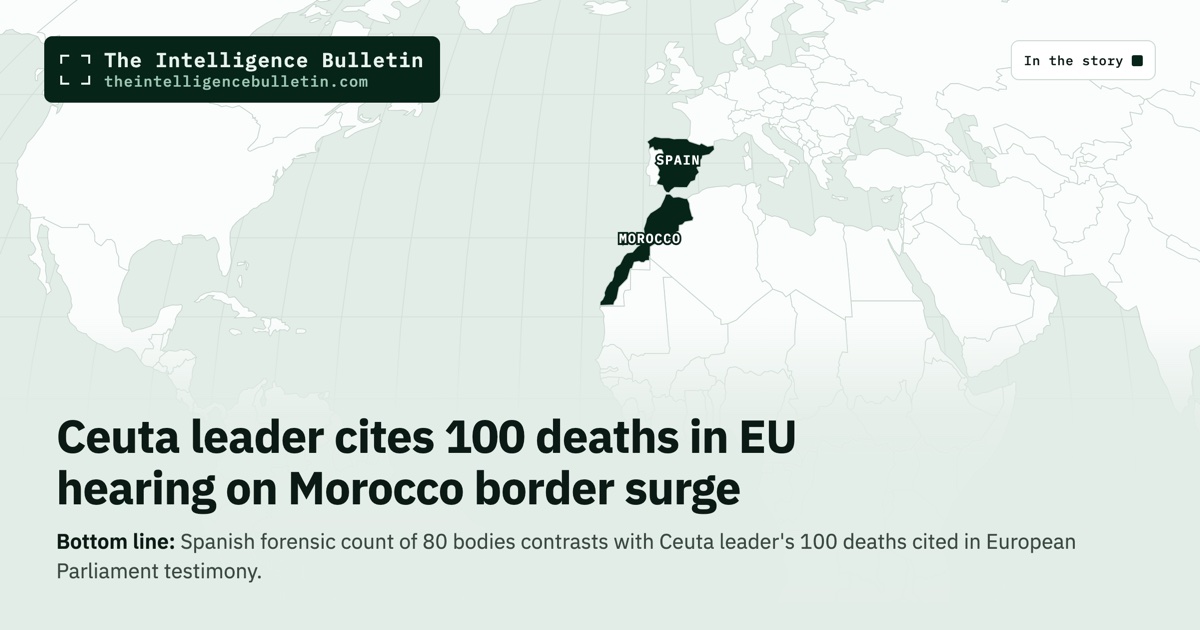
Spanish forensic count of 80 bodies contrasts with Ceuta leader’s 100 deaths cited in European Parliament testimony.
Coverage across the five outlets converges tightly on Ceuta president Juan Jesus Vivas’s testimony to the European Parliament’s civil liberties committee, where he put the death toll at about 100 and described 3,000 to 5,000 migrants still in the enclave with collapsed reception centers. Xinhua, Al Jazeera via Reuters, Tempo via Deutsche Welle, and Pajhwok all carry this Brussels-sourced account almost verbatim, including Vivas’s calls for more security and EU support. The Local stands apart by citing Spanish forensic authorities on 80 bodies recovered in Ceuta plus Morocco’s separate count of 11, without referencing the higher Vivas figure. This split reveals that the dominant narrative travels through the single parliamentary hearing rather than independent reporting chains from Spain or Morocco, leaving the precise toll dependent on one local official’s statement even while the scale of the influx and remaining humanitarian strain align everywhere.
Full analysis
On July 30, tens of thousands of migrants crossed from Morocco into Spain’s North African enclave of Ceuta, an autonomous Spanish city that forms part of the European Union’s external border. Spanish authorities recorded more than 72,000 people entering that day, a figure roughly equal to Ceuta’s own population of more than 80,000. Many swam around barriers or crossed on foot through a breakwater in scenes that left reception centers overwhelmed within hours.
Ceuta president Juan Jesus Vivas addressed an extraordinary meeting of the European Parliament’s Committee on Civil Liberties, Justice and Home Affairs in Brussels on August 6. He stated that about 100 people had died during the crossings. Vivas described the event as an invasion and said the city’s two reception centers, one for adults and one for unaccompanied minors, had collapsed under the strain. He called for immediate deportation of those who entered irregularly, stronger security deployments, and greater support from EU agencies. Between 3,000 and 5,000 migrants remained in the enclave at the time of his testimony, according to the same account.
Spanish legal authorities composed of forensics and Civil Guard experts reported that 80 bodies had been recovered from the sea in Ceuta since the surge. They had completed autopsies on 80 of 82 bodies found, identifying four people, with two additional autopsies scheduled for the following day. Morocco’s interior ministry separately stated that 11 people died on the Moroccan side of the border, all but one by drowning. Spanish officials said nearly all of the 72,000 who reached Ceuta had returned to Morocco voluntarily, though the remaining thousands faced limited access to shelter, food, water and sanitation.
European Commissioner for Internal Affairs and Migration Magnus Brunner told the same parliamentary committee that nothing on this scale had happened at any EU external border in 20 years. He noted Spain’s assurance that the crisis would not affect the Schengen passport-free travel zone, yet warned that Europe’s border security remained vulnerable because it depended on the cooperation of a single neighboring state. Brunner said the EU should use all available leverage, including visa policy and development aid, to secure Morocco’s cooperation on migration.
Morocco rejected suggestions that it bore responsibility for the surge. Officials there pointed to a Spanish court ruling that migrants arriving by swimming could not be immediately deported if they had not crossed a physical border barrier. Vivas said Moroccan authorities had refused to engage with Ceuta throughout the crisis and that local warnings about rising crossing numbers had gone unheeded in Madrid. He described the situation for unaccompanied minors as unsustainable and noted that hundreds remained in the enclave under difficult conditions.
The selected sources contain no reporting from Moroccan outlets. Statements attributed to Moroccan officials appear only through accounts published elsewhere.
Accounts converge on the scale of the influx and the number of migrants still present days later. Four of the five outlets carry Vivas’s parliamentary testimony placing the death toll at about 100 and the remaining population at 3,000 to 5,000. The Local alone reports the Spanish forensic recovery of 80 bodies in Ceuta and cites Morocco’s count of 11 without referencing the higher figure from Vivas. Pajhwok Afghan News notes an earlier Associated Press report of more than 80 deaths alongside Vivas’s later statement. Tempo and Al Jazeera add context on unaccompanied minors and the political resistance expected from some Spanish regions to redistributing those children under a 2025 immigration law.
The precise death toll therefore rests on two distinct counts that do not reconcile in the published reporting. Spanish forensic experts provided the 80-body figure from work performed in Ceuta. Vivas supplied the 100 figure in Brussels testimony. No independent verification chain connects the two numbers across the source set. Morocco’s 11 deaths appear only in The Local’s account and receive no mention in the Brussels-focused coverage.
The dominant narrative travels through the single parliamentary hearing rather than on-the-ground reporting from multiple countries. Xinhua, Al Jazeera, Tempo and Pajhwok all relay Vivas’s statements and Brunner’s response with nearly identical detail on numbers and calls for EU action. The Local’s focus on local identification work and the Moroccan ministry count stands outside that circuit. This pattern leaves the higher toll dependent on one local official’s public statement while the lower forensic count remains tied to Spanish technical authorities.
The corroborated elements point to a continuing humanitarian and administrative strain in Ceuta. The 3,000 to 5,000 migrants still present, including hundreds of unaccompanied minors, exceed the capacity of existing centers regardless of which death toll prevails. Vivas’s repeated requests for immediate deportations where legally possible and for reinforced security forces indicate that local authorities view the current posture as inadequate. Brunner’s emphasis on leverage over Morocco signals that EU institutions see the episode as evidence of structural dependence rather than an isolated breach.
What to Watch
The forensic recovery of 80 bodies in Ceuta supplies a concrete, named source for a minimum count on Spanish territory. Morocco’s reported 11 deaths supply a parallel minimum on the other side. The 100 figure from Vivas, while carried widely through the Brussels testimony, lacks a comparable chain of independent confirmation in the published material. Future EU-Morocco discussions on border management will likely reference both the scale of the July 30 movement and the remaining population inside Ceuta, because those numbers appear consistently across the reporting. The unresolved difference in death tolls will remain available for each side to cite according to its preferred framing of responsibility.
That’s how the world told the story.
Get our daily open-source intelligence on world events in your inbox — one email a day, up to six stories.
Subscribe freeNo spam. One-click unsubscribe. See the latest email →