 AI-generated analysis published under the editorial responsibility of Rohit Sinnas. How it works →
Press quoted
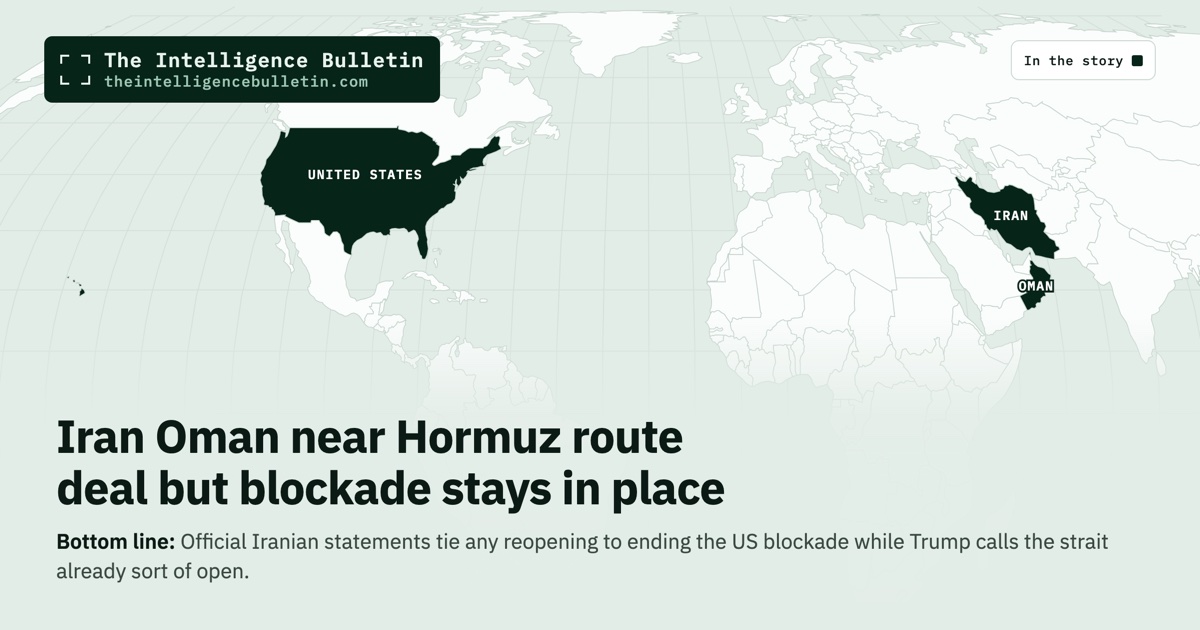
Official Iranian statements tie any reopening to ending the US blockade while Trump calls the strait already sort of open.
Iranian reporting stresses that the bilateral understanding with Oman on Hormuz routes is at an advanced stage yet remains conditional on third parties staying out and on changes in US policy toward the blockade. Muscat Daily carries Iranian comments that explicitly rule out any automatic reopening, underscoring Omani caution about continuity of navigation. The Jerusalem Post links the same statements to Trump’s public optimism and his description of the strait as “sort of open,” framing the moment through Israeli security concerns. LiveMint examines whether Washington is ready to accept an expanded Iranian role in one of the world’s key energy chokepoints. The National Council of Resistance of Iran places the talks inside a broader picture of Iranian internal divisions and external pressure. Across the accounts, the core divergence is not whether talks occurred but whether any bilateral text can be implemented without addressing the US blockade—an issue every outlet records Iranian spokesmen raising and no outlet resolves.
Full analysis
Iranian officials announced on August 5 that a framework understanding with Oman on shipping arrangements through the Strait of Hormuz had been reached. Inbound vessels entering the Persian Gulf would follow a northern route under Iranian Navy supervision and clearance. Outbound vessels heading toward the Sea of Oman would use a southern route managed from Muscat. Iranian Foreign Ministry spokesman Esmaeil Baghaei described the agreement as covering the geographic characteristics of the new route, with the two sides in the final stage of preparing a joint announcement provided certain third parties do not interfere. Deputy Foreign Minister Kazem Gharibabadi told state media that an understanding in principle covered almost all issues, including the map for maritime traffic, and that the arrangement could remain valid for two to four months.
The same officials made clear that the bilateral text does not automatically reopen the strait or restore normal traffic. Baghaei noted that many factors contributing to insecurity remain in place, including the US naval blockade and other aggressive actions against Iranian interests. A senior Iranian source quoted in reporting added that reopening depends on a change in US behavior and the correction of its violations. Traffic data illustrate the current state of the waterway. On one recent day only eight vessels crossed, five tankers and three bulk carriers, compared with the 130 to 140 ships that passed daily before the US-Israel war on Iran began on February 28 and Tehran sharply restricted navigation.
US President Donald Trump expressed optimism about the talks during public remarks on August 6. He said discussions with Iran were progressing well and that further details could emerge within 48 hours. Trump described the strait as sort of open right now, noting that the US Navy heads up a blockade it controls while warning that mines or other interference could still disrupt passage. No final announcement involving all parties has been made, and reports indicate the White House had aimed for an earlier public step that did not occur.
The proposed arrangement builds on an earlier memorandum of understanding signed between Iran and the United States on June 17. Under that interim text Tehran was expected to allow commercial vessels to transit without charges for 60 days in exchange for Washington lifting its naval blockade of Iranian ships. Iranian statements now tie any fuller reopening of Hormuz to relief from that blockade. One account of the new route framework said service fees could be charged for security and environmental protection, while another Iranian-linked report specified no fees or tolls under the temporary plan. Ships leaving the Gulf would use the route between Iran and Oman, with clearance issued through Muscat after Tehran was notified.
Omani authorities have not issued independent statements on the talks in the coverage examined. Iranian reporting instead carries the emphasis on continuity of navigation and the limits of the bilateral understanding. The National Council of Resistance of Iran, an opposition-in-exile group, placed the same statements alongside US claims of an imminent deal and Gulf officials’ assessment that the odds stand at 50-50, noting the requirement for blockade relief and non-interference by third parties.
The accounts converge on the existence of a framework between Tehran and Muscat while diverging on the immediacy and conditions of any operational change. Iranian state media and spokesmen foreground the advanced stage of the text and the higher-level decisions still required. Omani domestic reporting relays those Iranian comments but stresses that passage will not resume immediately. Israeli coverage connects the same Iranian remarks to Trump’s public optimism and his characterization of the strait as already sort of open, situating the moment within security concerns over mines and naval control. Indian reporting examines the route details and asks whether Washington is prepared to accept a larger Iranian role in the chokepoint. The opposition account contrasts US optimism with Gulf caution without adding new primary statements from either capital.
A reader limited to one national press would therefore miss the consistent Iranian insistence that implementation hinges on US policy shifts. Only the Omani and Indian accounts foreground the explicit denial of automatic reopening. Only the Israeli account supplies Trump’s precise phrasing on the current status of the strait. Only the opposition account records the 50-50 diplomatic odds cited by unnamed Gulf officials. The core factual spine remains the same across the independent reporting chains: a bilateral framework exists, the strait stays restricted, and any broader reopening is presented by Iranian officials as conditional on ending the blockade.
What to Watch
The Iranian account of the conditions carries the greatest weight because it rests on repeated on-record statements from named spokesmen across multiple outlets. Trump’s optimism is also on record but addresses the state of talks rather than the mechanics of implementation. The blockade linkage appears only in the Iranian chain and is not contradicted by any other source examined; it is simply absent from the others. The interest of Iranian officials in tying any concession to blockade relief is clear from the text they released. The interest of the US administration in presenting momentum without resolving the blockade is equally visible in Trump’s remarks. The next step that follows directly from the reporting is whether the two sides produce the promised joint announcement and whether that text addresses the blockade condition or leaves it for separate negotiations. The volume of daily traffic through the strait, currently a fraction of its normal level, will supply the practical test of whether any text changes the physical movement of vessels.
That’s how the world told the story.
Get our daily open-source intelligence on world events in your inbox — one email a day, up to six stories.
Subscribe freeNo spam. One-click unsubscribe. See the latest email →