 AI-generated analysis published under the editorial responsibility of Rohit Sinnas. How it works →
Press quoted
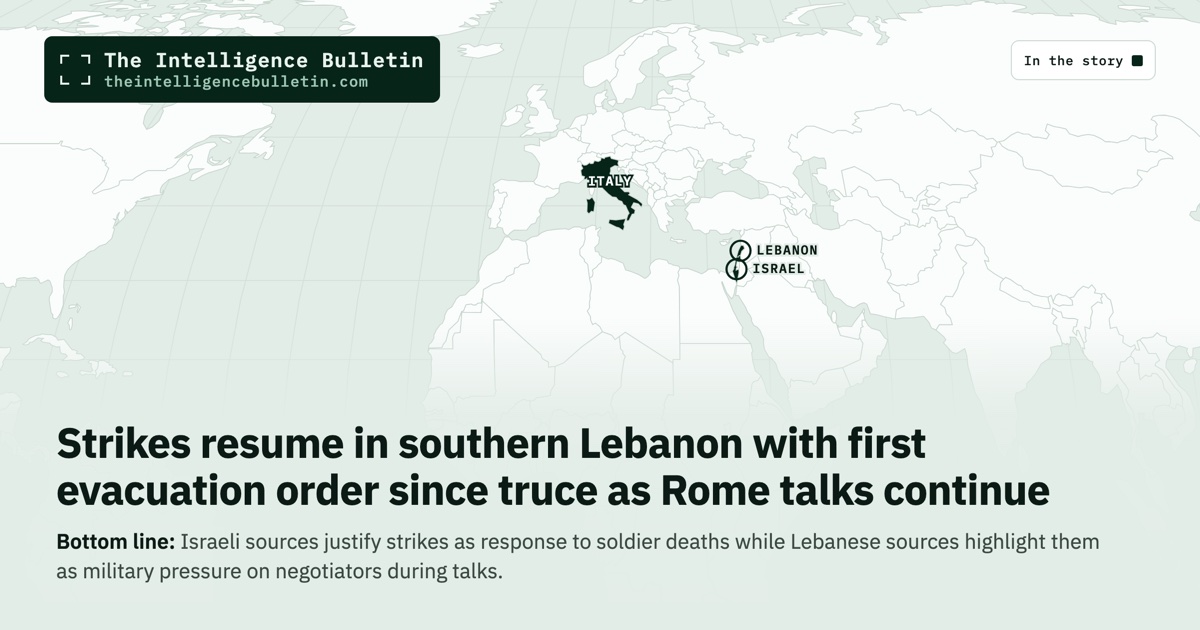
Israeli sources justify strikes as response to soldier deaths while Lebanese sources highlight them as military pressure on negotiators during talks.
The reporting converges on the basic sequence of an Israeli strike and evacuation order timed with the Rome talks but parts sharply on causation and stakes. Israeli domestic coverage presents the action as a direct response to a Hezbollah violation that killed soldiers, placing it against the backdrop of ongoing negotiations on the 1923 border and pilot withdrawal zones without dwelling on civilian displacement. Lebanese outlets instead lead with the military pressure on negotiators through the first evacuation warning in weeks, framing it as an attempt to influence the Lebanese delegation during the second day of the seventh round. Third-country reporting from Nigeria, Germany and Qatar consistently notes the simultaneity with diplomacy and records casualties on both sides, underscoring that the strikes resumed even as delegations discussed verification mechanisms and a 60-day ceasefire renewal. This pattern shows that outlets closest to the actors emphasize justification or civilian cost according to national vantage, while distant coverage highlights the diplomatic futility without adopting either side’s framing of necessity. The single consistent detail across independent chains is the evacuation order itself, absent from Israeli headlines but central to Lebanese accounts and noted in Western and African dispatches as marking a return to pre-truce tactics.
Full analysis
On the second day of the seventh round of US-mediated talks between Israel and Lebanon in Rome, Israeli forces carried out strikes in southern Lebanon and issued an evacuation order for the town of Mansouri. The order came after an explosion inside a booby-trapped building in the village of Majdal Zoun killed two Israeli soldiers and injured several others. Lebanese state media and the Health Ministry reported that one civilian died and twelve people were wounded when an Israeli strike hit the roof of a cemetery prayer hall in Tibnin. The strikes and the warning marked the first evacuation directive issued to a Lebanese town since the June truce.
The Rome negotiations, held at the US Embassy and scheduled to run through a third day, focused on land border demarcation according to the 1923 internationally recognized line and on military mechanisms for verification of any future Israeli withdrawal. Lebanon’s delegation, led by former ambassador Simon Karam, pressed for renewal of a full ceasefire for sixty days and for expansion of pilot withdrawal zones to additional southern towns. Israel’s delegation, headed by ambassador Yechiel Leiter, participated alongside fifteen US officials from the State Department, National Security Council and Pentagon. One session ended three hours early after the Israeli side cited alleged misleading leaks from the Lebanese side. Hezbollah leader Naim Qassem rejected the direct talks outright, stating they would bring Lebanon nothing but shame, humiliation and successive compromises.
The explosion in Majdal Zoun occurred while Israeli forces were operating in the area. The IDF described the subsequent strikes as precise actions taken in response to a blatant ceasefire violation by Hezbollah. Lebanese accounts placed the Mansouri warning north of the yellow line and noted that the town lies roughly nine kilometres south of Tyre and ten kilometres north of the border. Residents received instructions to move north immediately for their safety. Earlier in the week the IDF had destroyed a major Hezbollah tunnel network beneath Beaufort Castle using roughly seven hundred tons of explosives. Since the start of hostilities in March, Lebanese authorities have recorded more than four thousand three hundred deaths and more than twelve thousand wounded from Israeli attacks.
The June framework agreement that preceded these talks called for Hezbollah disarmament, a gradual Israeli withdrawal from southern Lebanon, and deployment of the Lebanese army in designated pilot zones. The current round is the latest in a series that began after Hezbollah fired rockets at Israel in support of its Iranian ally. Hezbollah is not a formal participant in the Rome talks. Italian Foreign Minister Antonio Tajani spoke with his Iranian counterpart during the same period and urged Tehran to halt Hezbollah operations.
Israeli reporting presented the strikes as a necessary response to the soldier deaths and placed them against the backdrop of continuing negotiations on border issues and security verification. It noted that the Israeli delegation had not insisted on prior Hezbollah disarmament as a precondition. Lebanese coverage led with the military pressure exerted on the negotiators through the evacuation order and the first such warning in weeks. It highlighted stalled progress on the second pilot zone and on verification mechanisms while recording Israeli recognition of the 1923 border line. Third-country accounts from Nigeria, Germany and Qatar recorded the civilian and military casualties on both sides and underlined that the strikes resumed even as the delegations met to discuss a sixty-day ceasefire renewal and verification arrangements.
The accounts diverge most clearly on the meaning of the timing. Israeli domestic sources treat the military action as a discrete response to a specific incident and keep the focus on the substance of the border and security discussions. Lebanese domestic sources treat the evacuation order itself as the central event and read it as an attempt to influence the Lebanese side during the negotiations. Outlets farther from the immediate actors consistently note the overlap between the strikes and the diplomatic schedule without adopting either justification or pressure narrative as primary.
A reader limited to one national press would therefore miss either the civilian displacement angle or the specific trigger of the soldier deaths, depending on the vantage. The single detail carried across independent reporting chains is the Mansouri evacuation order and its status as the first since June. That order appears in Israeli military statements, in Lebanese accounts of the pressure on negotiators, and in dispatches from Nigeria, Germany and Qatar that place it alongside the Rome schedule.
The evidence that can be weighed across chains is the sequence itself: an explosion that killed two Israeli soldiers, followed by strikes and an evacuation order issued while talks on border demarcation and verification continued. Lebanese casualty figures come from the Health Ministry and National News Agency. Israeli casualty figures come from the military’s own confirmation. The framework under discussion traces to the June agreement and is referenced in both Israeli and Lebanese reporting of the current round.
What to Watch
Israeli authorities have an interest in readers seeing the action as a limited and justified response to a violation. Lebanese authorities have an interest in readers seeing it as direct pressure on their negotiators. Third-country coverage, by recording both the civilian toll and the diplomatic setting, shows the narrow space in which any agreement must hold. The next round of talks will test whether the evacuation order and the strikes have narrowed or widened that space; the consistent reporting of the order’s novelty indicates that both sides are now operating with fewer buffers than existed even a week earlier.
That’s how the world told the story.
Get our daily open-source intelligence on world events in your inbox — one email a day, up to six stories.
Subscribe freeNo spam. One-click unsubscribe. See the latest email →