 AI-generated analysis published under the editorial responsibility of Rohit Sinnas. How it works →
Press quoted
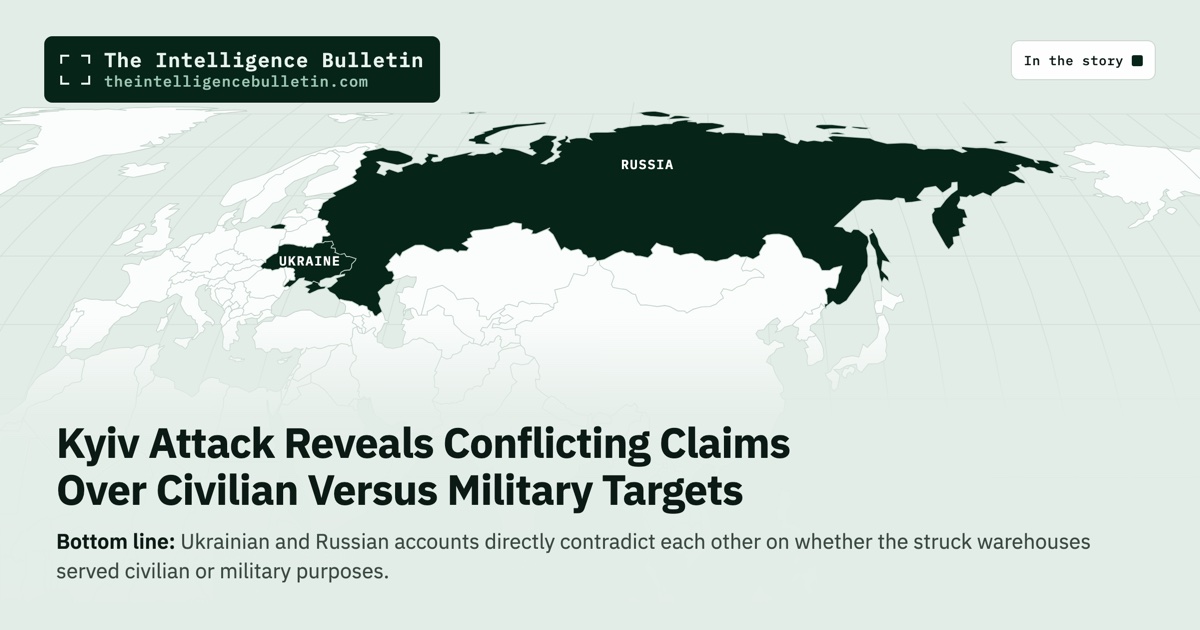
Ukrainian and Russian accounts directly contradict each other on whether the struck warehouses served civilian or military purposes.
The reporting converges on the scale of destruction and casualty count yet splits cleanly along national lines on what the strikes actually hit and why Ukraine could not stop them. Ukrainian domestic coverage from Kyiv Post details specific civilian sites struck including Nova Poshta, Rozetka and Epicentr warehouses, attributes the deaths directly to depleted interceptor stocks and records Zelensky’s explicit plea that additional Patriots would have saved lives. Russian-origin reporting via Mail.ru frames the same facilities as legitimate military targets storing dual-use goods and drone parts, presenting the Ministry of Defense list without Ukrainian rebuttal. Turkish Daily Sabah and Qatari Al Jazeera both relay the Ukrainian casualty and shortage narrative while noting Russian counter-claims, underscoring the interceptor gap as the decisive vulnerability. Canadian Globe and Mail coverage emphasizes Ukraine’s diplomatic appeals to Western partners, placing the event inside the broader supply shortage caused by diversion to other theaters. The single clearest divergence is the status of the logistics hubs: Ukrainian officials describe purely civilian retailers with no war connection, while Russian statements list them as supporting drone production and military logistics, a factual conflict no source reconciles. This pattern shows how each national press selects which official account to foreground rather than any shared factual baseline beyond the death toll itself.
Full analysis
Russia fired 24 ballistic missiles, four additional missiles identified as hypersonic Zircons or supersonic Oniks, and 115 attack drones at Ukraine overnight into August 5, 2026, with the barrage concentrated on Kyiv and the surrounding region. Ukrainian air defenses reported shooting down 98 of the drones but none of the ballistic missiles. The strikes set fires at warehouses, logistics centers, manufacturing sites and residential buildings across the capital and Kyiv region. Ukrainian President Volodymyr Zelensky stated that at least 17 people were killed and dozens injured, with 14 deaths and 27 injuries recorded in the Kyiv region and three deaths plus 24 injuries inside the city itself. Kyiv Mayor Vitali Klitschko and the State Emergency Service of Ukraine confirmed the same totals after updates through the morning.
The attacks marked the third large-scale Russian assault on the capital area in less than a week. Specific sites hit included a Nova Poshta sorting center in Obolonskyi district, where cluster munitions destroyed the facility and killed three workers while injuring eight others. A Rozetka distribution center in Brovary was struck and left beyond repair after processing more than 100,000 orders daily across a 100,000-square-meter site. Epicentr retail and construction facilities suffered rapid destruction, with one employee killed and three wounded. Additional damage struck an apartment building in Obolonskyi, private homes in Holosiivskyi, warehouses in Sviatoshynskyi and Desnianskyi districts, and an industrial site that triggered a contained ammonia leak. An ambulance was also damaged at one strike location.
Ukrainian officials described the targets as civilian logistics and retail infrastructure with no connection to military operations, naming a brewing company, construction materials warehouses, and postal and online retail hubs. Zelensky said on social media that ballistic missile interceptors could have saved the lives lost and that supplies of such missiles stood three times lower than in 2025. He urged partners to accelerate deliveries, warning that delays produce direct casualties.
Russian Defense Ministry statements listed seven logistics centers in Kyiv and the region as the intended targets, claiming they stored or distributed dual-use goods including components for long- and medium-range drones, robotic systems and electronic warfare equipment. The ministry described one Nova Poshta center as handling dual-use items and two other centers in the Kyiv region as involved with drone storage or parts. It also reported striking three bulk carriers on the Black Sea south of Odesa carrying weapons and military equipment. Separate Russian claims that night included downing 475 Ukrainian drones over multiple regions.
Ukrainian reporting from Kyiv recorded more than 30 explosions in 20 minutes, fires at multiple logistics and industrial sites, and air pollution warnings across districts. Emergency crews worked through the day on rescue, firefighting and debris clearance. Zelensky linked the outcome directly to interceptor shortages for Patriot systems, the only Ukrainian weapon capable of engaging Russian Iskander-M ballistic missiles.
Coverage from outlets outside Ukraine and Russia carried both the Ukrainian casualty figures and the Russian target list without reconciling the two descriptions of the same facilities. Turkish and Qatari reporting noted the interceptor shortage as the factor allowing the ballistic missiles through while recording the Russian assertions that the warehouses supported military activity. Canadian coverage placed the strikes inside Ukraine’s ongoing diplomatic requests for additional Western missile supplies, noting diversions of Patriots to other theaters. Russian-origin material presented the ministry’s military rationale as the primary frame and did not include Ukrainian statements describing the sites as purely civilian.
The accounts diverge most sharply on the character of the struck warehouses. Ukrainian officials and the affected companies stated that the facilities belonged to civilian retailers and logistics operators with no military role. Russian ministry statements asserted that the same locations handled drone components and dual-use materials for war production. No reporting chain reconciled these descriptions or provided independent verification of the contents. The death toll of 17 and the failure to intercept any ballistic missiles appear consistently across Ukrainian official statements and multiple international wires. The Russian account of the targets rests on ministry statements relayed in single-source form.
The Ukrainian description of the targets draws support from multiple independent reporting chains that include direct statements from Zelensky, Klitschko, the State Emergency Service, Nova Poshta, Rozetka and Epicentr. The Russian characterization originates solely from the Defense Ministry and receives no separate corroboration in the coverage examined. Both sides have clear interests in how the targets are presented: Russia seeks to frame the operation as proportionate military action, while Ukraine seeks to underscore the human cost of air defense gaps in order to secure additional interceptors. The pattern of repeated ballistic strikes on the capital area every few days this summer indicates that the shortage will continue to shape outcomes unless production or supply arrangements change before winter.
What to Watch
The corroborated record shows that Russia conducted the barrage, that Ukrainian defenses stopped the drones but not the ballistic missiles, and that 17 people died amid damage to retail and logistics infrastructure. The unresolved disagreement over whether those sites served military functions leaves readers of any single national press with an incomplete picture of what justified or failed to justify the strikes in the eyes of the opposing side. Future attacks will test whether additional interceptors reach Ukraine in time to alter the balance or whether the current supply constraints persist.
That’s how the world told the story.
Get our daily open-source intelligence on world events in your inbox — one email a day, up to six stories.
Subscribe freeNo spam. One-click unsubscribe. See the latest email →