 AI-generated analysis published under the editorial responsibility of Rohit Sinnas. How it works →
Press quoted
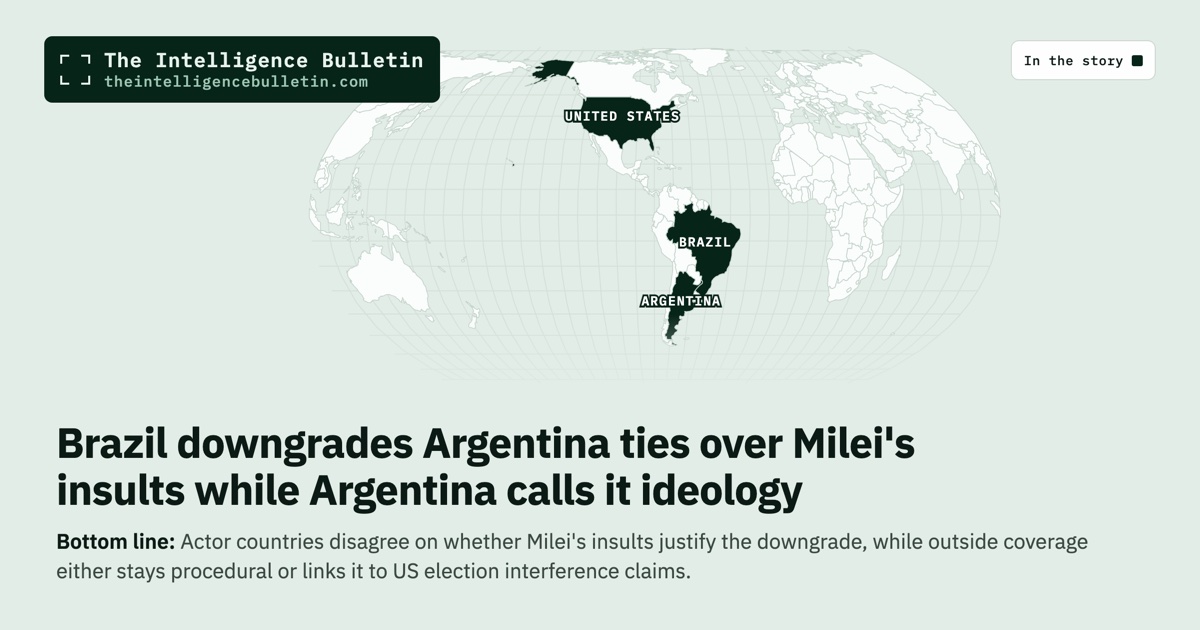
Actor countries disagree on whether Milei’s insults justify the downgrade, while outside coverage either stays procedural or links it to US election interference claims.
Brazilian reporting centers the downgrade on Milei’s personal attacks as a breach of diplomatic civility that made normal relations impossible, with Foreign Minister Mauro Vieira quoted directly on the need for respect over ideology. Argentine accounts treat the step as a Brazilian overreaction driven by political differences and highlight practical continuity through the ambassador’s scheduled return. Distant observers split between neutral mechanics of the downgrade and a broader narrative tying it to alleged US-Argentine interference in Brazil’s October elections. The reporting shows the two neighbors agree the trigger was Milei’s São Paulo convention speech supporting Flávio Bolsonaro and labeling Lula a thief and convict, yet disagree on whether insults justify institutional retaliation. No outlet presents evidence of formal expulsion or full rupture, only reciprocal reduction to chargé level. This pattern reveals how actor countries frame the same facts as either provocation or retaliation, while external coverage either stays procedural or folds the event into wider hemispheric tensions without resolving the core dispute.
Full analysis
Brazil reduced its diplomatic representation in Argentina to the level of chargé d’affaires on August 5 and recalled its ambassador from Buenos Aires, leaving the embassy under a business attaché. The move followed repeated public remarks by Argentine President Javier Milei against Brazilian President Luiz Inácio Lula da Silva. Foreign Minister Mauro Vieira summoned the Argentine ambassador in Brasília, Daniel Raimondi, delivered a formal note of protest, and informed him that Brazil’s ambassador in Buenos Aires, Julio Bitelli, would not return after his recent recall. The Brazilian embassy will continue to function, but without an ambassador at its head.
Vieira described the trigger in an interview with the Argentine program Modo Fontevecchia. He said Milei had made four separate statements in one week that criticized Brazil and its institutions through attacks on Lula, using language that was aggressive, unwarranted, and rude. Education and respect were prerequisites for dialogue, Vieira said, and ideology played no central role. The Brazilian government communicated the decision on the evening of August 4. It stressed that the step did not amount to a full rupture or formal expulsion.
The timeline of Milei’s statements begins with his appearance at the national convention of Brazil’s Liberal Party in São Paulo on July 25. There he addressed supporters of Flávio Bolsonaro’s presidential candidacy and referred to Lula as a thief, a convict, and socialist garbage. He also directed remarks at Supreme Federal Court Justice Alexandre de Moraes. Milei returned to the subject in later interviews and social media posts, repeating that Lula had been released from prison on a procedural point rather than cleared of wrongdoing and accusing him of having supported Milei’s 2023 opponent. Argentine officials later described these comments as spontaneous words rather than calculated insults.
Argentina’s foreign ministry issued a statement the same evening rejecting the Brazilian action as unilateral. It expressed regret and attributed the decision to ideological differences that had left Brazil isolated in the region. The ministry noted that political statements had flowed in both directions in recent years without either side turning them into diplomatic incidents. Argentine spokesmen confirmed that Ambassador Raimondi would return to Buenos Aires in the coming days, initially described as a vacation, leaving the mission under a career minister.
The downgrade occurred against a backdrop of separate friction between Brazil and the United States. One report linked the Argentine move to Brazilian government statements that the Trump administration and Milei had sought to influence Brazil’s October presidential elections through diplomatic pressure and public endorsements. Those statements cited the revocation of Brazil’s ambassador’s visa in Washington and earlier tariff disputes as part of a pattern of hostile measures. Brazilian officials rejected US explanations for the visa step and pointed to denied entry for certain US diplomats expected to question Brazil’s electoral system.
Neighboring coverage placed the episode in the longer record of Mercosur relations. Brazil remains Argentina’s largest trading partner, and both countries anchor the bloc. Earlier incidents included Brazil’s withdrawal from representing Argentine interests in Caracas after a Milei post and Lula’s absence from a Mercosur-European Union agreement signing. The current step marks the first time in decades that Brasília has reduced its representation with Buenos Aires to this level.
Brazilian accounts treat the downgrade as a necessary institutional response to personal attacks that crossed a line of basic civility. Argentine accounts present it as an overreaction rooted in political disagreement rather than any objective breach. Coverage from outside the two capitals either records the mechanical sequence of recalls and notes or folds the episode into the larger pattern of Brazil-US tension without resolving whether the insults alone justified the institutional step.
The two governments agree on the central trigger: Milei’s July 25 speech and the statements that followed it. They diverge on the proper response. Brazilian reporting supplies the direct ministerial justification that respect must precede dialogue. Argentine reporting supplies the counter-claim that the Brazilian decision itself reflected ideology and that practical continuity remains through the chargé d’affaires arrangement. No reporting examined here shows evidence of a formal break or expulsion on either side.
The Brazilian account of the trigger rests on the widest corroboration. Multiple independent reporting chains record the same São Paulo convention speech and the same sequence of subsequent remarks. The Argentine claim that the move was purely ideological appears in its own foreign ministry statement and receives emphasis in domestic coverage. The allegation of coordinated election interference surfaces in one outlet’s account of Brazilian government statements and is not repeated elsewhere in the set.
Brazil has an interest in presenting the downgrade as a defense of institutional norms against personal attacks that could erode them. Argentina has an interest in presenting it as an ideological gesture that reveals Brazil’s isolation. The single-source interference framing carries the additional interest of linking the Argentine episode to a larger US-Brazil dispute already under way. The most durable element across the record is the documented sequence of Milei’s public statements and Brazil’s reciprocal reduction of diplomatic rank. That sequence stands regardless of the motives each side assigns to the other.
What to Watch
The immediate consequence is that both embassies now operate at chargé level, with no ambassador in post. Further statements by Milei on Brazilian politics would test whether the reduction remains temporary or hardens. The episode shows how personal language from a head of state can produce institutional consequences that neither side treats as routine, even when both insist the relationship itself is not broken.
That’s how the world told the story.
Get our daily open-source intelligence on world events in your inbox — one email a day, up to six stories.
Subscribe freeNo spam. One-click unsubscribe. See the latest email →