 AI-generated analysis published under the editorial responsibility of Rohit Sinnas. How it works →
Press quoted
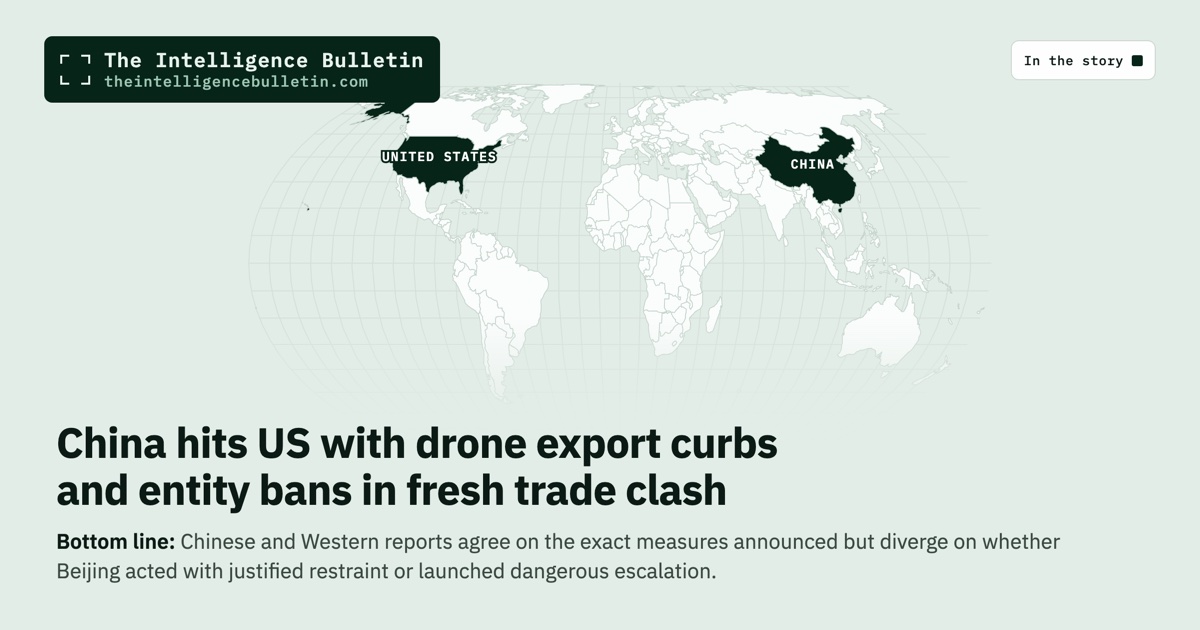
Chinese and Western reports agree on the exact measures announced but diverge on whether Beijing acted with justified restraint or launched dangerous escalation.
All outlets that published full articles agree on the core facts: Beijing’s Ministry of Commerce responded on August 5 with export controls requiring case-by-case review of drones and related technology sold to the United States, plus prohibitions on Chinese dealings with six named US entities including Human Rights in China and Applied DNA Sciences. The same outlets record Beijing’s additional steps against Compliance Testing LLC and its initiation of a national-security probe into imported office equipment containing foreign software. Where the accounts diverge is emphasis. Global Times presents the package as swift, lawful self-defense against US “unilateral protectionist moves” tied to Xinjiang and national-security claims, repeatedly stressing that China acted with restraint and inviting the US to return to consultation. The AP dispatch carried by WRAL and The Canberra Times reports identical measures but frames them as the latest round in simmering tensions ahead of Xi Jinping’s planned September visit to the United States, noting that the US actions themselves responded to earlier Chinese practices. CNA’s Beijing-datelined piece records the same list of Chinese steps and quotes the “restrained” language but situates the trigger explicitly as Washington’s July 31 addition of 43 Chinese companies to the forced-labor list. ARY’s brief AFP item simply registers the announcement without elaboration. The reporting therefore converges on what Beijing did and why it says it acted; it parts company on whether the sequence constitutes justified reciprocity or an escalatory cycle that risks broader supply-chain effects.
Full analysis
China’s Ministry of Commerce announced on August 5 a package of countermeasures that included case-by-case export reviews for drones and their key components sold to the United States, prohibitions on Chinese dealings with six named American entities, suspension of certain US certification bodies for China Compulsory Certification inspections, and a national-security investigation into imported office equipment containing foreign software. The measures took effect immediately. Beijing named the six entities as Applied DNA Sciences, Inc., Stratum Reservoir, LLC, Altana Technologies, Inc., the Responsible Business Alliance, Verite Group, Inc., and Human Rights in China. It separately added Compliance Testing LLC to its countermeasure list. The ministry stated that these steps responded to recent US restrictions, including Federal Communications Commission bans on Chinese drone imports and the Department of Homeland Security’s addition of 43 Chinese companies to the Uyghur Forced Labor Prevention Act entity list on July 31.
Chinese statements described the package as generally restrained and required by the need to safeguard national security and fulfill non-proliferation obligations. A ministry spokesperson said the US actions violated consensus reached by the two heads of state and damaged China’s legitimate rights and interests. The spokesperson urged Washington to revoke the measures, stop what Beijing called erroneous practices, and return to consultation. If the United States introduced new restrictions, the spokesperson warned, China would take further countermeasures. Global Times reported the announcement under the headline that China was retaliating with swift countermeasures against the latest US restrictions. Central News Agency’s Beijing report quoted the same restrained language and listed the identical six entities while situating the July 31 US list addition as the immediate trigger.
The same measures appear in the Associated Press dispatch carried by WRAL and The Canberra Times. That account records Beijing’s requirement for case-by-case reviews of unmanned aerial vehicles and related dual-use items, the ban on dealings with the six US entities, the action against Compliance Testing LLC, the suspension of US certification bodies, and the office-equipment investigation. It adds that the US actions themselves followed earlier Chinese practices and places the exchange in the context of simmering tensions ahead of an expected visit by Chinese President Xi Jinping to the United States in September. The AP report notes that the FCC had banned new Chinese drone imports in December, later revising the ban to allow some models, and that last week Washington announced bans on new foreign-made humanoid robots and power inverters citing national security.
ARY News carried a short AFP item that registered the announcement of countermeasures after US trade sanctions without further detail. The five outlets that published fuller accounts converge on the specific actions Beijing took and on the US moves that Beijing cited as the cause. They differ in the weight they give to justification versus sequence. Global Times repeatedly stresses the legal basis under China’s Export Control Law and the restrained character of the response while calling for renewed consultation. The AP accounts foreground the tit-for-tat character and note that the US restrictions themselves responded to earlier Chinese practices. CNA records the full Chinese list and the restrained claim but opens by naming the July 31 addition of 43 Chinese firms to the forced-labor list as the precipitating US step.
A reader limited to any single account would therefore miss the precise list of six entities that appears in the Chinese-language reporting and in the AP dispatch, or would miss the explicit July 31 date of the 43-firm US listing that CNA foregrounds. The same reader would encounter different framings of motive: one outlet presents Beijing’s moves as lawful self-defense, another presents them as the latest round in an ongoing cycle whose next turn depends on Washington’s choices. The AP dispatch notes that the measures come despite signs of warming ties during Xi’s May meetings with US President Donald Trump in Beijing.
What to Watch
The convergence across independent reporting chains on the concrete measures and on Beijing’s stated rationale supplies the strongest available warrant for treating those elements as the settled spine of the event. Global Times, as the outlet aligned with the announcing ministry, has an institutional interest in presenting the steps as proportionate and legally grounded. The AP dispatch, filed from Bangkok and Hong Kong, has an interest in placing the moves inside the bilateral diplomatic calendar and supply-chain implications for American firms. CNA’s reporting from Beijing, produced by a Taiwanese outlet, carries the same facts while adding the local lens of cross-strait technology friction. The shared factual core across these chains indicates that the event itself is the incremental tightening of export and certification rules rather than a dramatic rupture. What remains open is whether the next US move will trigger the further Chinese response Beijing has already signaled.
That’s how the world told the story.
Get our daily open-source intelligence on world events in your inbox — one email a day, up to six stories.
Subscribe freeNo spam. One-click unsubscribe. See the latest email →