 AI-generated analysis published under the editorial responsibility of Rohit Sinnas. How it works →
Press quoted
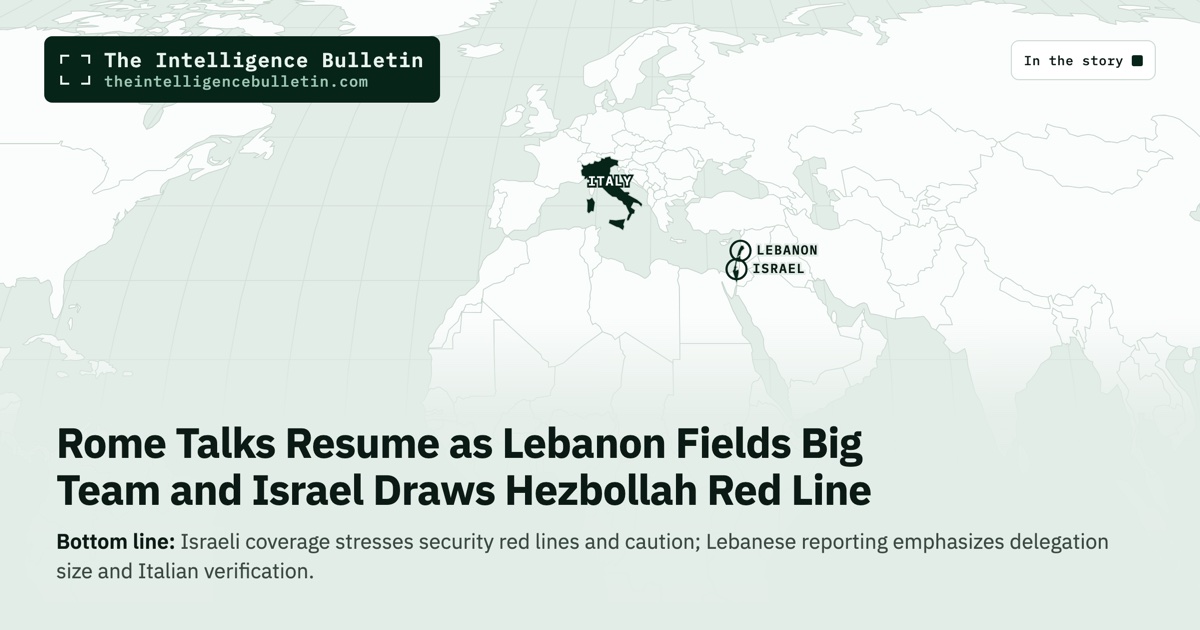
Israeli coverage stresses security red lines and caution; Lebanese reporting emphasizes delegation size and Italian verification.
The coverage reveals a clear split in priorities rather than outright contradiction. Naharnet, drawing on Lebanese sources, leads with Beirut’s unusually large team and the planned Italian-led verification committee, framing the talks around Lebanon’s fulfilled obligations and need for US pressure on Israeli bulldozing. Israeli outlets Israel National News and JNS instead foreground Jerusalem’s explicit red line on Hezbollah’s Ali al-Taher Ridge compound and US envoy warnings against haste. Asharq Al-Awsat, citing both sides, stresses persistent obstacles including Israeli demolitions and Hezbollah’s refusal to discuss weapons, noting little chance of breakthrough before Israeli elections. Anadolu’s short neutral summary simply records the round opening. All five reports corroborate the same core facts from overlapping Lebanese and US diplomatic sources: the Rome venue, seventh round timing, pilot zones in towns such as Zawtar al-Gharbiyeh, and the Italian preference over French for verification. The pattern shows domestic outlets amplifying their government’s negotiating posture while the pan-Arab and Turkish accounts treat the impasse as structural, not merely tactical.
Full analysis
Lebanon is sending an unusually large political and military delegation to the seventh round of direct negotiations with Israel, scheduled to open Tuesday at the US Embassy in Rome. The team will be led by former ambassador Simon Karam and will include Lebanon’s ambassador to Washington, Nada Hamadeh Moawad, the director of operations at the army command, Brigadier General George Rizkallah, plus five specialized officers, legal adviser to the presidency Antoine Sfeir, and maritime affairs expert Najib Masihi. Masihi participated in the earlier US-mediated maritime border demarcation reached under President Michel Aoun. The additions of Sfeir and Masihi were described as a precaution in case Israel raises legal or topographical points, as occurred in the previous round.
The Lebanese side plans to open the session by reiterating points already agreed, above all consolidation of the ceasefire, an end to hostilities, and an Israeli commitment, guaranteed by the United States, not to bulldoze towns inside the yellow line that it currently occupies. The delegation also intends to present Washington with evidence of Israel’s transformation of parts of southern Lebanon into scorched earth and to press for US pressure on Israel to halt that activity. Lebanese sources stated that continued inaction would strengthen Hezbollah’s position by allowing it to claim the framework agreement is being undermined in favor of reviving an Iranian-American understanding that is already strained.
On the verification mechanism for Lebanese Army deployment in the designated pilot zones, the prevailing view inside the talks favors an Italian officer to head the committee. The zones named so far are Froun, Srifa, Qalaway, Burj Qalaway, and Zawtar al-Gharbiyeh, all previously occupied by Israel. The preference for an Italian stems in part from the fact that an Italian general already commands the UNIFIL peacekeeping force and in part from American and Israeli objections to a French officer.
Israel, for its part, has conveyed to Washington that Hezbollah must immediately evacuate its large and strategic military compound on the Ali al-Taher Ridge. Jerusalem has indicated it is prepared to let the Lebanese Armed Forces attempt to persuade the group to leave, but has made clear that failure would force Israel to take full military control of the site itself. At the same time, Israeli reporting notes that Beirut’s delegation is expected to demand a full ceasefire, including a halt to all hostilities and US guarantees against further Israeli demolitions in captured towns and villages.
Two main obstacles stand in the way of progress. The first is Israel’s continued demolitions and detonations in southern Lebanon. The second is the unresolved status of Hezbollah’s weapons arsenal, an issue that has seen no serious internal Lebanese discussion and that the party itself continues to reject as a topic for negotiation. Lebanese ministerial sources told Asharq Al-Awsat that the weapons question is not being discussed inside Lebanon, while Hezbollah has attacked the framework agreement and refused the pilot-zones program. Tel Aviv continues to condition any withdrawal on Hezbollah laying down its arms. A breakthrough before Israel’s October elections is considered unlikely.
US Ambassador to Lebanon Michel Issa issued a statement Monday urging both governments to reach a successful outcome while stressing that a great deal of technical work remains to ensure civilian safety on the ground. He noted the meaningful difference between an agreement on paper and responsible implementation, warning that moving too quickly risks jeopardizing the civilians the process is meant to protect. Both sides must agree on a clear, workable process before proceeding, he said. Lebanon’s Agriculture Minister Nizar Hani stated that Beirut’s goals remain ending Israeli attacks and demolitions and securing full withdrawal.
The five reports examined corroborate the Rome venue, the seventh-round timing, the list of pilot-zone towns, and the expectation of an Italian-led verification panel. They also agree that the Lebanese delegation will press for an end to Israeli demolitions and that Hezbollah’s weapons remain off the table. The single-source claims about the precise size and composition of the Lebanese delegation and the exact location of the Ali al-Taher Ridge compound appear only in the reporting chains that cite the same Lebanese sources.
Domestic outlets in the two countries that are parties to the talks give greatest weight to their own side’s immediate demands. Naharnet, drawing on Lebanese sources close to the delegation, foregrounds the scale of Beirut’s team and the planned Italian verification role. Israel National News and Jewish News Syndicate instead lead with Jerusalem’s red line on the Ali al-Taher Ridge compound and the US envoy’s call for caution and a clear process. Asharq Al-Awsat, using ministerial sources from Lebanon and the US Embassy statement, centers the structural obstacles and the low prospect of progress before Israeli elections. Anadolu Agency’s published report records only that the seventh round has opened.
The corroborated elements—Israeli demolitions continuing in the south, Hezbollah’s refusal to address its weapons, and the US ambassador’s explicit caution against haste—rest on overlapping but independent reporting chains that include Lebanese ministerial sources and the on-record US Embassy statement. These points are not disputed in any of the five articles. The single-source details on delegation composition and the precise Israeli red line on the Ali al-Taher Ridge compound have not been contradicted but also have not been independently confirmed by a second reporting chain. The Turkish agency’s minimal summary adds no new information and does not contradict the others.
What to Watch
The accounts that treat the impasse as structural rather than tactical therefore rest on the broadest base of corroboration. Lebanon’s domestic reporting correctly records the size of its own delegation and the verification mechanism under discussion, but it does not address the Israeli red line on the Ali al-Taher Ridge. Israeli reporting correctly records Jerusalem’s stated condition on that compound but does not detail the Lebanese delegation’s makeup. The pan-Arab account that places both sets of demands inside the larger context of ongoing demolitions and an undiscussed weapons issue aligns with the facts carried across the largest number of independent sources. Talks are therefore likely to proceed with each side restating its core position while the verification committee question moves forward on the Italian track, with little expectation of a breakthrough until after Israel’s elections.
That’s how the world told the story.
Get our daily open-source intelligence on world events in your inbox — one email a day, up to six stories.
Subscribe freeNo spam. One-click unsubscribe. See the latest email →