 AI-generated analysis published under the editorial responsibility of Rohit Sinnas. How it works →
Press quoted
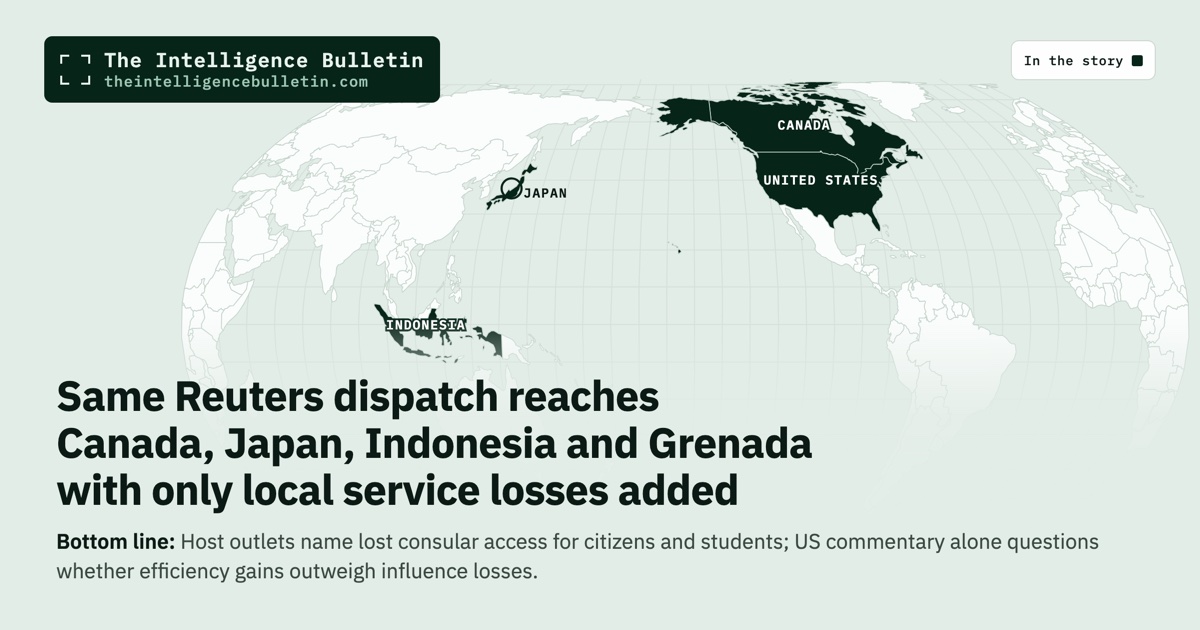
Host outlets name lost consular access for citizens and students; US commentary alone questions whether efficiency gains outweigh influence losses.
Nearly every outlet in this cluster carries identical Reuters reporting on the State Department’s confidential notice to Congress detailing the five closures. That shared text already balances the administration’s efficiency claims with Democratic warnings about lost leverage against China and Russia. Host-country additions stand out only where local stakes are named: Now Grenada details the embassy’s third closure attempt since 1984 and its role serving thousands of US students at St. George’s University. The Jakarta Post headline foregrounds Trump and Indonesia, while Global News and Japan Today simply list the affected Canadian and Japanese sites. Newsweek’s separate analysis contends the cuts undermine influence more than they save, directly challenging the cost-saving rationale embedded in the wire copy. The pattern reveals how a single anonymous-source dispatch travels globally while local outlets append only the narrowest national consequence before the story moves on.
Full analysis
The US State Department sent notices last week to some congressional committees announcing plans to close five foreign missions. Four of the five outlets examined here published nearly identical accounts of that notice, all drawn from reporting by Reuters correspondents Humeyra Pamuk and Gram Slattery. The shared text lists the posts as the embassy in St. George’s, Grenada; the consulate in Nagoya, Japan; the consulate in Medan, Indonesia; the embassy branch office in Douala, Cameroon; and the consulate in Winnipeg, Canada. It states that the people familiar with the notice spoke on condition of anonymity because the document itself was not public. The text calls the expected closures a rare example of multiple mission shutdowns not tied to any particular geopolitical event.
That common dispatch places the move inside the Trump administration’s broader push to align the State Department with America First priorities. It notes that early last year the department began preparations to shut down nearly a dozen foreign missions as part of efforts to transform the bureaucracy. The White House Office of Management and Budget had advocated an even larger program targeting up to 30 missions. Some administration officials privately described smaller missions as inessential and not cost-effective. The text records that the State Department underwent a broad overhaul last year that cut dozens of bureaus and hundreds of staff, though no foreign missions were closed at that time. It adds that US Secretary of State Marco Rubio has described cost-cutting as necessary to right-size an organization many conservatives view as bloated.
The same paragraphs record the counter-view from Democrats and some former foreign policy and national security officials. They argue that cuts to the diplomatic footprint, together with the dismantling of the US Agency for International Development, risk undermining American leadership and leaving space for adversaries such as China and Russia. The dispatch states that the State Department, when asked for comment, issued a statement that did not confirm the closures but said it was focused on ensuring an efficient and effective footprint while following congressional notification procedures.
Global News, The Jakarta Post, and Japan Today each carried this full text under their own mastheads with only headline and minor formatting differences. Global News titled its version around the three consulates in Canada, Japan, and Indonesia and placed the story under a national section. The Jakarta Post headlined it as “Trump wants to close missions in Indonesia, Japan and Canada” and located it in the Americas section. Japan Today specified the Nagoya consulate in its headline and ran the piece in its politics category. None of these three added independent reporting beyond the Reuters copy.
Now Grenada published its own account rather than the wire. Its report opens with the same list of five posts but then supplies Grenada-specific details absent from the shared text. It notes that the US Embassy in St. George’s serves Grenada, Carriacou, and Petite Martinique and that this would be the third time Washington has proposed closing the post since it opened in February 1984. The article records a 1994 proposal under President Clinton that was abandoned after congressional opposition, including from the Congressional Black Caucus and Republican lawmakers who cited US military sacrifices on the island in 1983. It states that the embassy is led by Principal Officer Cindy Diouf and that the post provides consular services to thousands of American students and faculty at St. George’s University. The report adds that any closure would require formal consultations with the House Foreign Affairs Committee and Senate Foreign Relations Committee before taking effect.
Newsweek published an original analysis that accepts the reported closures as fact but reaches a different conclusion about their value. Its piece cites the same five posts and the administration’s efficiency argument, then contends that diplomacy cannot be measured solely by visas processed or costs saved. It compares the planned cuts to earlier Biden-era openings of missions in the Pacific region aimed at countering Chinese influence. The analysis notes that China maintains diplomatic presence in three of the five locations listed for closure while the United States would reduce its own. It states that relationships built through regular contact become harder to sustain remotely, particularly outside capital cities.
What to Watch
The single reporting chain means the core claims about the notice itself and its stated rationale rest on one set of anonymous sources. The additional Grenada history and the Newsweek critique stand as separate layers placed on top of that chain. Congressional notification procedures remain the next required step before any closures can proceed.
That’s how the world told the story.
Get our daily open-source intelligence on world events in your inbox — one email a day, up to six stories.
Subscribe freeNo spam. One-click unsubscribe. See the latest email →