 AI-generated analysis published under the editorial responsibility of Rohit Sinnas. How it works →
Press quoted
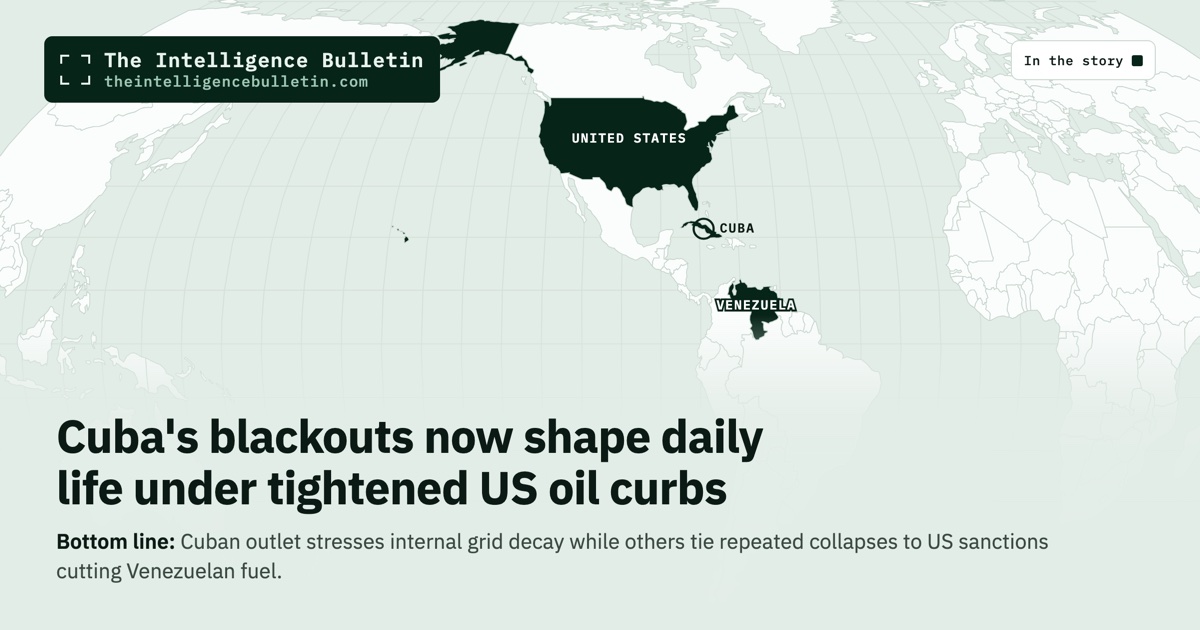
Cuban outlet stresses internal grid decay while others tie repeated collapses to US sanctions cutting Venezuelan fuel.
Cuba’s latest total blackout arrived as just another data point in a now-predictable cycle, yet the selected outlets reveal how the concrete costs of tightened US oil sanctions register differently depending on distance from Havana. Cuba Headlines documented the sixth collapse of 2026 in clinical detail, tracing it to decades of under-maintained plants and chronic fuel shortfalls without naming Washington. Al Jazeera and SCMP both foregrounded the Trump-era oil blockade that severed Venezuela’s supply line and halted Mexican imports, while still listing internal decay. Infobae captured the lived reality in Havana streets where traffic lights stayed dark, fridges emptied and residents now plan lives around the next failure. ABC noted the mutual accusations: Havana blames the blockade, Washington cites mismanagement. The pattern shows sanctions’ domestic bite is acknowledged across the set, even as the Cuban outlet keeps the emphasis on structural failure at home.
Full analysis
Cuba suffered its sixth complete nationwide blackout of 2026 when the National Electric System disconnected entirely at 10:43 p.m. on August 2. The state utility Unión Eléctrica de Cuba posted a brief notice on its Facebook page confirming the total failure without stating an immediate trigger. Power began returning gradually the following day, but only 23 percent of Havana had service by Monday morning.
The collapse followed a partial outage the day before that had already left provinces from Pinar del Río to Matanzas in the dark. Earlier in the week the shortfall had reached 2,042 megawatts on July 31, and on July 29 the utility had projected a record deficit of 2,380 megawatts against demand of 3,200 megawatts with only 850 megawatts available. This latest failure marked the sixth island-wide event in 2026. The first lasted 29 hours and 29 minutes on March 16. Three more occurred in July alone, including one on July 6 that affected roughly 9.6 million people after Unit 6 at Nuevitas shut down.
Restoration followed the standard protocol of building small isolated networks first to serve hospitals, water systems and food facilities before reconnecting larger plants from west to east. Officials named the termoeléctricas at Jaruco, Santa Cruz, Mariel, Guiteras, Cienfuegos and later Nuevitas as the sequence. Two units at the Energas gas-fired plant at Boca de Jaruco east of Havana were already being brought back online Monday. The process remained constrained by limited fuel stocks.
Cuba’s electricity system has operated for years with thermoelectric plants more than thirty years old that receive little maintenance. Chronic shortages of both fuel and replacement parts compound the problem. The government in Havana states that United States sanctions, tightened under the Trump administration after the January 3 abduction of Venezuelan President Nicolás Maduro, cut off the island’s main oil supply from Venezuela. Imports from Mexico have also stopped under the same pressure. Only one Russian vessel carrying 100,000 tons of petroleum was permitted to arrive in the first seven months of the year, according to Cuban officials. The administration in Washington, for its part, points to decades of underinvestment and mismanagement inside Cuba as the core problem.
Daily life has adjusted around the uncertainty. Residents in Havana open refrigerators each morning to check what food can still be saved. One woman told Reuters she now buys groceries in small quantities to limit spoilage and charges phones whenever current returns. Another described the exhaustion of rising and going to bed without light, adding that the constant risk of another outage leaves people without the will to work. Semaphores stayed dark at major intersections Monday, forcing drivers into informal negotiations at every crossing. Gas stations remained closed in some areas while garbage accumulated along roadways. In parts of the capital, outages have already stretched beyond thirty consecutive hours in recent weeks; interior provinces sometimes go days without service.
The same four outlets that carried the sanctions explanation also recorded the technical failures. Al Jazeera noted the ageing grid and fuel shortages while adding that the Communist government blames Washington for restricting oil, financing and equipment. The South China Morning Post reported that a US energy embargo halted regular fuel deliveries for power stations. Infobae described the permanent change to routines and quoted government figures on the limited Russian shipment. ABC stated that Havana accuses the United States of an oil blockade while Washington attributes the crisis to internal mismanagement. Cuba Headlines, the single Cuban source in the set, listed the structural issues of outdated plants, breakdowns and fuel shortages but did not mention sanctions.
Four independent reporting chains therefore converged on the same core facts: the date and sequence of the blackout, the restoration percentage in Havana, the ageing infrastructure, the fuel constraint, and the Cuban government’s attribution of that constraint to US policy after the Maduro episode. The Cuban domestic outlet stands apart by confining its account to internal causes. No US outlet appears in the selected group, so the Washington perspective on mismanagement reaches readers here only through the Spanish paper’s summary of competing claims.
What to Watch
The accounts that include both the domestic engineering problems and the sanctions’ effect on fuel supply rest on the broadest corroboration. They draw from the same state utility announcements used by the Cuban source plus on-record Cuban government statements about specific import volumes and the Maduro-related policy change. The domestic cost of those restrictions shows up in the resident testimony carried by the Argentine and Qatari reports: food loss, disrupted water and transport, and the shift to planning around the next outage rather than any fixed schedule. Continued shortfalls are likely to persist while the fuel bottleneck remains unaddressed, regardless of how the next plant is restarted.
That’s how the world told the story.
Get our daily open-source intelligence on world events in your inbox — one email a day, up to six stories.
Subscribe freeNo spam. One-click unsubscribe. See the latest email →