 AI-generated analysis published under the editorial responsibility of Rohit Sinnas. How it works →
Press quoted
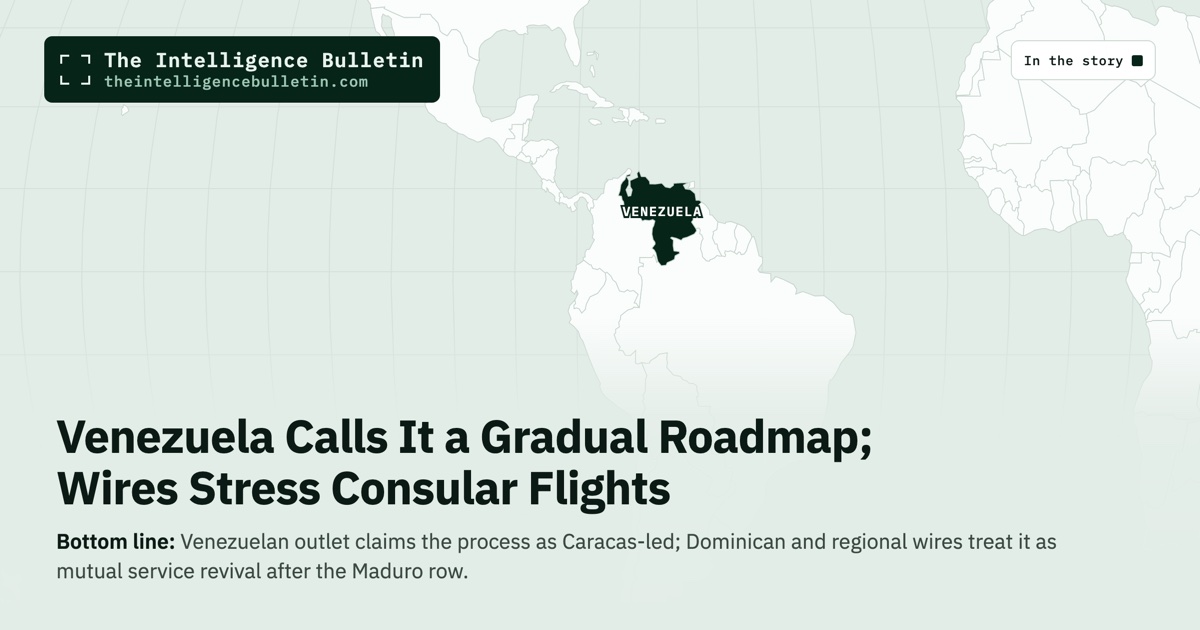
Venezuelan outlet claims the process as Caracas-led; Dominican and regional wires treat it as mutual service revival after the Maduro row.
Venezuela’s El Universal presents the August 2 deal as Caracas’s own hoja de ruta, quoting Foreign Minister Félix Plasencia and stressing a phased process under mutual respect and international law. By contrast, the Dominican Republic’s El Nacional carries an EFE dispatch that zeroes in on immediate practical gains: consular reactivation and air connections suspended since the 2024 break. Jamaica Observer and La Estrella de Panamá, both relaying wire copy, embed the story in the Maduro election dispute and note parallel resets with Peru and Chile. Al Jazeera stays detached, adding context on US-led regime change and Delcy Rodriguez’s interim government opening to Washington investment. The pattern shows Venezuela claiming initiative while most others record a mutual reset without crediting either capital as driver.
Full analysis
Venezuela and the Dominican Republic agreed on August 2 to begin a gradual restoration of diplomatic and consular relations that had been cut in 2024.
The Venezuelan foreign ministry issued the announcement through Foreign Minister Félix Plasencia, stating that both governments had settled on a joint roadmap. The first phase would restore consular services for citizens of each country. Later stages would move toward full diplomatic ties on a schedule the two capitals would set together. The statement described the move as serving the interest of both peoples in stronger institutional channels and in reviving long-standing ties of friendship. It committed the process to the principles of international law, mutual respect, and sustained dialogue.
The break itself began after the July 2024 Venezuelan presidential election. The Dominican Republic joined other governments in questioning the results declared by Venezuela’s National Electoral Council, which had proclaimed Nicolás Maduro the winner. Venezuela responded by ordering the withdrawal of Dominican diplomats and severing formal relations. Air links were suspended at the end of July 2024 on Venezuelan orders.
By January 2026 Maduro had been removed from power in a U.S. military operation and taken to New York for trial on drug-related charges. Delcy Rodríguez, previously vice president, assumed the role of interim president under an order from Venezuela’s Supreme Court. In the months that followed, Caracas reopened talks with several countries that had broken ties after the 2024 vote, including Peru and Chile. The Dominican Republic and Venezuela had already reached a preliminary understanding in February 2026 to resume flights and some consular work; the August 2 statement advanced that understanding into a broader normalization track.
The Dominican side has not issued a separate public statement of its own in the coverage examined. Reports on the Dominican end instead relay the Venezuelan ministry text and add context on the original rupture and the suspended services.
Coverage from Venezuelan outlets presents the agreement as an initiative launched from Caracas. The text quotes the foreign minister directly and centers the phased roadmap Caracas says it has proposed. It makes no reference to the 2024 election dispute or to the change of government in Caracas that preceded the talks.
Wire reports carried by Dominican, Panamanian, and Jamaican outlets supply the missing background on the election challenge and the Maduro government’s fall. They record the Dominican Republic’s earlier refusal to recognize the 2024 results and note that Venezuela severed ties in response. They also mention parallel normalization moves with Peru and Chile. These accounts describe the current step as the reactivation of concrete services—consular offices and direct flights—rather than as a Venezuelan-led project.
Al Jazeera’s account remains closer to the ministry language on the roadmap itself while adding detail on the interim government’s broader opening to U.S. investment and its decision to withdraw from the International Criminal Court. It does not assign credit for the initiative to either capital.
The accounts therefore diverge on emphasis rather than on disputed facts. The core claims—that the two governments reached the August 2 understanding, that consular and air links come first, and that the 2024 election dispute caused the original break—are carried consistently across the independent reporting chains. No outlet contradicts another on these points.
The Venezuelan presentation leaves out the election dispute that triggered the severance and the subsequent removal of Maduro. A reader limited to that account would see only forward-looking cooperation between two friendly states. The wire reports and Al Jazeera supply the causal sequence and the changed political circumstances in Caracas that made renewed contact possible. Because those details appear in multiple separate reporting chains that draw on the same primary ministry text plus regional context, they supply the fuller picture of what changed between 2024 and 2026.
What to Watch
The normalization is therefore best understood as a pragmatic reset driven by the new interim authorities in Caracas rather than a victory for the prior Maduro government or a concession extracted from the Dominican Republic. Caracas gains an early diplomatic channel at a moment when it is seeking wider reintegration; Santo Domingo regains consular access and flight options without having altered its earlier stance on the 2024 vote. The next practical markers will be the actual reopening dates for consular posts and the resumption of scheduled flights, steps both sides have already signaled will follow in the coming weeks.
That’s how the world told the story.
Get our daily open-source intelligence on world events in your inbox — one email a day, up to six stories.
Subscribe freeNo spam. One-click unsubscribe. See the latest email →