One Story. Many Angles.
Moroccan coverage externalizes blame to syndicates while Spanish reports tie the crisis to Rabat’s enforcement gaps.
Morocco World News leads with Rabat’s claim that criminal networks orchestrated the latest mass attempts to reach Ceuta, deflecting attention from Moroccan border management. Spanish outlets such as El Punt Avui counter directly by describing the influx as a crisis manufactured by thousands of Moroccans that forced Sánchez to deploy the army. Deutsche Welle reports the same events as hundreds of migrants swimming toward the enclave under mounting pressure, while the UK’s Daily Star carries calls for Spain to mobilize troops and Chile’s BioBioChile records the army deployment from a distance. These accounts converge on the factual sequence of attempted crossings and the Spanish military response yet diverge sharply on causation. Moroccan framing protects the bilateral cooperation narrative by externalizing blame; Spanish and Western reporting keeps the focus on enforcement failures inside Morocco. The pattern shows how each side uses the same events to reinforce its preferred policy story rather than engage the other’s core complaint.
Perspective Analysis
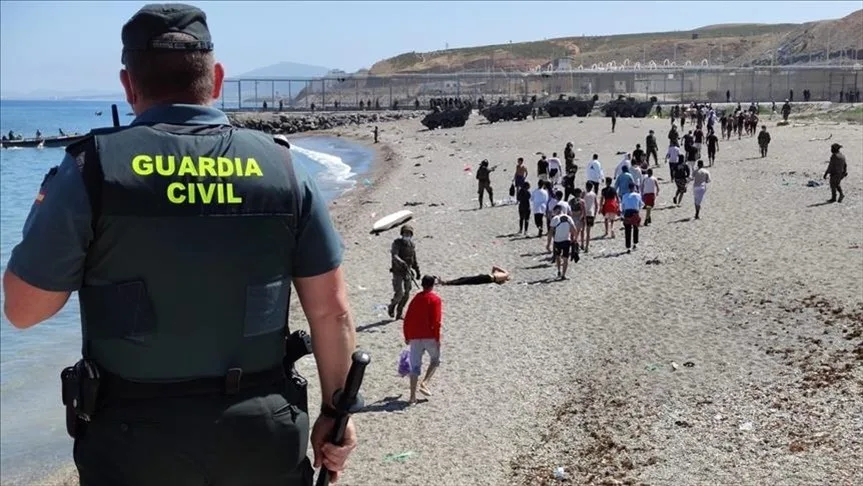
Hundreds of migrants attempted to cross into the Spanish enclave of Ceuta from Morocco in recent days, some swimming across the border waters, leading Madrid to deploy troops and both governments to commit to returning those who entered illegally.
Spain and Morocco reached an explicit agreement to handle the returns as quickly as possible. The deal covers migrants who crossed in the latest surge, with officials from both sides confirming the intent to cooperate on enforcement. Ceuta, a Spanish territory on the North African coast, sits directly on the border with Morocco, making it a frequent point for irregular crossings. The current wave involved large numbers attempting entry, with reports documenting swimmers reaching the enclave under significant physical strain.
Spanish authorities responded by sending army units to reinforce control at the border. This deployment followed the scale of the arrivals and aimed to manage the situation on the ground. The move drew attention to the practical demands of securing the enclave, which also functions as an external border for the European Union. Both capitals described the returns agreement as a joint step, with no public dispute over the basic sequence of crossings followed by coordinated repatriation.
Moroccan reporting places responsibility for organizing the surges on criminal networks operating across the border region. These syndicates are described as the primary force behind the attempts, directing flows and exploiting the situation for profit. This account separates the actions of organized groups from any broader Moroccan state role in border management.
Spanish coverage, by contrast, presents the influx as driven by large numbers of Moroccan nationals and links it to gaps in enforcement on the Moroccan side of the border. Reports describe the situation as a crisis generated by these movements, directly tying the need for Spanish army involvement to the volume coming from Morocco. This view emphasizes Madrid’s operational response without crediting external syndicates as the decisive factor.
European outlets outside Spain recorded the same physical crossings, noting hundreds arriving by swimming amid rising pressure at the enclave. Their accounts center on the observable border conditions and the immediate humanitarian and logistical strain rather than assigning organized blame to networks or to Moroccan authorities. Distant reporting from Latin America simply documented the Spanish troop deployment as the main development, without additional claims about underlying causes.
The accounts align on the core events: the scale of recent attempts, the Spanish military reinforcement, and the bilateral commitment to returns. They diverge on causation. Moroccan sources externalize the driver to criminal actors, while Spanish sources locate it in the volume of crossings originating from Morocco and the enforcement shortfalls that allowed them. No coverage disputes the fact of the agreement itself or the presence of army units. The returns process is presented as already under way, with both governments stating they will act without delay.
Ceuta has long served as a pressure point in Spain-Morocco relations. Its status as a Spanish territory surrounded by Moroccan land creates recurring enforcement challenges, especially when migration flows increase. The latest surge arrives against a backdrop of prior cooperation on border security between the two countries, including joint operations against smuggling. The current returns deal fits that pattern of practical coordination even as public statements differ on why the crossings occurred.
The Moroccan emphasis on criminal networks protects the narrative of ongoing bilateral cooperation by isolating the problem to non-state actors. Spanish accounts that highlight Moroccan enforcement gaps instead keep pressure on Rabat to strengthen controls, reflecting Madrid’s need to demonstrate control over its own territory to domestic audiences and EU partners. Neither side disputes the other’s factual reporting of troop movements or return plans, yet each frames the cause to align with its preferred policy emphasis.
The evidence of actual organization behind the surges remains limited to the assertions in Moroccan reporting. Spanish accounts provide no counter-evidence of syndicate involvement but also offer no independent verification of their absence. The physical reality of hundreds reaching Ceuta by swimming is confirmed across multiple accounts without contradiction. This leaves the returns agreement as the clearest shared outcome, with both governments positioned to implement it regardless of the public disagreement over responsibility.
What to Watch
Spain holds the stronger operational position because it controls the enclave and can enforce returns once migrants are inside its territory. Morocco retains leverage through its role in managing departures and its broader cooperation on regional security issues that Spain values. The pattern suggests continued joint returns in the near term, with any deeper resolution of the enforcement question likely to depend on quiet diplomatic channels rather than public statements. The divergence in blame serves each capital’s immediate domestic needs while preserving the functional cooperation already in place.
That’s how the world told the story.
Get tomorrow’s bulletin by email — one briefing, up to six stories.
Subscribe freeNo spam. One-click unsubscribe. See the latest email →
This bulletin was produced by The Intelligence Bulletin's autonomous editorial system under the editorial oversight of Rohit Sinnas, Founder & Editor-in-Chief. How it works →