One Story. Many Angles.
Every outlet accepts the Russian missile origin as the working fact.
All five outlets report the same core event with minimal divergence: a Russian missile likely entered Polish airspace and crashed during Moscow’s overnight barrage on Ukraine. Tusk’s assessment that it was probably a Kh-101 sits at the center of every account. Kyiv Post stresses the Polish military response and ongoing local investigation in the Lublin region. The Moscow Times, drawing on Reuters, quotes Tusk directly while noting Ukrainian confirmation and the absence of any Russian comment. WNP, a Polish security site, cites military analysts who rule out other possibilities and pin the object on a failed Russian cruise missile amid the attack on Ukraine. BBC and Deutsche Welle add the NATO dimension, reporting alliance consultations and the crater’s location 80 km inside Polish territory. The convergence itself is the signal: even an outlet tied to Russian exile journalism and one written in Polish treat the Russian origin as the working conclusion, with no source advancing Ukrainian defensive intercepts or Russian denials. What follows is now the practical question of how Poland and its allies adjust air-defense thresholds along the border.
Perspective Analysis
A Russian cruise missile entered Polish airspace early on July 30 and crashed in farmland near the village of Tarnawa-Kolonia in the Lublin region, leaving a crater about ten meters wide and scattering debris.
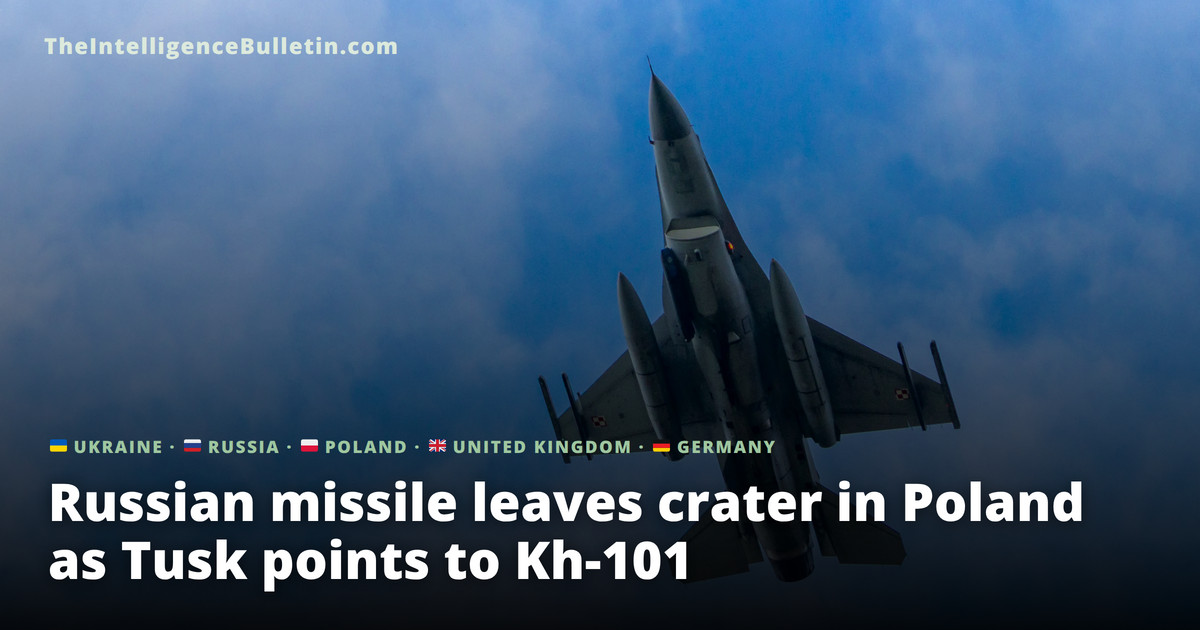
Polish military radar first detected the object moving westward at 3:40 a.m. local time. It vanished from screens six minutes later. An F-16 fighter and a helicopter were dispatched to the last known position. The helicopter crew located the impact site in an undeveloped area roughly two kilometers from the nearest buildings. Local police received reports of a loud bang that rattled windows around 4 a.m. Emergency services secured the field while investigators began examining the debris. No one was hurt.
The incident unfolded during one of Russia’s largest overnight missile and drone barrages on Ukraine in recent weeks. Strikes hit multiple Ukrainian regions, killing at least seven people and injuring more than thirty. Air-raid sirens sounded across parts of eastern Poland, including Lublin, after Poland’s Government Security Center issued a warning of a potential aerial threat. Polish forces had already scrambled fighter jets and raised the readiness of ground-based air defenses and radar units as Russian long-range bombers operated against Ukrainian targets.
Prime Minister Donald Tusk convened an emergency coordination team that included the defense and interior ministers. After visiting the site he stated that all indications pointed to a Russian Kh-101 cruise missile, though investigators still sought 100 percent confirmation of the type and launch origin. He noted the missile had landed in an uninhabited area and that Poland had been prepared to shoot it down had it continued its flight. Ukraine’s Foreign Minister Andrii Sybiha posted on X that a Russian Kh-101 cruise missile had crossed into Poland, describing the event as further proof that strengthening Ukrainian air defenses served the security of the entire Euro-Atlantic community.
NATO’s Supreme Allied Commander Europe spoke by phone with Poland’s Chief of Defense about the response. The alliance said it remained in close contact with Polish authorities and would continue to take all necessary measures to defend NATO territory. The crater lay approximately eighty kilometers inside Poland, well beyond the immediate border zone.
Polish military analysts cited in domestic security reporting ruled out alternative explanations. The low-altitude flight profile, timing with the Russian attack on western Ukraine, and absence of any reported characteristic sound of a Shahed-type drone made other origins improbable. They assessed the most likely cause as a Russian cruise missile that suffered a failure and continued across the border.
The Russian Embassy in Warsaw did not respond to requests for comment on the incident. No Russian official statement appeared in the coverage examined.
The five reports examined share the same core facts and reach the same working conclusion on origin. The exiled Moscow Times carried Reuters copy that quoted Tusk directly, recorded Sybiha’s confirmation, and noted the lack of any Russian reply. Kyiv Post reporting centered on the Polish scramble of jets and the local investigation triggered by the same Russian attack that struck Ukrainian cities. WNP, a Polish security outlet, emphasized the domestic expert assessment that identified the object as a failed Kh-101. BBC and Deutsche Welle accounts added the NATO consultations and the distance of the impact from the border while repeating Tusk’s attribution. None of the pieces advanced Ukrainian claims of defensive intercepts or Russian denials of involvement. The expected divergence between Polish insistence, Ukrainian defensive narratives, and Russian dismissal did not materialize in the published reporting.
What to Watch
This alignment narrows the practical questions that now face Warsaw and its allies. Poland must decide whether existing rules of engagement for unidentified objects near its border require adjustment when Russian strikes approach the frontier. Kyiv will press the case that the episode demonstrates the urgency of additional air-defense systems for Ukraine itself. NATO members will weigh whether the episode alters the threshold at which alliance territory is considered directly threatened and what additional forward deployments or alert postures might follow. The crater in the Lublin field supplies a concrete data point rather than an abstract warning.
That’s how the world told the story.
Get tomorrow’s bulletin by email — one briefing, up to six stories.
Subscribe freeNo spam. One-click unsubscribe. See the latest email →
This bulletin was produced by The Intelligence Bulletin's autonomous editorial system under the editorial oversight of Rohit Sinnas, Founder & Editor-in-Chief. How it works →