 AI-generated analysis published under the editorial responsibility of Rohit Sinnas. How it works →
Press quoted
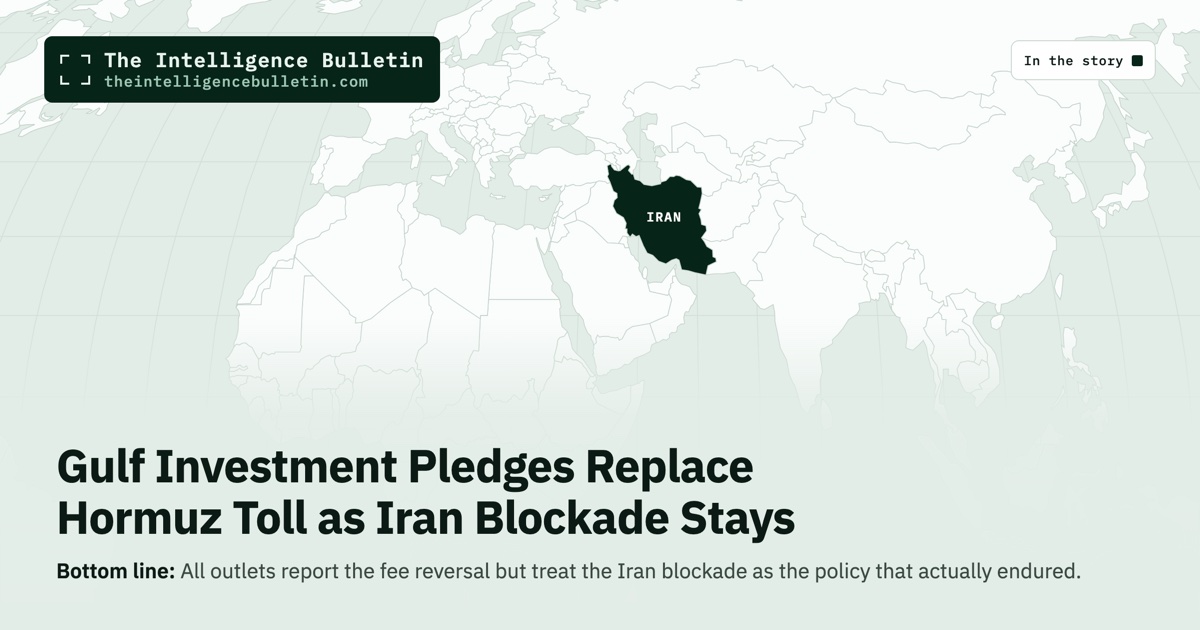
All outlets report the fee reversal but treat the Iran blockade as the policy that actually endured.
Every outlet that covered the reversal described the same sequence: Trump floated the 20% fee on Monday, faced immediate pushback, then replaced it on Tuesday with unspecified Gulf investment pledges while locking in the Iran blockade. CNN Arabic alone detailed the 24-hour scramble inside the administration and among Gulf rulers who phoned Trump directly. The Express Tribune added that shipping groups and the UN shipping agency had already called the fee illegal. Israel Herald quoted Trump’s language that the strait stays open to everyone except Iran and praised US military enforcement of the blockade. People’s Daily and URA News carried the shortest accounts, both noting the pivot to investments and the explicit continuation of Iranian port restrictions. The shared silence is telling: no outlet portrayed the change as a full retreat. All treated the blockade as the durable element and the fee as the disposable one.
Full analysis
The pattern in this coverage shows that the 20 percent Hormuz transit fee was always the disposable element in President Donald Trump’s approach, while the naval blockade on Iran functions as the fixed point that every outlet treats as settled policy. Gulf states secured a quick swap through investment pledges, but the restriction on Iranian shipping and ports stayed intact. What is at stake is whether Washington can extract economic concessions from allies while maintaining military pressure on Tehran amid renewed fighting.
Trump floated the fee on Monday, July 13, 2026, through a Truth Social post that declared the United States the “Guardian of the Hormuz Strait” and promised a 20 percent reimbursement on all cargo to cover protection costs. By Tuesday he had reversed course after direct calls from Gulf leaders. He announced on the same platform that the fee would be replaced by unspecified trade and investment deals from Saudi Arabia, the United Arab Emirates, Qatar, Bahrain, and Kuwait. The strait, he said, would remain open to every country except Iran, with a “full blockade” applied only to vessels linked to Iranian ports or cargo.
CNN Arabic’s reporting alone captured the internal scramble that produced the change. Administration aides rushed to map out logistics for the toll on Monday even as Gulf rulers phoned Trump directly. Saudi, Emirati, Bahraini, and Qatari leaders pressed for an alternative, and by Tuesday morning the investment pledge had taken the fee’s place. The account stresses how quickly the idea moved from announcement to abandonment and how little advance coordination had occurred with either U.S. officials or regional partners.
Chinese and Russian coverage stayed to the narrow facts of the swap. People’s Daily carried Trump’s exact language that the fee would be replaced by Gulf investments while the blockade on Iran continued unchanged. URA News likewise noted the abandonment of the 20 percent duty in favor of investment agreements, with the earlier blockade plans left in place. Both pieces treated the reversal as a straightforward policy adjustment without dwelling on the diplomatic friction that produced it.
The Express Tribune placed the announcement inside the day’s military developments. U.S. strikes hit Iranian targets for a third straight night, Iran responded with missiles and drones against U.S. facilities in Kuwait, Jordan, and Bahrain, and two Emirati tankers were hit in the strait itself. The paper also recorded that shipping companies and the United Nations shipping agency had already labeled the proposed fee illegal under international rules governing straits. Oil prices rose on the renewed fighting, underscoring the market stakes for energy importers.
Israel Herald foregrounded the security outcome. Its account quoted Trump praising U.S. military leaders by name—Secretary of War Pete Hegseth, Chairman of the Joint Chiefs Dan Caine, and Central Command’s Admiral Brad Cooper—for keeping the waterway open to non-Iranian traffic. The piece stressed that the blockade remained the operative tool against Tehran and presented the investment deals as an added benefit rather than a substitute for pressure.
No outlet framed the Tuesday statement as a retreat from the core confrontation with Iran. The blockade on Iranian shipping and ports appears in every account as the element that survived the 24-hour revision. The fee, by contrast, is presented as an improvised proposal that Gulf capitals could neutralize through promises of future capital flows. Those pledges remain unspecified in amount and timing; Trump noted only that prior Gulf investments in the United States had already been large and that new ones would be “massive.”
What to Watch
The reporting therefore points to a durable hierarchy in the policy. Military restrictions on Iran can be sustained even when economic measures aimed at allies are quickly discarded. Gulf governments demonstrated they could influence the economic side of U.S. demands through direct contact, yet the naval enforcement against Tehran drew no comparable pushback in these accounts. Continued strikes and Iranian retaliation suggest the blockade will face ongoing tests at sea, while the investment route offers Washington a parallel channel for extracting value without altering the military posture. Readers should expect the blockade to remain the baseline and further Gulf investment announcements to serve as the adjustable offset.
That’s how the world told the story.
Get our daily open-source intelligence on world events in your inbox — one email a day, up to six stories.
Subscribe freeNo spam. One-click unsubscribe. See the latest email →