 AI-generated analysis published under the editorial responsibility of Rohit Sinnas. How it works →
Press quoted
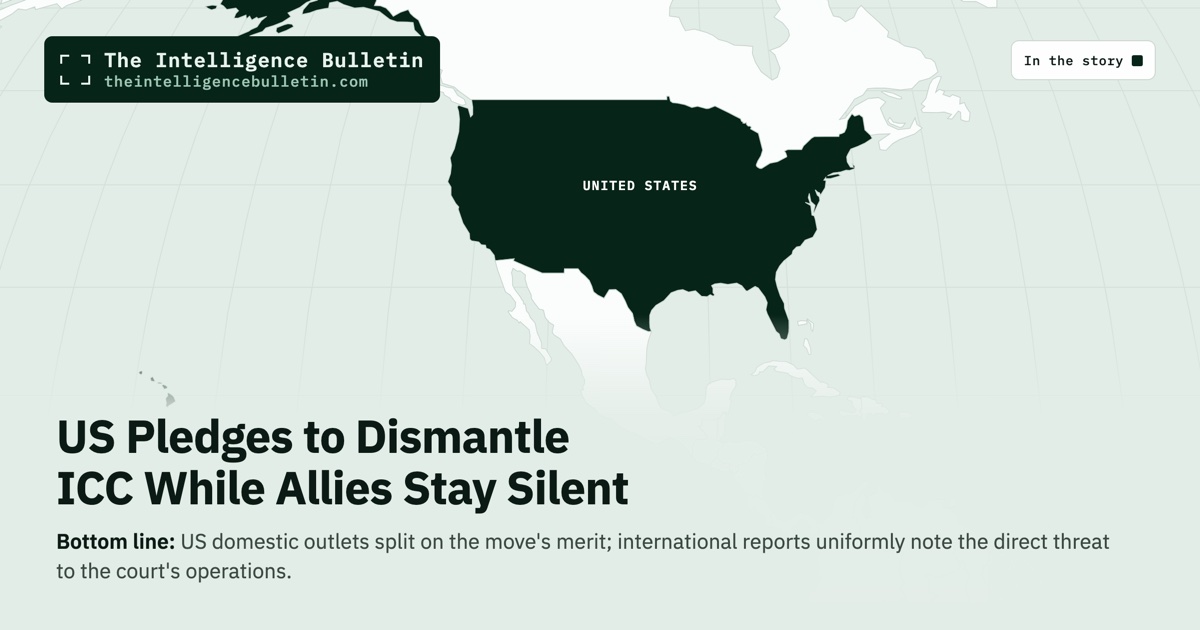
US domestic outlets split on the move’s merit; international reports uniformly note the direct threat to the court’s operations.
All five outlets reported the same core facts from Washington: Rubio’s vow to systematically disable the ICC through sanctions, travel restrictions and pressure on allies. Townhall treated the statements as a necessary defense of US independence from foreign judges. Truthout portrayed them as a bid for impunity, quoting critics who called the effort hypocritical and obstructive of justice. The Guardian added legal experts noting the ICC only acts on territory of member states and highlighted US inconsistency over Ukraine cases. SCMP stuck to the sovereignty framing without criticism. DW’s Russian service emphasized the direct operational threat to the court’s continued work. The shared factual base reveals a US move that isolates Washington from the 120-plus member states without triggering bloc-style outrage elsewhere.
Full analysis
US Secretary of State Marco Rubio’s July 13 announcement of a campaign to dismantle the International Criminal Court marks a sharp escalation in Washington’s long-standing refusal to accept any external check on its military and law enforcement actions abroad. The move, centered in Washington, deploys sanctions, visa bans, travel restrictions, and diplomatic pressure on other governments to isolate the Hague-based court. It reveals a United States willing to treat an institution created to address genocide, war crimes, and crimes against humanity as an existential threat when its own personnel face scrutiny, while the court’s 120-plus member states and traditional US allies register no coordinated response.
The United States has never joined the Rome Statute that established the ICC in 2002. Successive administrations have argued that the court lacks jurisdiction over American citizens because the country never consented to its authority. Rubio’s statements on July 13 built directly on that position. In a video and a Wall Street Journal op-ed, he described the ICC as waging “a war against our country, not with bullets or missiles, but with statutes, compacts and the force of so-called international law.” He warned that border patrol agents, Marines, and prosecutors could face foreign judges for actions taken in defense of the United States, invoking the Declaration of Independence’s rejection of trials in distant courts. The State Department statement accompanying the announcement said the effort would “systematically disable the ICC’s ability to operate, target American servicemen or officials, or otherwise threaten American sovereignty.”
These measures extend actions already taken. In February 2025, President Trump issued an executive order declaring a national emergency over the ICC and imposing sanctions on court officials, including judges and prosecutors involved in cases touching US personnel in Afghanistan and Israeli actions in Gaza. The ICC had issued arrest warrants for Israeli Prime Minister Benjamin Netanyahu and Defense Minister Yoav Gallant in November 2024 for alleged war crimes in the Gaza Strip. Rubio’s new campaign adds explicit calls for other nations to reject the court’s authority or face US scrutiny, including potential loss of assistance.
Reporting across outlets shows the same core facts but diverges sharply on what the campaign means. One American conservative publication presented Rubio’s words as a necessary assertion of independence from unelected global bureaucrats, quoting his claim that Americans “choose our own leaders” and “determine our own laws.” It framed the ICC as a radical departure from its original promise to act only as a narrow backstop when national courts fail. Progressive American coverage, by contrast, quoted human rights advocates who described the effort as a direct bid for impunity. Raed Jarrar of Democracy for the Arab World Now called it an attempt to dismantle “the rules-based international order that grew out of the ashes of World War II,” while noting that obstruction of justice itself violates the Rome Statute. Kenneth Roth, former executive director of Human Rights Watch, pointed out that the ICC acts only on crimes committed on the territory of states that have accepted its jurisdiction, not on US soil, and accused Rubio of misrepresenting the court’s limited reach to shield potential American violations.
British reporting added legal context that the others largely omitted. Experts there noted the ICC’s jurisdiction is confined to member states’ territory and highlighted inconsistency in the US position: the same administration welcomed ICC scrutiny of Russian actions in Ukraine, a Rome Statute party, while rejecting any parallel accountability for its own forces or allies. Chinese coverage stayed close to the official US rationale, describing the ICC as an “intolerable threat to American sovereignty” without adding criticism or legal rebuttals. German public broadcaster coverage, in its Russian service, stressed the concrete operational threat, detailing planned visa revocations, expanded sanctions, and diplomatic isolation that could hinder the court’s ability to function at all.
Allies have stayed silent. None of the reports record statements of support or condemnation from European capitals, despite the ICC’s heavy European membership and funding base. The absence is notable given prior US sanctions on court officials, which drew muted European criticism but no reversal of support for the institution. Rubio’s plan explicitly contemplates pressuring non-member states that still rely on US security assistance, raising the possibility of bilateral friction that has not yet surfaced in public.
The factual record shows the United States is acting alone to weaken an institution it never joined, using tools calibrated to its economic and diplomatic leverage rather than seeking multilateral reform. The sovereignty argument rests on a straightforward refusal to submit American personnel to any external court. Critics counter that this stance allows powerful states to commit crimes on the territory of weaker states that have voluntarily accepted ICC jurisdiction, while the court has no power inside the United States itself. The coverage split tracks these positions: one side celebrates the defense of national control, the other sees selective exemption from rules the United States helped shape after 1945.
What to Watch
What happens next is likely to be incremental pressure rather than dramatic collapse. The ICC will continue its existing investigations where member states cooperate, but new US sanctions and diplomatic arm-twisting could complicate staff travel, funding flows, and cooperation from governments wary of losing American support. For readers in ICC member states, the episode demonstrates that the world’s largest economy and military power still views international criminal justice as optional when its own interests are at stake. The silence from allies suggests they calculate that confronting Washington directly carries higher costs than tolerating a campaign aimed at one institution. That calculation preserves short-term relations but leaves the court’s long-term authority more dependent on the willingness of mid-sized and smaller states to resist US inducements.
That’s how the world told the story.
Get our daily open-source intelligence on world events in your inbox — one email a day, up to six stories.
Subscribe freeNo spam. One-click unsubscribe. See the latest email →