 AI-generated analysis published under the editorial responsibility of Rohit Sinnas. How it works →
Press quoted
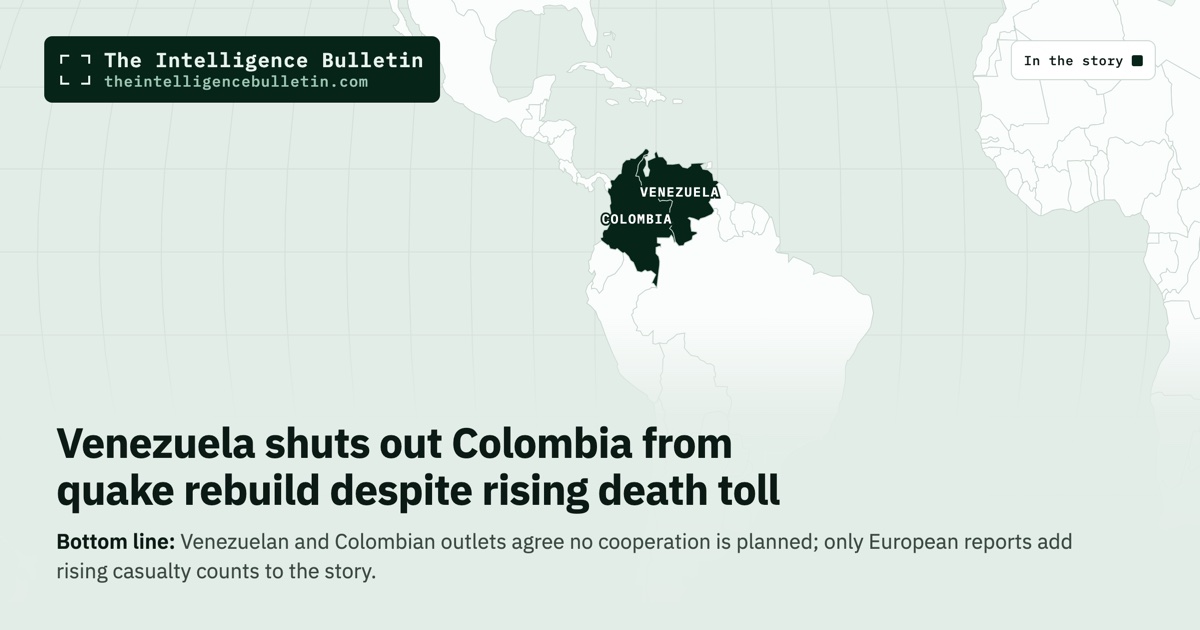
Venezuelan and Colombian outlets agree no cooperation is planned; only European reports add rising casualty counts to the story.
Venezuelan state-aligned coverage treats the episode as a straightforward defense of sovereignty, quoting the foreign ministry’s surprise at De la Espriella’s claim that Colombia must handle the rebuild and stressing that any foreign help will be chosen by Caracas alone. Colombian outlets split between defending the president-elect’s limited intent and simply recording the diplomatic snub from Bogotá’s side. European reporting from Spain and Portugal adds casualty updates and notes their own nationals among the dead while placing the exchange against the physical scale of the disaster. The shared thread across all five outlets is the absence of any Venezuelan openness to Colombian involvement, even as the same governments have accepted help from Brazil and discussed lines with Washington. This unanimity on the closed door reveals how quickly the new Colombian leadership’s outreach collided with Caracas’s determination to control every aspect of recovery.
Full analysis
Venezuela’s rejection of any Colombian role in rebuilding after the June 24 earthquakes reveals a government determined to retain absolute control over recovery, even as the death toll climbs past 4,300 and other nations continue to provide assistance. Caracas framed the incoming Colombian administration’s offer as an unacceptable overreach, closing the door on coordination while accepting help from Brazil and opening talks with Washington.
The double quake struck the northern coastal state of La Guaira, leaving official counts of at least 4,118 dead according to Venezuelan state sources and rising to 4,333 after rescue teams recovered another 215 bodies on July 11. El Confidencial reported 41 of the dead were Spanish citizens, with 138 more Spaniards still unaccounted for, alongside Portuguese figures of at least 110 dead and 55 missing or unreachable. More than 16,740 people were injured, nearly 1,000 buildings suffered severe damage or collapse, and almost 18,000 residents were displaced into temporary camps. Over 1,200 aftershocks have continued to shake the area.
On July 11, Venezuela’s Foreign Ministry issued a statement expressing surprise at remarks by president-elect Abelardo de la Espriella. The Colombian had said in a public event that “the reconstruction of Venezuela after the earthquake has to be done by Colombia, with all that it implies,” and announced plans to form an engineering team under his designated defense minister, Jorge Eduardo Mora. Caracas responded that planning, leadership, and execution of recovery belong exclusively to the Venezuelan state. It noted that no coordination with the incoming Colombian government was planned, while adding that any future international partnerships would be chosen by Caracas alone.
Venezuelan coverage, led by outlets aligned with the government such as El Siglo, presented the episode as a straightforward defense of sovereignty. The report listed resources already mobilized—public companies, national industry, and the private sector—and highlighted ongoing work by acting president Delcy Rodríguez to secure land for new “ciudades antisísmicas” and a 200-million-dollar fund for international donations. It mentioned existing Brazilian medical support and conversations with Washington but made no reference to any Colombian clarification.
Colombian outlets recorded the same rejection from a domestic vantage. La FM centered its account on de la Espriella’s office issuing a follow-up statement that the proposal was limited to solidarity and cooperation under international law and did not challenge Venezuelan sovereignty. Vanguardia reported the Venezuelan snub as Bogotá’s outreach being turned away, emphasizing that the process would remain under exclusive Venezuelan direction without planned articulation with the new Colombian administration.
European reporting placed the diplomatic exchange inside the larger humanitarian picture. El Confidencial updated the casualty figures to 4,333, including the Spanish deaths, and described the scale of destruction and ongoing rescue efforts alongside the sudden clash over reconstruction leadership. Diário de Notícias noted Venezuelan criticism of Colombian intentions while recording Portuguese casualties and the arrival of international rescue teams, maintaining distance from the bilateral rhetoric in Caracas and Bogotá.
The same Venezuelan government that rejected Colombian involvement has accepted a Brazilian field hospital that provided 1,200 medical attentions and has discussed new cooperation lines with the United States. This selective openness underscores the consistent thread across the coverage: Caracas will decide every aspect of recovery and will not extend that decision-making to the incoming Colombian leadership. De la Espriella’s limited offer of technical support collided immediately with that determination.
What to Watch
The pattern suggests the new Colombian government’s early regional outreach has already encountered firm limits. Caracas’s priority remains centralized control over resources and narratives, regardless of the mounting death toll or offers framed strictly as cooperation. Future assistance will flow only through channels Caracas designates, narrowing the space for broader neighborhood involvement even as the physical recovery stretches on.
That’s how the world told the story.
Get our daily open-source intelligence on world events in your inbox — one email a day, up to six stories.
Subscribe freeNo spam. One-click unsubscribe. See the latest email →