 AI-generated analysis published under the editorial responsibility of Rohit Sinnas. How it works →
Press quoted
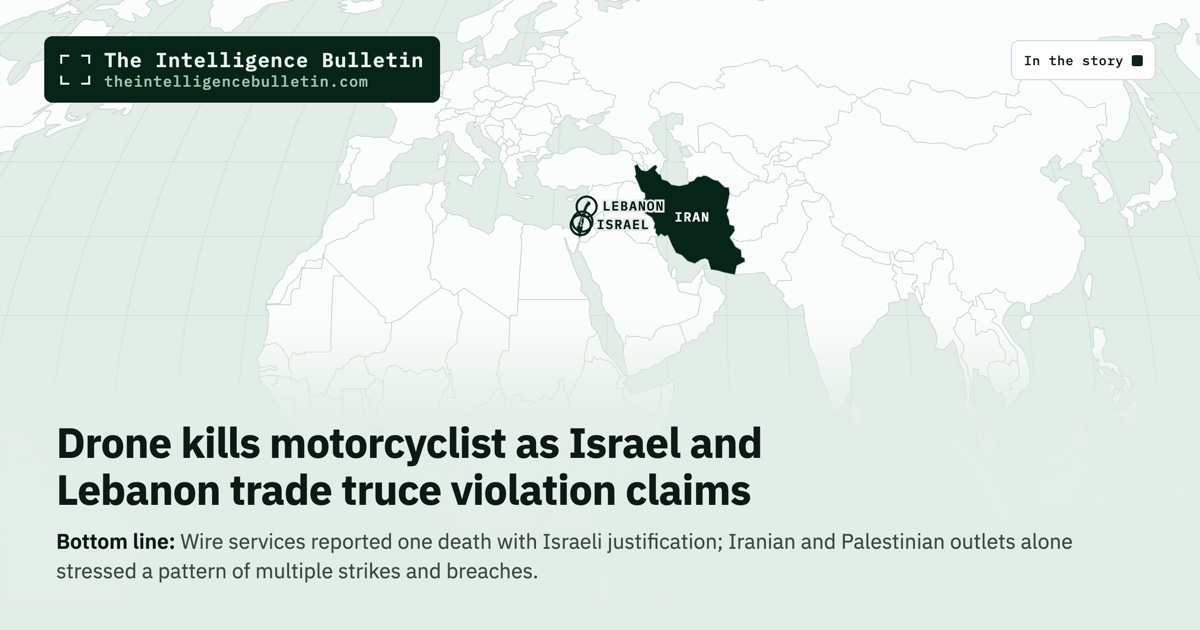
Wire services reported one death with Israeli justification; Iranian and Palestinian outlets alone stressed a pattern of multiple strikes and breaches.
Wire copy dominated coverage, with Naharnet, Arab News and Al Bayan running near-identical AFP accounts that stated the motorcycle killing, noted a second injury, quoted Israel’s Hezbollah-target claim, and sketched the broader truce context including the rejected framework agreement. Press TV alone widened the event into multiple drone strikes across several sites, adding a garbage-collecting van hit earlier and demolition operations in Khiam, while stressing continued occupation. Al Rayah News, the Palestinian outlet, bypassed the death entirely and led instead with two injuries from a truck strike plus UNIFIL’s warning on fragile stability, foregrounding repeated ceasefire breaches. The pattern shows most outlets treated the event as a contained, verified incident with standard Israeli justification; only Iranian and Palestinian reporting chose to embed it in a longer pattern of violations without the same balancing detail.
Full analysis
The coverage of the July 10, 2026 Israeli drone strike in southern Lebanon shows how most outlets reduce a lethal attack on a civilian motorcyclist to a contained incident with standard military justification, while Iranian and Palestinian reporting alone places it inside a sequence of repeated breaches. This split matters because the strike occurred against the backdrop of a US-mediated framework agreement that Hezbollah has rejected and that lacks any withdrawal timetable, leaving Israeli forces in a declared security zone and exposing civilians to ongoing risk.
Lebanon’s National News Agency recorded the death of a young man from Nabatieh who was riding a motorcycle in Kfar Rumman when hit by an enemy drone. At least one additional person was wounded in the same area. The Israeli military stated it had struck a Hezbollah operative near an underground access shaft on Ali al-Taher Ridge inside the security zone and eliminated a second suspect in a vehicle. Both Naharnet and Arab News carried near-identical accounts from AFP that included these Israeli claims alongside the Lebanese casualty figures and the rejected framework agreement. Al Bayan’s Arabic report added the detail of two separate drone strikes—one on the motorcycle and one on a car—while remaining close to the same wire text.
These three outlets treated the event as a discrete truce violation supported by Lebanese state reporting and offset by Israel’s operational statement. They also noted the upcoming Rome talks and Lebanese President Joseph Aoun’s planned Washington visit, where he has called for American pressure to stop strikes on infrastructure and to secure full Israeli withdrawal. The accounts therefore supply the basic facts a reader needs: one confirmed death, Israeli targeting language, and the absence of a timetable in the June 26 framework.
Press TV expanded the same day’s events into a series of strikes. It reported the motorcycle death in Kfarrumman, a car strike that seriously wounded another man taken to Sidon hospital, an earlier van attack on garbage collectors between Shoukin and Kfar Dajjal that injured two, additional drone hits on Nabatieh al-Fawqa outskirts, and large-scale demolition operations inside Khiam. The report repeatedly framed the activity as continued occupation despite the framework agreement and cited the overall death toll since March 2026 as exceeding 4,300. This account correctly registers that the Nabatieh killing did not stand alone.
Al Rayah News, a Palestinian outlet, led instead with two injuries from a drone strike on a garbage truck and cited UNIFIL’s warning that stability in the south remains fragile. It listed prior attacks including house burnings and machine-gun sweeps, but omitted the reported motorcycle death and Israel’s Hezbollah-target statement. The piece centers cumulative ceasefire breaches without balancing operational detail from the Israeli side.
The wire-based reports from Naharnet, Arab News and Al Bayan come closest to accurate balance because they anchor the casualty in Lebanese state media, quote Israel’s justification directly, and sketch the diplomatic context without inflating or omitting the single verified death. Press TV’s wider lens accurately captures a pattern of activity that the framework has not halted, while Al Rayah News correctly flags UNIFIL concerns but narrows the immediate incident. The divergence tracks institutional alignments: Gulf and Lebanese outlets relay the verified incident plus standard claims; Iranian and Palestinian outlets embed it in sustained pressure on Lebanese territory.
What to Watch
The stakes are concrete. Israel has stated it will keep forces in a ten-kilometer security zone as long as Hezbollah remains armed, and the framework provides no enforcement mechanism or deadline. Each additional strike risks drawing Hezbollah retaliation or derailing the Rome talks and Aoun’s Washington visit. Without concrete steps to enforce withdrawal or restrain operations, these incidents will accumulate, civilians will continue to bear the cost, and the fragile truce will erode into renewed fighting.
That’s how the world told the story.
Get our daily open-source intelligence on world events in your inbox — one email a day, up to six stories.
Subscribe freeNo spam. One-click unsubscribe. See the latest email →