 AI-generated analysis published under the editorial responsibility of Rohit Sinnas. How it works →
Press quoted
Saudi outlets celebrate the new council; Canadian outlets add human-rights warnings to the same economic story.
Saudi coverage treats the visit as a straightforward diplomatic success that cements a new institutional framework. Arab News and Al Riyadh detail the three MoUs and palace protocol without reference to past friction. Canadian reporting, by contrast, pairs every economic prospect with reminders of Saudi human-rights problems and the 2018 rupture. The Globe and Mail and National Observer carry near-identical copy that quotes experts on worsening repression even while listing mining and AI opportunities. Zawya adds the investment minister’s concrete numbers—250 Canadian licenses issued last year, non-oil GDP share above 50 percent—giving the economic substance a Gulf business voice that neither Riyadh nor Ottawa foregrounds. The shared silence across all five outlets is any discussion of what the new council will actually do or whether it alters Canada’s leverage on rights cases such as Raif Badawi’s travel ban. The pattern shows Ottawa seeking diversification from U.S. tariffs while Riyadh seeks partners beyond its traditional circle, yet each side still speaks past the other’s core constraint.
Full analysis
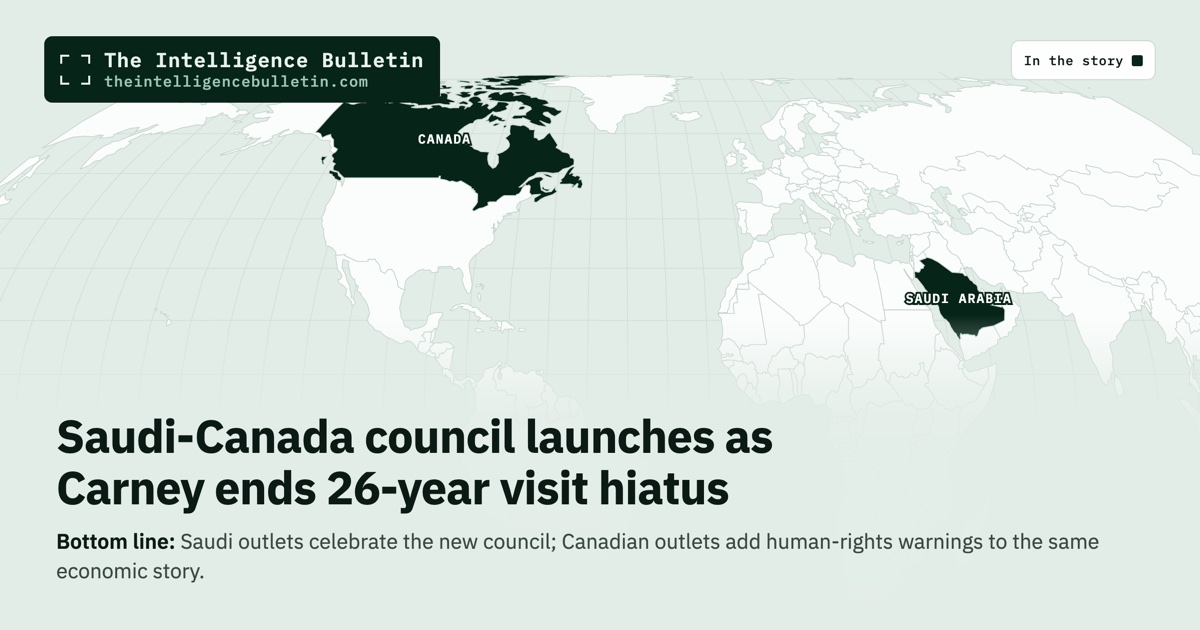
Canadian Prime Minister Mark Carney’s July 9, 2026, meeting with Crown Prince Mohammed bin Salman at Al-Salam Palace in Jeddah produced three bilateral memoranda of understanding and launched a Saudi-Canadian Coordination Council, ending a 26-year absence of sitting Canadian prime ministers from the kingdom. The coverage across Saudi, Canadian, and Gulf business outlets shows two governments aligning on economic outreach while speaking past each other on the political constraints that will determine whether the new council delivers more than symbolic progress.
Saudi reporting presents the visit as an uncomplicated diplomatic and commercial win. Arab News described Carney departing Jeddah on July 10 after a two-day trip that included the council’s creation plus agreements on energy cooperation and artificial intelligence and skills development. It noted Carney’s emphasis on mining and energy ties and his separate meeting with Saudi Aramco chief Amin Nasser, framing these steps as natural extensions of Canada’s need to diversify away from U.S. tariffs. Al Riyadh supplied the most detailed official record: the energy MoU exchanged between Saudi Energy Minister Prince Abdulaziz bin Salman and Canadian Foreign Minister Anita Anand; the council MoU signed by Foreign Minister Prince Faisal bin Farhan and Anand; and the AI MoU involving the Saudi Data and AI Authority head and Anand. It listed the full roster of senior Saudi attendees, including the defense and finance ministers, and their Canadian counterparts, underscoring protocol and mutual expressions of interest in expanding cooperation across sectors.
Canadian outlets, by contrast, embed every economic prospect inside reminders of Saudi Arabia’s human-rights record and the 2018 rupture. The Globe and Mail and National Observer published near-identical Canadian Press accounts that open with the 26-year milestone and Carney’s search for partnerships, then immediately quote University of Ottawa professor Thomas Juneau on the kingdom’s “notorious human rights record” that has deteriorated further. Both pieces recount the 2018 crisis—Ottawa’s criticism of the justice system and treatment of women, Riyadh’s withdrawal of its ambassador and expulsion of Canada’s envoy—and note the subsequent restoration of ambassadors in 2023. They cite Human Rights Watch on a surge in executions and the Raoul Wallenberg Centre’s call for Ottawa to press Riyadh to lift the travel ban on blogger Raif Badawi, whose family lives in Quebec. The reports list Canadian priority sectors—mining, AI, cleantech, agriculture—but pair them with Juneau’s assessment that political reform remains absent and rights conditions have worsened over the past decade.
Zawya supplies the concrete investment metrics that neither the Saudi dailies nor the Canadian papers foreground. It quotes Saudi Investment Minister Fahad Al-Saif stating that Saudi Arabia issued nearly 250 investment licenses to Canadian companies in the previous year, double the prior figure, and that 625 Canadian firms now operate in the kingdom, including 13 regional headquarters. Al-Saif added that non-oil activities exceed half of Saudi GDP, that total fixed capital formation reached more than $370 billion last year with non-oil, non-government investment at roughly 77 percent, and that the new council represents a practical institutional step. He also welcomed the start of talks on a bilateral investment promotion and protection agreement. These details give the economic substance a Gulf commercial voice absent from the Riyadh-aligned accounts, which stay at the level of protocol, and from the Ottawa-focused pieces, which prioritize political caveats.
The shared omission across all five outlets is any examination of what the Coordination Council will actually do or whether it changes Canada’s limited leverage on individual rights cases. Al Riyadh’s verbatim reproduction of the council MoU describes it only as a platform to implement a joint work document and roadmap for the next phase of relations. Canadian reporting notes the 2018 precedent but offers no analysis of whether renewed institutional channels will produce movement on Badawi’s ban or similar files. Zawya treats the council as one among several mechanisms for investor facilitation without addressing enforcement. Saudi coverage simply omits the rights dimension entirely.
This pattern reflects concrete interests on both sides. Ottawa faces U.S. tariffs on key exports and has already pursued Gulf outreach to the UAE and Qatar; Carney’s visit fits a broader diversification effort that includes security and diplomatic cooperation alongside trade. Riyadh seeks partners outside its traditional circle while pursuing Vision 2030 diversification, with non-oil GDP now dominant and FDI inflows up nearly fivefold since 2017. Yet each government’s domestic reporting shields its audience from the other’s core constraint: Canadian readers hear that rights concerns persist and may limit deeper ties; Saudi readers hear only of successful institutionalization and commercial opportunity.
The Canadian accounts come closest to the underlying reality. They accurately record both the economic openings and the political friction that the 2018 episode demonstrated can halt cooperation abruptly. The Saudi framing aligns with official objectives but leaves readers unprepared for any renewed friction. Zawya’s numbers usefully quantify the commercial baseline yet do not bridge the gap.
What to Watch
The most probable next phase is incremental commercial activity—new mining or AI projects, expanded Canadian licenses—without meaningful change on high-profile rights files. The council will likely function as a coordination mechanism for existing interests rather than a lever for political concessions. For Canadian investors and exporters, that means opportunities tempered by reputational and regulatory risks; for Saudi authorities, it means additional partners in diversification without external pressure on domestic governance. The visit resets formal relations after a long hiatus, but the divergent coverage shows both capitals still calibrate their publics for limited rather than transformative engagement.
That’s how the world told the story.
Get our daily open-source intelligence on world events in your inbox — one email a day, up to six stories.
Subscribe freeNo spam. One-click unsubscribe. See the latest email →