 AI-generated analysis published under the editorial responsibility of Rohit Sinnas. How it works →
Press quoted
Full analysis
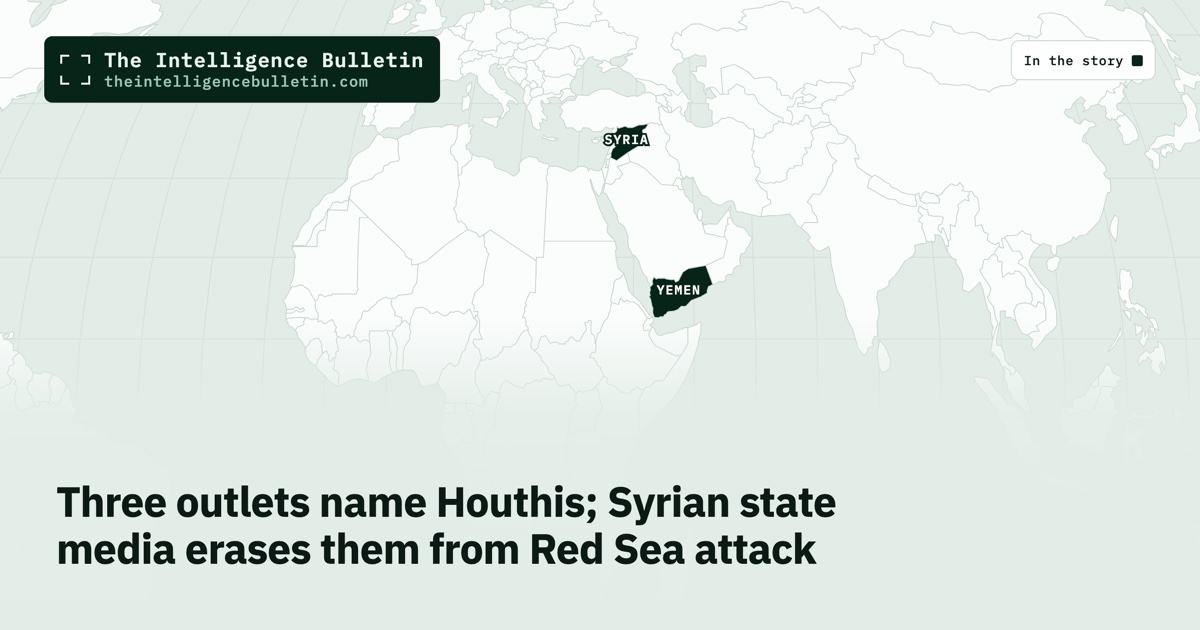
A single unclaimed attack on a commercial vessel in the Red Sea on July 5, 2026, exposed how even routine maritime security alerts fracture along geopolitical fault lines once they reach different newsrooms. Three outlets reproduced a detailed wire account that placed the incident in the context of Houthi activity near Hodeida, while Syrian state media stripped every reference to the most frequently cited suspects and presented only the barest official alert.
The incident itself was narrowly reported. The United Kingdom Maritime Trade Operations center stated that a cargo ship signaled it was under attack by unknown armed assailants roughly 30 nautical miles southwest of Hodeida, Yemen. British authorities opened an investigation, no group claimed responsibility, and no casualties were recorded. The location lies in waters that have seen repeated Houthi threats to international shipping since the onset of the Gaza conflict, though no recent strikes had been attributed to the group in the days preceding the alert.
Macau Daily Times published the incident on July 6 as a concise world brief, reproducing the UKMTO language almost verbatim while adding the standard background that Hodeida remains under Iranian-backed Houthi control. The account recalled the earlier campaign of drone and missile strikes that forced many carriers to divert around the Cape of Good Hope rather than risk the Bab al-Mandab Strait, and it noted recent Somali pirate activity in the Gulf of Aden. The Portuguese-language outlet, operating from an Asian shipping hub, treated the story as a straightforward update on lane security without additional local framing.
The Navhind Times carried nearly identical agency text on the same day, with one modest expansion: it included a specific July 1 pirate incident 76 nautical miles south of Balhaf in which four armed men on a small craft caused minor bridge damage. The Indian paper framed the episode around potential disruptions to Europe-bound routes, reflecting the commercial interests of a country whose exports rely on secure passage through the same waters. Otherwise the core paragraphs matched those appearing in Macau.
Adevărul in Romania published its version on July 5, again echoing the same wire copy while emphasizing the British military investigation and the strategic importance of the Red Sea as a corridor linking Europe and Asia. The Romanian account mentioned Houthi threats to resume attacks and noted that a Houthi spokesman had not responded to queries. It also referenced ongoing Somali pirate risks in the Gulf of Aden. The European perspective highlighted Western investigative efforts and the broader trade-security implications for EU-linked shipping.
SANA, Syria’s official news agency, issued a Spanish-language dispatch the same day that cited only the UKMTO alert, the ongoing investigation, and standard safety advisories to vessels. The report mentioned the position southwest of Hodeida and the distress signal but omitted any reference to Houthi control of the port, prior Houthi campaigns, or Somali piracy. It added a brief note about a June 11 engine-room fire on a tanker near the Strait of Hormuz, yet supplied no actor attribution or historical linkage to the new incident.
The near-identical phrasing across the three non-Syrian outlets indicates they drew from the same Western agency feed, a pattern common in international maritime reporting where UKMTO bulletins travel quickly through global wires. Each publication adapted the copy slightly for its audience—Macau for port logistics, India for export corridors, Romania for European security concerns—yet preserved the core elements naming the Houthis and recalling the Gaza-era disruptions. SANA’s version demonstrates a deliberate editorial filter: even when reporting an unclaimed event in waters adjacent to a key Iranian-aligned actor, the Damascus outlet removed every contextual clue that could implicate Houthi forces.
This divergence matters because Red Sea security remains sensitive. Shipping companies continue to weigh the cost of longer voyages against the risk of renewed attacks, while regional powers watch for any sign that the Houthis might resume operations. A single alert, stripped of attribution in one capital and fully contextualized in others, illustrates how quickly maritime incidents become instruments of narrative control.
The Takeaway
For observers monitoring the lanes, the next developments to track are any official claims or denials from Houthi spokesmen, updates from the British investigation, and whether subsequent UKMTO reports register further suspicious activity near Hodeida. Should another incident occur without immediate attribution, the same pattern of selective omission or inclusion is likely to reappear across the same outlets.
That’s how the world told the story.
Get our daily open-source intelligence on world events in your inbox — one email a day, up to six stories.
Subscribe freeNo spam. One-click unsubscribe. See the latest email →