 AI-generated analysis published under the editorial responsibility of Rohit Sinnas. How it works →
Press quoted
Full analysis
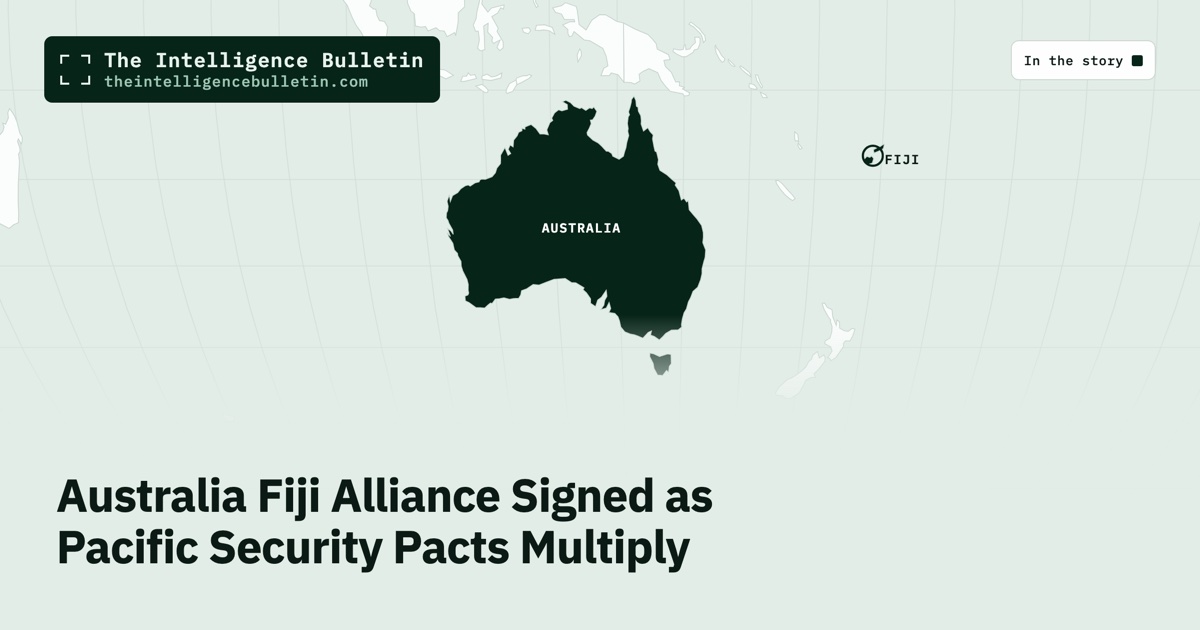
On July 6, 2026, Australian Prime Minister Anthony Albanese and Fijian Prime Minister Sitiveni Rabuka signed the Vuvale Union and the Ocean of Peace treaty at State House in Suva, formalizing a mutual defence alliance that upgrades their bilateral ties while remaining open to other Pacific nations. The agreement includes more than $1 billion in Australian commitments over a decade for security, health, infrastructure and related priorities, marking the latest in a series of pacts that have reshaped Canberra’s regional posture since the 2022 Solomon Islands security deal with China.
Regional reporting from Pacific outlets placed heavy emphasis on the ceremonial and relational dimensions of the day. Coverage from the Pacific Islands News Association highlighted Albanese’s arrival the previous evening, greeted on the tarmac by Deputy Prime Minister Viliame Gavoka and Foreign Minister Sakiasi Ditoka, followed by a guard of honour, a Fiji Military brass band playing Australia’s national anthem and a performance of “I Still Call Australia Home.” The reporting framed the visit as reinforcing the Vuvale Partnership through mutual respect, cooperation and shared regional priorities, including a traditional welcome ceremony and a courtesy call on President Ratu Naiqama Lalabalavu. Albanese was quoted stressing that “Fiji and Solomon Islands are not just our neighbours, we are part of the Pacific family,” while noting his subsequent travel to the Solomon Islands to advance another treaty and his participation in that country’s Independence Day celebrations as the first foreign leader to do so.
Australian coverage from the ABC provided the most detailed account of the treaty’s substance. Reporters on the ground in Suva described the Ocean of Peace Alliance as introducing explicit mutual defence obligations, under which an armed attack on either party within the Pacific “would be dangerous to each other’s peace and security” and each would “act to meet the common danger, in accordance with its domestic processes.” The pact also contains provisions for consultation on any “security-related development that threatens the sovereignty, peace or stability” of either country. Albanese described the significance as one that “cannot be underestimated,” adding that “there is no higher obligation than to come to each other’s aid at a time of need.” The report noted the treaty’s openness to accession by other Pacific nations “in a position to further the purposes and principles of this treaty and to contribute to the security of the Pacific,” with Rabuka telling journalists that “the more, the stronger, the better.” It tied the agreement to more than $1 billion in Australian spending on transnational crime, education, health and infrastructure, and situated the signing within Albanese’s rapid regional itinerary that also included meetings with leaders from Papua New Guinea, Tonga and the Solomon Islands.
International outlets adopted a sharper geopolitical lens. The BBC led with the alliance as a step by Australia to counter Beijing, noting the timing of a Chinese submarine ballistic-missile test in the Pacific hours after the signing. Foreign Minister Penny Wong was quoted accusing China of “destabilising” the region amid a “rapid military buildup” lacking transparency. The report connected the Fiji deal to earlier fears sparked by the 2022 Solomon Islands pact and listed Australia’s other recent arrangements, including the Nakamal Agreement with Vanuatu that bars foreign military bases and the Pukpuk Treaty with Papua New Guinea. Rabuka was cited insisting the treaty “does not threaten Fiji’s relationship with China nor Australia’s relationship with China,” and that Beijing would “welcome the understanding.”
Taiwan’s Central News Agency emphasised joint maintenance of South Pacific security without foregrounding rivalry. Its account described the Ocean of Peace agreement as establishing a defence alliance under which both sides reaffirmed commitments to sovereignty, common defence and regional stability. It noted Fiji’s renewed emphasis on traditional partnerships since Rabuka took office in 2022 and referenced the Nakamal Agreement with Vanuatu, while recording China’s earlier warning against “geopolitical games” in the Pacific. The reporting stayed focused on the text’s language about preserving peace and security across the region.
Asharq Al-Awsat, reflecting a broader international-affairs perspective, presented the pact explicitly as Australia’s effort to outmaneuver China. It detailed the mutual-defence clause, the clause allowing other Pacific nations to join, and Rabuka’s efforts to downplay potential pushback from Beijing. The outlet linked the development to China’s 2022 Solomon Islands deal and its infrastructure investments across the region, while noting parallel Australian arrangements with Papua New Guinea, Vanuatu and Tuvalu.
Across these accounts, the factual core remains consistent: the signing of a mutual-defence alliance embedded in the Vuvale framework, backed by substantial Australian funding and designed with an accession mechanism for additional partners. Where the reporting diverges is in emphasis. Pacific and Australian sources lingered on protocol, the elevation of the “Vuvale” relationship and concrete deliverables, while external coverage situated the move within great-power competition. Rabuka’s repeated assurances that the treaty poses no threat to Fiji’s or Australia’s ties with China appear in multiple accounts, underscoring that Pacific actors continue to frame their diplomacy in integrative rather than exclusionary terms.
The Takeaway
Albanese’s itinerary offers the clearest near-term indicators of momentum. After the Fiji signing he was scheduled to travel immediately to the Solomon Islands for Independence Day events and further treaty talks with Prime Minister Matthew Wale, who has floated the idea of a broader Pacific-wide security arrangement. Meetings in Brisbane with the leaders of Papua New Guinea, Tonga and Samoa were set to mark the entry into force of the Pukpuk Treaty and discuss additional cooperation. Observers will watch whether the Ocean of Peace accession clause draws formal interest from other island nations with standing militaries, and whether any such expansion alters the balance of external commentary on the pacts’ strategic intent.
That’s how the world told the story.
Get our daily open-source intelligence on world events in your inbox — one email a day, up to six stories.
Subscribe freeNo spam. One-click unsubscribe. See the latest email →