 AI-generated analysis published under the editorial responsibility of Rohit Sinnas. How it works →
Press quoted
Full analysis
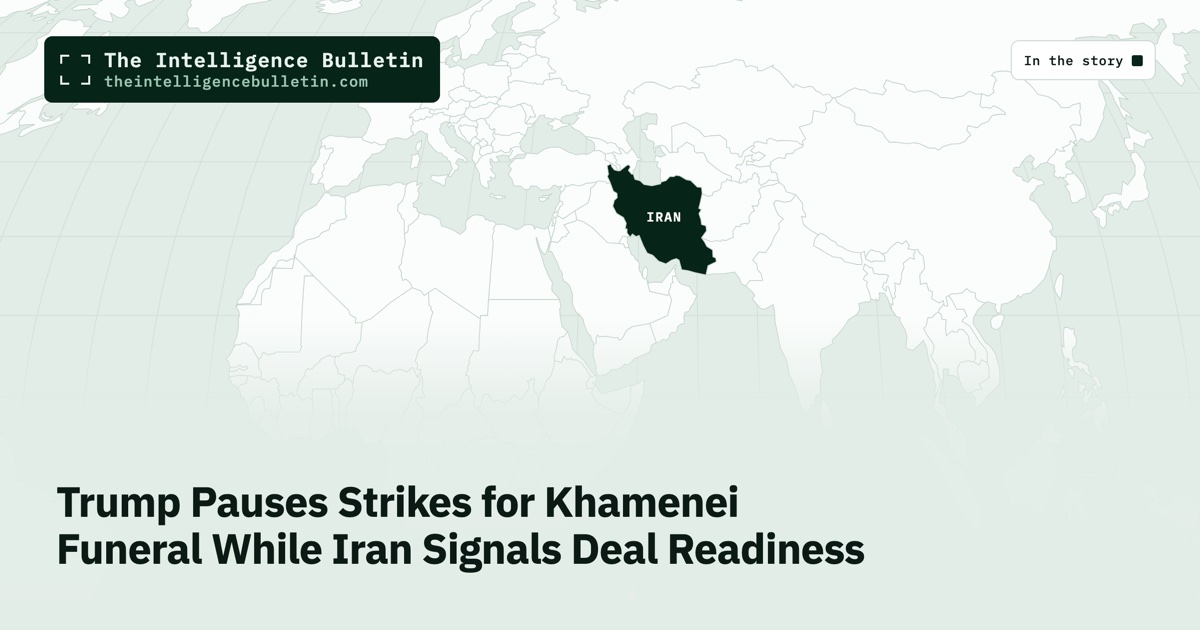
The announcement by President Donald Trump on July 4, 2026, at Mount Rushmore that the United States had granted Iran a one-week pause in operations for the funeral of former Supreme Leader Ali Khamenei underscored American leverage in an ongoing diplomatic process while exposing how differently regional and international outlets interpret the same events. Trump framed the reprieve explicitly as a humanitarian courtesy during an America 250 celebration, pairing it with the assertion that Iran had been struck hard and was now eager for a political settlement with Washington.
The pause occurs against the backdrop of US and Israeli strikes that began on February 28, when Khamenei, then 86, was killed along with family members in attacks on his residential area. Those strikes marked the start of open conflict, after which Mojtaba Khamenei was appointed the new Supreme Leader in March. Earlier diplomacy had produced a 14-point memorandum of understanding signed in mid-June, followed by technical talks in Switzerland and then Doha involving Qatari and Pakistani mediators. Several complex files remain unresolved, chief among them management of the Strait of Hormuz, where Tehran seeks joint oversight with Oman and compensation described as service fees, positions opposed by both Washington and Muscat.
Saudi Arabia’s Okaz placed the pause squarely inside the Riyadh-Tehran rivalry, noting the US strikes that preceded it and the lingering Hormuz question in current negotiations. The outlet reported Trump’s Mount Rushmore remarks in detail, including his claim that Iran is “eagerly and desperately seeking a political settlement,” while adding historical context on the June memorandum and the Qatari-Pakistani mediation track that other coverage largely omitted. Its editorial lens emphasized the security implications for Gulf states of any US-Iran accommodation, particularly regarding navigation rights in a vital waterway.
Kosovo’s Shenja, writing from the perspective of a small NATO-aligned nation, highlighted the humanitarian character of the pause and Trump’s broader boasts of American military power. The report quoted the president saying the United States had “created the strongest and most powerful army,” won two world wars, and left Cold War adversaries “in the depths of history,” before turning to recent conflicts with the line that Washington “beat Venezuela in one day and knocked the hell out of Iran” and therefore granted “a week off for a funeral because we’re nice.” The emphasis remained on US strength and goodwill rather than the substance of the talks.
India’s Khas Khabar treated the story as one item in a global roundup, reporting the one-week reprieve in neutral language and underscoring Iran’s weakened position after US actions. The outlet avoided any emphasis on potential deals or regional rivalry, instead noting that Iran had been “shaken” and was now compelled to seek compromise on American terms, consistent with New Delhi’s traditional distance from direct entanglement in US-Iran dynamics.
Pakistan’s The News focused on the diplomatic opening, quoting Trump’s characterization that Iran is “dying to settle” and “wanting to settle so badly.” It added confirmation from Iranian negotiators, including parliament speaker Mohammad Bagher Ghalibaf, that discussions would resume once the funeral ceremonies concluded. The paper noted that mourning had already begun on Saturday with an expected six days of events drawing 15 to 20 million participants across Tehran, Qom, and Mashhad.
The Pakistan Observer shifted attention almost entirely to the Iranian domestic scene, describing thousands of mourners in black filling streets and the Grand Mosalla complex in Tehran, where a casket was displayed inside a glass enclosure amid symbolic red banners. It reported that new Supreme Leader Mojtaba Khamenei might avoid large public appearances due to security concerns tied to possible threats, citing a University of Tehran research fellow who linked the caution to fears of further Israeli action. Trump’s statement appeared only briefly as an aside in this on-the-ground account.
The Takeaway
Across the five outlets the common thread is Trump’s blunt assertion of American power and Iran’s current need for accommodation, yet the framing diverges sharply according to each publication’s vantage point. Saudi coverage stresses unresolved security files and Gulf interests; Kosovar reporting accentuates alliance solidarity and US benevolence; Indian dispatches remain detached and factual; one Pakistani paper tracks negotiation prospects while the other captures street-level mourning and leadership vulnerabilities. Iranian negotiators have indicated talks will restart after the ceremonies, leaving the trajectory of the 14-point memorandum and the Hormuz file as immediate tests of whether the one-week pause translates into substantive progress or renewed pressure.
That’s how the world told the story.
Get our daily open-source intelligence on world events in your inbox — one email a day, up to six stories.
Subscribe freeNo spam. One-click unsubscribe. See the latest email →