 AI-generated analysis published under the editorial responsibility of Rohit Sinnas. How it works →
Press quoted
Full analysis
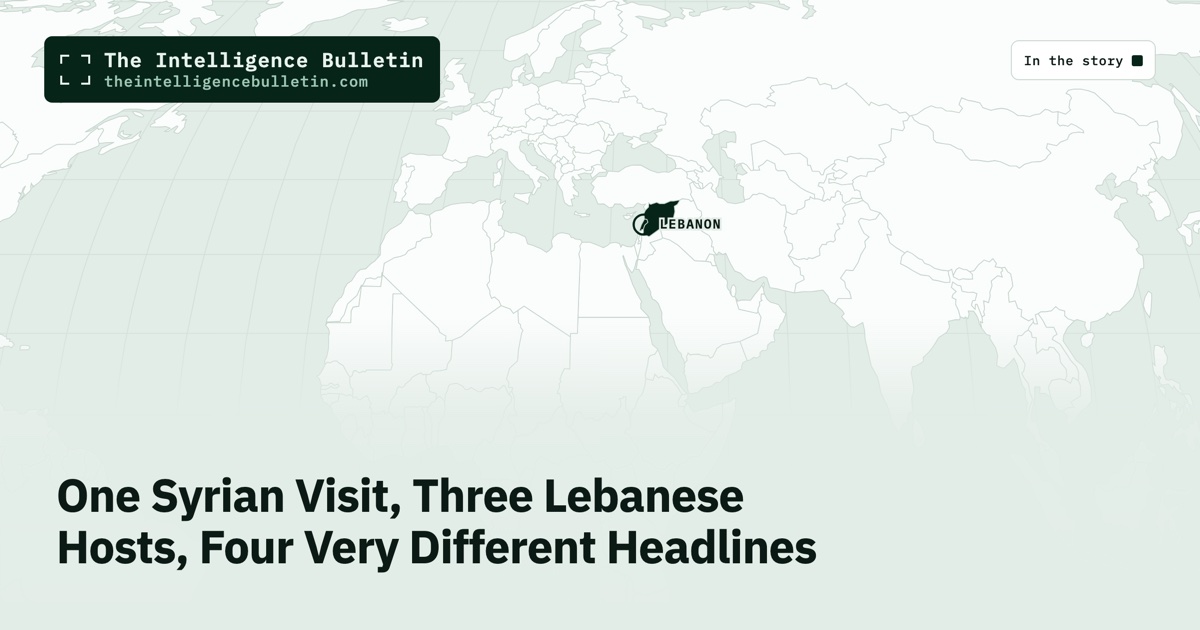
On July 2, 2026, Syrian Foreign Minister Assaad Hassan al-Shaibani conducted a tightly scheduled round of meetings in Beirut that illustrated both the mechanics of Syrian outreach and the contrasting ways regional media interpret it. The single day’s itinerary—encounters with Lebanon’s president, prime minister, and parliament speaker—produced a narrow but verifiable set of outcomes: agreement to establish a joint ministerial committee focused on economic cooperation and regional coordination. Yet the four principal outlets that covered the visit presented four distinct narratives, each shaped by institutional priorities rather than any dispute over the underlying facts.
Syrian state media, represented by SANA, framed the visit as standard high-level diplomacy that delivered a concrete institutional result. Its report listed the sequence of meetings with President Joseph Aoun, Prime Minister Nawaf Salam, and Speaker Nabih Berri without embellishment, noting that the discussions addressed bilateral ties, economic cooperation, and regional developments. The establishment of the joint ministerial committee was presented as the principal deliverable, consistent with Damascus’s emphasis on measurable steps toward normalization after years of strained relations. The tone remained bureaucratic, underscoring mutual interests and the continuation of an official visit rather than any symbolic breakthrough.
Turkish coverage, carried by Anadolu Agency, narrowed its focus sharply to the encounter with President Aoun. The headline and lead centered on the meeting at the presidential palace in Baabda, treating the formal head-of-state channel as the primary story. This emphasis aligns with Ankara’s preference for engaging recognized executive institutions amid its own regional diplomacy. While the agency’s dispatch acknowledged the broader context of al-Shaibani’s Lebanon trip, it did not dwell on the subsequent stops at the prime minister’s office or the speaker’s residence, thereby elevating the most constitutionally conventional Lebanese interlocutor.
French international broadcaster France 24 adopted a different lens entirely, centering its framing on the physical movement of the Syrian envoy between Baabda and Ain el-Tineh. The title itself mapped the route—“From Baabda to Ain el-Tineh”—highlighting Lebanon’s fragmented centers of authority rather than the substance of any single conversation. This approach implicitly drew attention to the country’s divided sovereignty, a longstanding preoccupation of French reporting on Lebanese affairs. The piece treated the itinerary itself as newsworthy, reflecting Paris’s sustained interest in Beirut’s institutional balance and the challenges of conducting coherent diplomacy across multiple power centers.
Russian Arabic output from RT stood apart through its deliberate use of symbolic and aspirational language. Its headline invoked “the cedars of Lebanon and the roses of Damascus” to portray the visit as the dawn of a new era of brotherhood and cooperation. The account described a gift exchange in which Prime Minister Nawaf Salam presented symbols representing the two nations, and it quoted al-Shaibani expressing Syria’s desire for relations that serve Lebanese stability. The tone projected optimism and fraternal renewal, elements absent from the drier procedural accounts elsewhere, and positioned the meetings within a broader narrative of stabilized alignment favorable to Moscow’s regional positioning.
Across these reports, the shared factual core remains consistent: one Syrian foreign minister shuttled between three Lebanese officials in a matter of hours, discussed economic and regional files, and secured agreement on a joint ministerial committee. The divergence appears instead in selection and register. SANA emphasized outputs and listed all interlocutors; Anadolu elevated the presidential channel; France 24 foregrounded geographic and institutional fragmentation; RT supplied poetic framing and gift symbolism. These choices reveal how each capital’s media ecosystem reads Damascus’s outreach through its own lenses of institutional preference, interest in Lebanese stability, and desired regional narrative.
The visit occurs against a backdrop of post-conflict normalization efforts between the two neighbors. Syria and Lebanon share deep economic, familial, and security linkages that have been complicated by years of conflict and political upheaval. Al-Shaibani’s itinerary, which also included conveying an invitation from Syrian President Ahmed al-Sharaa for Aoun to visit Damascus, signals an attempt to activate formal and informal channels simultaneously. Lebanese officials, for their part, appear receptive to practical cooperation on economic matters while navigating their own domestic constraints.
The Takeaway
What to watch next is whether the announced joint ministerial committee produces follow-through meetings or concrete agreements on trade facilitation, border management, or coordinated responses to regional developments. The speed and tone with which subsequent coverage in each outlet registers any progress—or lack thereof—will further illustrate the same pattern of selective emphasis observed on July 2. In a region where diplomatic gestures are routinely interpreted through multiple prisms, the differing headlines already demonstrate that the message Damascus seeks to project is received in distinctly local keys.
That’s how the world told the story.
Get our daily open-source intelligence on world events in your inbox — one email a day, up to six stories.
Subscribe freeNo spam. One-click unsubscribe. See the latest email →