 AI-generated analysis published under the editorial responsibility of Rohit Sinnas. How it works →
Press quoted
Full analysis
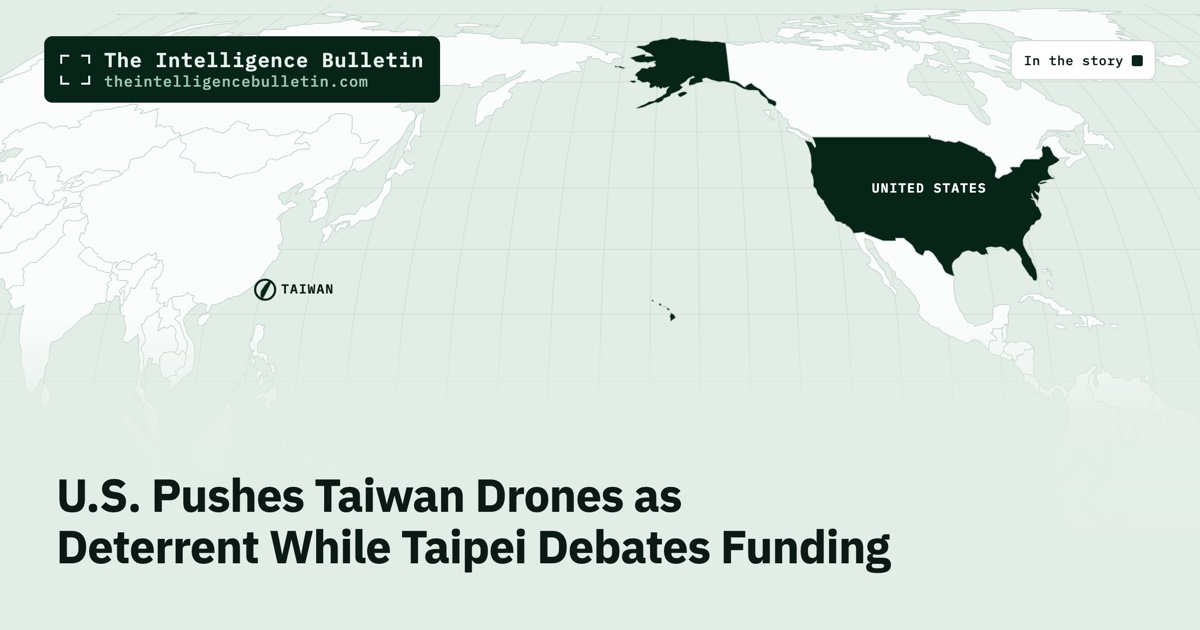
On July 2, 2026, a single set of remarks by the de facto U.S. ambassador to Taiwan crystallized a shared strategic consensus: asymmetric drone capabilities now sit at the center of efforts to deter conflict across the Taiwan Strait. American Institute in Taiwan Director Raymond Greene delivered the message at a drone industry forum in Taichung, framing expanded U.S.-Taiwan cooperation on uncrewed systems as both an economic opportunity and a decisive security upgrade. His central image—that nothing would deter conflict more effectively than turning Taiwan into a “hornet’s nest” of air, surface, and subsurface drones—travelled intact through coverage in Taiwan, Europe, and the Caribbean, underscoring how settled the narrative of drone-centric deterrence has become.
Greene opened with the lessons of Ukraine. A military possessing robust drone production capacity and a culture of technological innovation, he said, “can punch far above its weight” against a larger adversary. Taiwan’s world-beating technology and production capabilities positioned it to replicate that advantage, he argued. Drones, he continued, offered “new avenues for business” while representing a “game-changing opportunity” to enhance Taiwan’s security and reinforce peace throughout the Indo-Pacific. The United States stood ready to anchor “democratic drone production,” reduce supply-chain vulnerabilities, and strengthen the collective deterrence posture of the free world. Greene placed the partnership in historical sequence: after a “golden age” of U.S.-Taiwan cooperation in AI and semiconductors, drones and the broader ecosystem of uncrewed systems, embodied AI, and advanced robotics could usher in a “platinum age” in which the two economies jointly lead in the technologies that will define the future.
The speech arrived as Taiwan’s political parties advanced competing legislative proposals to accelerate domestic drone production and procurement. The ruling Democratic Progressive Party’s Cabinet plan called for a special budget without an annual spending cap through the end of 2031, financed through government borrowing or carried-over surpluses. Opposition caucuses from the Kuomintang and Taiwan People’s Party countered with funding drawn from the regular central-government budget, warning that a special mechanism would lack continuity and crowd out spending on social welfare and education. President Lai Ching-te reinforced the urgency the same week, describing the build-up of asymmetric capabilities as a “race against time” in the face of evolving modern warfare and geopolitical shifts.
Focus Taiwan, the island’s English-language wire service, presented Greene’s remarks as a bilateral win that could replicate the semiconductor success story for Taiwan’s next generation. The outlet lingered on the domestic legislative wrangling, detailing the structural differences between a special budget and regular appropriations and noting how each side viewed the other’s approach as fiscally risky. Its emphasis stayed squarely on partnership benefits and policy implications for a Taiwanese audience already attuned to supply-chain resilience and industrial policy.
Kurier, the Austrian broadsheet, embedded the same “hornet’s nest” quotation inside a European security frame. It situated the statement within the larger Indo-Pacific contest with China, cited Ukraine’s experience as proof that drones can offset numerical disadvantage, and added historical context on the Chinese civil war that left Taiwan under separate governance since 1949. The piece highlighted Taipei’s prioritization of asymmetric systems even after parliament approved only two-thirds of requested additional defense outlays in May, framing the moment as a narrowing window for capability development.
The Dominican Republic Post reprinted Al Jazeera copy with minimal local interpretation. It reproduced Greene’s core quotation and added concrete figures absent from the Taiwanese report: a proposed NT$210 billion (US$6.59 billion) package for surveillance, coastal-attack, and small unmanned-surface drones; the opposition Kuomintang’s alternative cap of NT$240 billion (US$7.5 billion) over six years with an annual ceiling of NT$40 billion; and the May pause of a US$14 billion U.S. arms sale to preserve munitions for other contingencies. The piece noted Lai’s rejection of Beijing’s sovereignty claims and his insistence that only Taiwan’s people may decide the island’s future, but offered no additional regional color.
Across the three outlets the core message remained consistent. Ukraine demonstrated the defensive utility of mass drone production; Taiwan possesses the industrial base to scale that model; closer U.S. partnership can lock in democratic supply chains and collective deterrence. Divergence appeared only in emphasis. Focus Taiwan treated the speech as industrial-policy opportunity and local legislative contest. Kurier applied a great-power lens that included explicit historical background on cross-strait tensions. The Caribbean aggregator stayed closest to wire-service neutrality, layering in spending numbers and the arms-sale pause without interpretive overlay. No outlet advanced a counter-narrative questioning the deterrence logic itself.
The Takeaway
What happens next will test whether rhetorical convergence translates into sustained funding and production capacity. Taiwan’s legislature must reconcile the special-budget proposal with opposition alternatives before the end of the current session. Any compromise will determine whether the “platinum age” Greene described begins with predictable, multi-year resources or with annual appropriations vulnerable to fiscal and political pressure. At the same time, the pace of U.S.-Taiwan technical exchanges on uncrewed systems will reveal how quickly the envisioned joint ecosystem can move from forum rhetoric to fielded capability. Observers will watch both the legislative vote and the first concrete announcements of co-development or procurement contracts to gauge whether the hornet’s-nest vision remains aspirational or becomes operational.
That’s how the world told the story.
Get our daily open-source intelligence on world events in your inbox — one email a day, up to six stories.
Subscribe freeNo spam. One-click unsubscribe. See the latest email →