 AI-generated analysis published under the editorial responsibility of Rohit Sinnas. How it works →
Press quoted
Full analysis
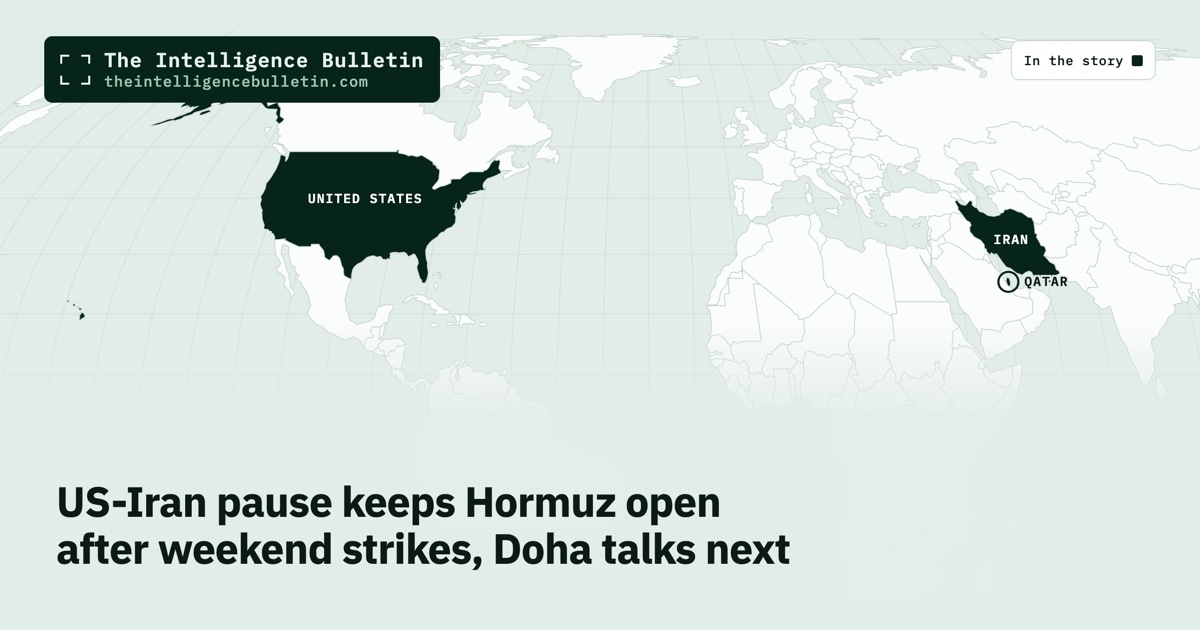
The weekend’s exchange of strikes between the United States and Iran gave way within hours to a narrow, technical stand-down that every major outlet covering the story treated as credible enough to report without immediate qualification. A U.S. official announced late on June 28 that both sides would halt attacks for now, allow commercial vessels to move freely through the Strait of Hormuz, and keep technical talks alive on the June 17 memorandum of understanding. The pause was framed not as a political breakthrough but as a pragmatic measure to restore the flow of oil and gas through the critical waterway that carries roughly one-fifth of global hydrocarbons.
Background to the understanding stretches back to the June 17 memorandum itself, which had sought to reopen the strait after earlier disruptions tied to the broader U.S.-Iran conflict that began earlier in the year. Fresh tensions erupted over the weekend when the U.S. military accused Iran of striking commercial ships, prompting American strikes on Iranian drone and missile storage facilities, surveillance infrastructure, communications systems, air-defense sites, and minelayer capabilities near the strait. Iran responded by targeting positions in Bahrain and Kuwait. Within hours of those exchanges, the U.S. official statement signaled de-escalation, emphasizing that technical discussions on every element of the memorandum would continue.
U.S.-based reporting, exemplified by The Epoch Times, stayed tightly aligned with the American official’s wording. The outlet detailed the continuation of technical talks across the full scope of the memorandum and stressed the explicit assurance that vessels could transit freely. It placed the pause in direct sequence with the June 27–28 strikes, noting U.S. Central Command’s targeting of specific Iranian military assets after alleged attacks on the M/V Ever Lovely and M/T Kiku. The piece avoided speculation about venue or timing for follow-on talks, keeping the focus on Washington’s sourcing and the immediate restoration of shipping access.
French coverage on BFMTV introduced a distinctly conditional tone, highlighting the phrase “for the moment” in the U.S. announcement and underscoring that the halt remained provisional. The report incorporated Iranian Foreign Minister Abbas Araghchi’s insistence that only Tehran bears responsibility for managing the strait and that any external interference would delay reopening and heighten tensions. It also situated the Hormuz developments within the wider regional picture, noting continued Israeli strikes in Lebanon despite a separate framework agreement signed in Washington. This layering of context distinguished the French account from more narrowly diplomatic treatments elsewhere.
Indian reporting through ANI News presented the stand-down in concise, neutral terms drawn from U.S. official statements carried by CBS and ABC. The emphasis fell on the continuation of technical talks and the global economic stakes created by four months of conflict, including pressure on energy prices and diplomatic relations. The outlet mentioned possible Qatar talks only in passing via Axios reporting and avoided inserting regional or energy-route specifics, consistent with a wire-style approach that privileges sourced diplomacy updates over local angles.
Pakistani coverage in Daily Pakistan foregrounded the expected Tuesday meeting in Doha and its relevance for regional stability near a Muslim-majority neighbor. The report noted that U.S. officials described the talks as covering all areas of the memorandum while both sides work to reduce tensions and ensure free commercial movement. It placed the pause against the backdrop of President Trump’s social-media warnings and Iran’s foreign-minister statements on shipping delays, giving South Asian readers an immediate diplomatic calendar rather than abstract strategic analysis.
Indonesian agency reporting via Antara News, drawing on Xinhua, centered the maritime dimension and the abrupt relocation of talks. The account explained that discussions originally slated for Switzerland on Iran’s nuclear program had shifted to Doha once Hormuz tensions flared, with the new focus squarely on shipping security. It referenced the earlier establishment of a military hotline between U.S. forces and Iran’s Islamic Revolutionary Guard Corps that had yet to become operational, and it framed the pause as a direct response to renewed attacks on commercial vessels. This energy-security lens reflected Southeast Asian dependence on stable passage through the strait.
Across these five outlets the shared factual core remains identical: a limited, technical pause engineered to keep the strait open rather than a comprehensive political settlement. Differences appear mainly in emphasis—the U.S. piece on official sourcing and memorandum mechanics, the French piece on provisional language and Iranian sovereignty claims, the Indian piece on global economic consequences, the Pakistani piece on the Doha venue and timing, and the Indonesian piece on the shift from Swiss nuclear talks to Qatari maritime discussions. No outlet presented the understanding as permanent or expansive.
The Takeaway
What happens next hinges on the Tuesday Doha session. Observers will watch whether the military hotline becomes functional, whether the promised free transit materializes without further incidents, and whether the 60-day provisions in the June 17 memorandum can be extended or expanded. Any renewed strikes or delays in implementation would quickly test the durability of the current stand-down.
That’s how the world told the story.
Get our daily open-source intelligence on world events in your inbox — one email a day, up to six stories.
Subscribe freeNo spam. One-click unsubscribe. See the latest email →