 AI-generated analysis published under the editorial responsibility of Rohit Sinnas. How it works →
Press quoted
Full analysis
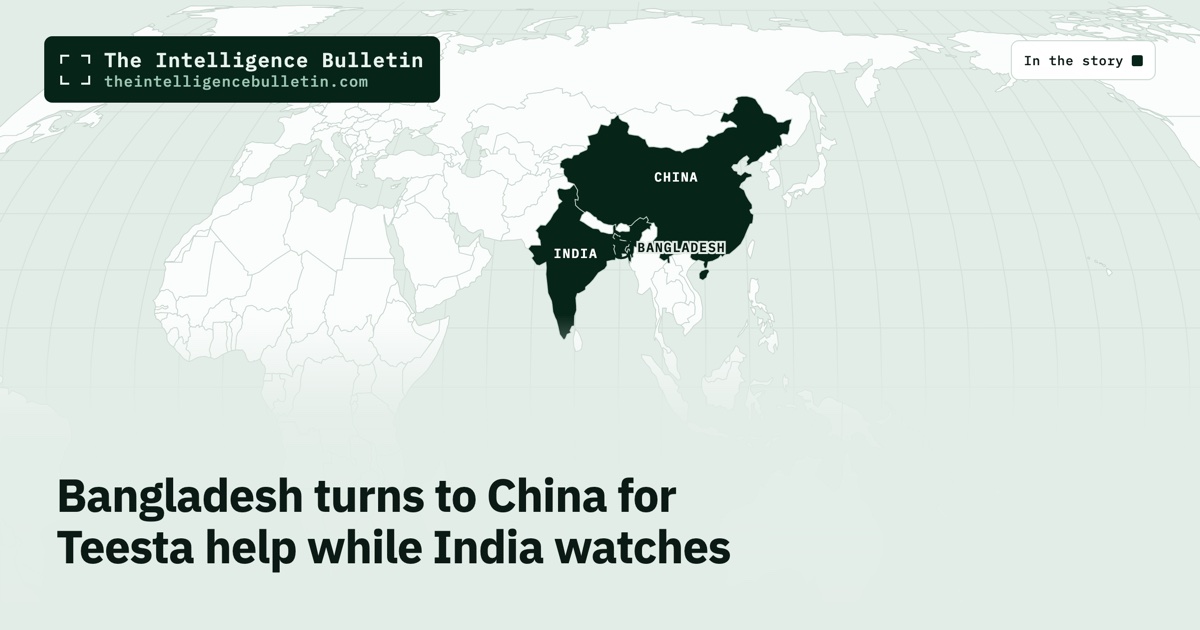
Bangladesh’s decision to seek Chinese technical help for managing the Teesta River marks a clear step toward diversifying its water-resource partnerships at a moment when India remains closely attentive to any external involvement in the shared basin. The move, announced on June 25, 2026, during Prime Minister Tarique Rahman’s visit to Beijing, underscores how transboundary river issues continue to intersect with broader geopolitical calculations in South Asia.
The Teesta originates in the eastern Himalayas, flows through India’s Sikkim and West Bengal states, and enters Bangladesh, where it supports irrigation and livelihoods for millions. Bangladesh has long faced challenges of flooding, riverbank erosion, and inadequate dry-season water availability. Its government has pursued an ongoing river-excavation program aimed at flood-risk reduction, environmental protection, and better water-resource oversight. Against this backdrop, the latest agreement with China builds on an existing Memorandum of Understanding signed in 2005 and a visit by Chinese water experts to Bangladesh the previous year.
Chinese Water Resources Minister Li Guoying met Prime Minister Tarique Rahman at the Diaoyutai state guest house in Beijing on June 25. During the discussion, Rahman directly requested Chinese technical assistance for the Teesta management project as well as support for preventing riverbank erosion, improving irrigation systems, and enhancing inland water navigation. He also highlighted the national river-excavation program and sought broader Chinese help in strengthening overall water-resource management. Li responded by pledging full cooperation, noting that bilateral efforts in the sector are practical and research-based. He invited Bangladeshi water experts and officials to receive training in China and emphasized that Bangladesh could draw on Chinese experience in the field.
The meeting occurred on the margins of Rahman’s wider China visit. He had arrived in Beijing the previous day by high-speed train from Dalian, where he had attended the World Economic Forum’s Summer Davos forum after an earlier stop in Malaysia. The Teesta discussions formed part of a larger schedule that included expected talks with President Xi Jinping and Premier Li Qiang. Bangladesh’s state news agency presented the exchange as a straightforward diplomatic achievement, focusing on the requests made and the pledges received without additional regional commentary.
Indian reporting carried the same core sequence of events but situated them within the context of India-Bangladesh water relations and China’s longstanding interest in the Teesta basin. The river’s upper reaches lie near India’s sensitive Siliguri Corridor, which connects the Indian mainland to its northeastern states. Indian coverage noted that the Rahman government had already sought Chinese involvement in the Teesta River restoration project during Foreign Minister Khalilur Rahman’s visit to Beijing the previous month. It also recalled India’s own 2024 offer of technical and conservation assistance for the Teesta basin and pointed out that the 1996 Ganges Water Treaty, governing dry-season sharing between the two countries, is due to expire in 2026 unless renewed.
Both accounts confirm an identical factual record: the June 25 meeting, the specific requests for Teesta assistance and related water projects, the reference to the 2005 MoU, the training invitation, and the presence of Bangladeshi ministers and advisers including Water Resources Minister Md Shahiduddin Chowdhury Anee. No contradictions appear between the reports. The difference lies in framing. The Bangladeshi state agency emphasizes bilateral progress and the practical benefits sought by Dhaka. The Indian outlet layers on the river’s path through Indian territory, past sensitivities around the Siliguri Corridor, and New Delhi’s parallel offer of help, thereby highlighting potential implications for regional water-sharing dynamics.
The development arrives after political transitions in Bangladesh. Tarique Rahman’s government assumed office in February 2026, succeeding an interim administration led by Muhammad Yunus that followed the ouster of former Prime Minister Sheikh Hasina. Water sharing has remained a persistent item on the India-Bangladesh agenda, and the new outreach to China adds another dimension to ongoing efforts to address flood control, erosion, and irrigation needs.
The Takeaway
Observers will watch several developments in the coming months. Rahman’s scheduled meetings with Xi Jinping and Li Qiang could produce further agreements or clarify the scope of Chinese involvement. Any follow-up actions on the 2005 MoU or the training offers will indicate how quickly the pledges translate into concrete projects. India’s response, particularly regarding its own technical assistance proposal and the approaching expiration of the Ganges treaty, will shape the wider diplomatic environment. Continued reporting on the Teesta project’s progress and any trilateral or multilateral water initiatives will reveal whether the Beijing agreement accelerates a shift in how the basin’s upper and lower riparian states coordinate their interests.
Share this story
That’s how the world told the story.
Get our daily open-source intelligence on world events in your inbox — one email a day, up to six stories.
Subscribe freeNo spam. One-click unsubscribe. See the latest email →