 AI-generated analysis published under the editorial responsibility of Rohit Sinnas. How it works →
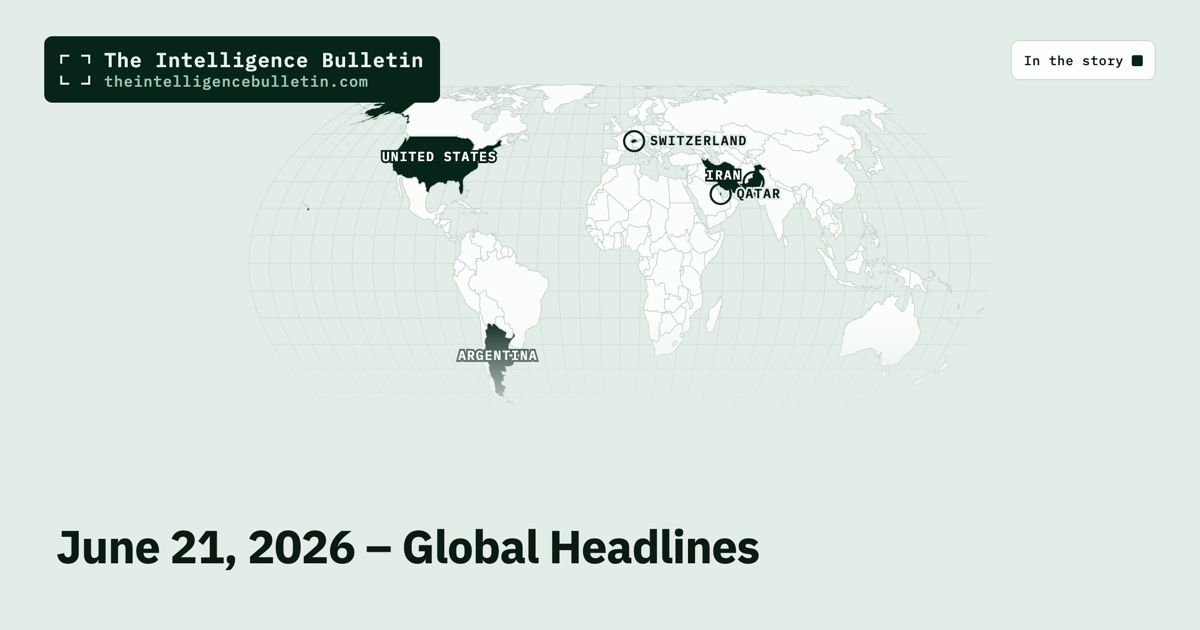
1Washington ties Swiss talks to Hormuz threats. Islamabad claims mediation credit. Buenos Aires notes arrivals.
The sudden prominence of Pakistan’s prime minister and army chief at Bürgenstock marks the clearest shift since Qatari mediators first shuttled between Tehran and Washington two weeks ago. Earlier reports tracked Vice President Vance’s abrupt cancellation followed by Steve Witkoff’s arrival; now the addition of Pakistan’s top leadership suggests the talks have moved beyond bilateral US-Iran channels into a wider South Asian brokerage role that both sides appear willing to accept. NBC News anchors the coverage in Washington’s familiar frame of leverage, pairing the Swiss venue with Trump’s renewed threat of a “guardian angel toll” on Hormuz traffic, a reminder that US domestic signaling remains central even when the venue is neutral. The Frontier Post instead leads with Pakistan’s facilitation task and the spotlight on Hormuz and Lebanon, treating the meeting as validation of Islamabad’s mediating credentials rather than a US-Iran story alone. Infobae, publishing from Buenos Aires, narrows further to the physical arrival of Pakistan’s duo, reflecting a Latin American editorial habit of tracking non-Western actors who rarely dominate global diplomacy headlines. Across the three accounts the factual sequence stays consistent, yet the emphasis reveals a structural pattern: American outlets embed the event inside ongoing US pressure tactics, Pakistani reporting elevates the host country’s new role, and distant observers focus on the arrival of unexpected mediators. That convergence on the meeting itself, paired with these distinct entry points, shows how the same diplomatic step registers differently depending on each capital’s stake in the wider nuclear file.
2Italian and US outlets both treat Meloni’s denial of the Trump photo claim as fact.
Italian coverage opens directly with the bilateral rupture, treating the photo claim as the spark for an actual diplomatic crisis between Italy and the United States. qds.it frames Meloni’s denial as the necessary Italian counter to an American provocation that has already damaged relations. US outlets, by contrast, center Meloni’s personal rebuke and the practical consequence of a canceled trip, presenting the episode as one more instance of Trump’s loose assertions colliding with a European leader unwilling to absorb them. The Boston Globe stresses the flat assertion that Italy does not beg, while ABC11 records the slam and the immediate scheduling fallout. Both American accounts therefore register the same factual denial yet embed it in a narrative of transatlantic optics rather than crisis. This difference reveals how proximity shapes emphasis: the Italian source registers the event as damage to its own government’s standing, whereas the US sources register it as another data point in Trump’s pattern of public claims. The underlying alignment across all three remains striking. Every outlet accepts Meloni’s version of events without qualification and notes the same sequence of assertion, denial, and scheduling consequence. That convergence suggests the story’s signal is not interpretive spin but the speed with which a single disputed photograph at a Brussels corridor can force measurable diplomatic adjustments between two NATO allies.
3Serbia traces the order to Poroshenko’s rivalry. Romania to Zelensky’s gesture. Portugal to a Poland-Ukraine war of medals.
The most revealing detail is how little any outlet disputes the underlying facts yet each selects a different personal actor to anchor the narrative. Blic.rs leads with Poroshenko’s renunciation, treating the episode as another chapter in the long-running Ukrainian elite rivalry that resonates in the Balkans where similar honor-stripping episodes have punctuated post-communist politics. Adevărul instead frames Zelensky’s act itself as the unprecedented move, reflecting Romania’s immediate neighbor anxiety that symbolic ruptures between Kyiv and Warsaw could complicate the shared Black Sea security perimeter both countries now inhabit. Portuguese Euronews, furthest from the border, casts the episode as an escalating “war of decorations,” presenting the mutual withdrawals as evidence that historical memory disputes have now reached a new threshold of formality. This convergence on the sequence of events but divergence on the central protagonist shows how proximity shapes which Ukrainian figure registers as the story’s protagonist. The low market-sensitivity score attached to the event in GDELT data underscores that markets already price in such symbolic friction; what still travels across borders is the reminder that EU accession talks opened only days earlier now sit alongside an unresolved Polish-Ukrainian memory conflict that no amount of cluster-fundamentals language has yet dissolved.
4No Nigerian outlet questions Oyebanji’s re-election, treating the APC win as closed.
Nigerian coverage of Oyebanji’s re-election converged on the same narrow set of facts: an INEC declaration, an APC victory, and a second-term mandate. What stands out is the absence of any reported challenge to the result. PM News Nigeria moved quickly past the count to Oyebanji’s vow that every household would feel the second term, treating the election as settled and shifting attention to delivery. Nigerian Eye stayed strictly with the commission’s announcement, presenting the outcome as a bureaucratic endpoint. This Day Live alone stressed the margin, labeling it a landslide and thereby converting the declaration into evidence of decisive support. The three angles together show how domestic outlets treat a state election once the formal result is issued: they record the winner, note the scale or the promises, and move on. That pattern suggests the APC’s hold in Ekiti is viewed as stable enough that further scrutiny is unnecessary. In a country where many governorship races produce immediate litigation, the uniform decision to treat this result as closed is itself the signal. It indicates either genuine acceptance of the outcome or a shared editorial judgment that contesting it would not alter the political reality on the ground.
5Colombian outlets that split on politics both lead with troops and turnout numbers
Both Colombian outlets frame the runoff primarily through the lens of logistical scale rather than candidate platforms or ideological stakes. hsbnoticias.com leads with the 400,000-strong security deployment, underscoring the state’s visible control over potential flashpoints on election day. elpais.com.co instead opens with the 41 million voters who will decide the outcome, presenting the process as a straightforward civic exercise. This shared emphasis on numbers—personnel and citizens—reveals a domestic media consensus that the story’s core tension lies in execution and participation, not in the policy differences between the finalists. The absence of regional or international angles in either account suggests Colombian coverage treats the vote as an internal administrative challenge whose success will be measured by turnout and the absence of major incidents. That convergence is telling: when outlets that normally diverge on political coverage align on the mechanics of security and voter mobilization, it signals that the election’s immediate risks are viewed as institutional rather than partisan. The Goldstein-scale data on the security operation reinforces this reading, showing a state-driven effort calibrated to maintain order without external mediation.
That’s how the world told the story.
Get our daily open-source intelligence on world events in your inbox — one email a day, up to six stories.
Subscribe freeNo spam. One-click unsubscribe. See the latest email →