 AI-generated analysis published under the editorial responsibility of Rohit Sinnas. How it works →
1Vance Cancels Switzerland Trip for Iran Nuclear Talks
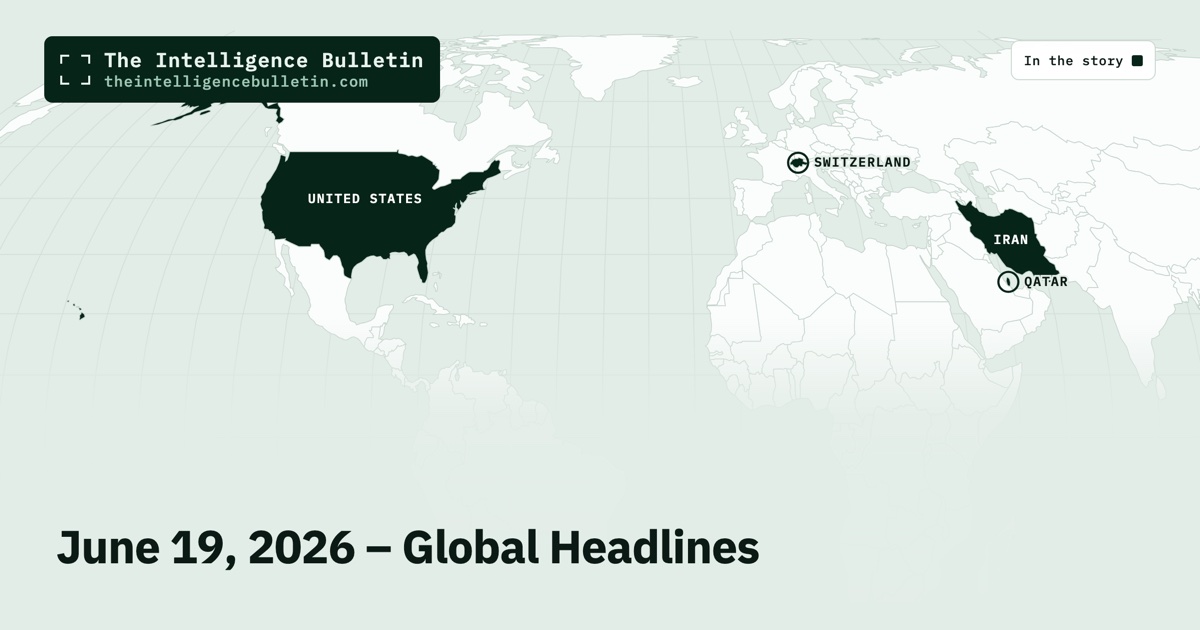
The postponement of Vance’s flight underscores how fragile the current US-Iran channel remains even after weeks of Qatari shuttle diplomacy. New York Post coverage centers on the abrupt cancellation itself and the domestic optics for the vice president, treating the event as a straightforward scheduling failure. Jerusalem Post instead stresses the resulting uncertainty for the talks, framing the delay against Israel’s longstanding concerns over any US-Iran understanding that might leave regional security questions unresolved. Arab News places the same announcement in a Gulf context, noting how any slowdown affects Riyadh’s calculations about Iranian leverage and potential sanctions relief. Across these accounts the factual core stays consistent, yet each outlet’s emphasis reveals the different stakes it sees in whether the diplomacy advances or stalls. Prior coverage of drone downings and Trump’s public defense of the emerging deal shows the pattern: every incremental step is immediately tested by competing regional priorities that make even a logistical hitch read as a signal.
2Khamenei Approves US-Iran Nuclear Framework Despite Initial Doubts
Khamenei’s endorsement marks the clearest public signal yet that Tehran is prepared to lock in the framework even after earlier resistance. Iranian state media immediately cast the statement as a decisive guarantee of national victory, turning the Supreme Leader’s reluctant shift into proof of strength rather than concession. US coverage split along familiar lines. One outlet highlighted the practical mechanics of a 60-day clock and the immediate relief of lifted port restrictions, treating the story as the start of an implementation phase rather than a political breakthrough. Another outlet led with Trump’s explicit caution that Tehran will lie and cheat, presenting the diplomacy as a calculated gamble whose success hinges on verification that has repeatedly failed before. This divergence is not accidental. Iranian reporting must demonstrate that the Leader’s word overrides any domestic skepticism. American conservative framing must remind readers that past nuclear diplomacy produced unverifiable commitments. The public-radio emphasis on timelines and blockade relief reflects a narrower institutional focus on measurable next steps. The underlying continuity is that the same sequence of drone incidents, frozen-asset threats, and Qatari shuttling has now produced a document whose durability remains the only real question.
3US Backs Venezuela Talks Between Figuera and Rodríguez
All three outlets treat the Rodríguez-Figuera encounter as a concrete event rather than speculation, which itself signals that both sides see value in publicizing contact at this moment. Diariolasamericas frames Figuera’s return from exile as the central development, consistent with a Miami readership attuned to opposition figures re-entering the country. Correodelcaroni quotes Figuera directly crediting the State Department invitation, underscoring the US role that opposition readers in Venezuela often highlight when dialogue surfaces. Radiomundial, by contrast, leads with Rodríguez as institutional authority and presents the table as a routine strengthening of National Assembly processes. The shared factual core—two named politicians met, the United States commented positively—reveals that no outlet is denying the meeting occurred or inventing US involvement; the divergence lies only in which actor is cast as the protagonist. This convergence on the basics across exile, regional opposition, and state media suggests the dialogue channel carries enough weight that each side prefers to shape its meaning rather than suppress the story.
4Meloni Rejects Trump Photo Claim, Italy Cancels US Trip
The episode registers less as a bilateral crisis than as a brief assertion of Italian dignity inside a week dominated by US-Iran negotiations. What stands out across the three outlets is how little any of them treat the cancellation itself as the central event; instead each uses the spat to illustrate something larger about Meloni’s posture. La Vanguardia lingers on the personal sharpness of her rebuttal, framing it as a domestic political necessity for a leader whose coalition includes figures wary of appearing too close to Washington. South China Morning Post records the same facts but places the cancelled trip at the centre, presenting the move as evidence that even minor personal friction can disrupt scheduled diplomacy when both sides are already managing far more consequential files. The Daily Mail goes furthest, folding Meloni’s denial into a broader swipe at Trump’s reported ties to adversaries, thereby turning the story into another data point in its running narrative of Western cohesion under strain. The convergence on the core sequence—Trump spoke, Meloni answered, Tajani stayed home—suggests the outlets see the same limited diplomatic cost; the divergence lies in which audience each outlet believes needs reminding that personal slights still register in Rome even while nuclear talks proceed elsewhere.
5Iran Ties US Peace Deal to Full Israeli Withdrawal from Lebanon
The most striking element is how uniformly the outlets treat Iran’s withdrawal demand as the central new fact, yet each selects a different actor to foreground as the obstacle. Israel National News leads with Netanyahu’s flat refusal, presenting the Israeli position as the decisive and non-negotiable stance that closes the matter. Anadolu Agency instead details Israel’s operational plan for a permanent 10-km zone, framing the story around the concrete military footprint that would remain even after a US-Iran accord. El Tiempo, by contrast, centers Iran’s explicit threat to nullify the deal, casting the conditional language itself as the active diplomatic lever. These choices track national vantage points: the Israeli outlet reports government resolve, the Turkish outlet registers the buffer zone as a regional security fact, and the Colombian outlet registers the Iranian condition as the variable that could still unravel the agreement. The pattern reveals less disagreement over facts than over which capital’s next move is treated as the story’s hinge. Continuity with earlier TIB reporting on postponed US-Iran talks in Switzerland makes the Lebanon linkage appear as the latest external constraint inserted into a process already marked by sequential delays and third-party mediation.
That’s how the world told the story.
Get our daily open-source intelligence on world events in your inbox — one email a day, up to six stories.
Subscribe freeNo spam. One-click unsubscribe. See the latest email →