 AI-generated analysis published under the editorial responsibility of Rohit Sinnas. How it works →
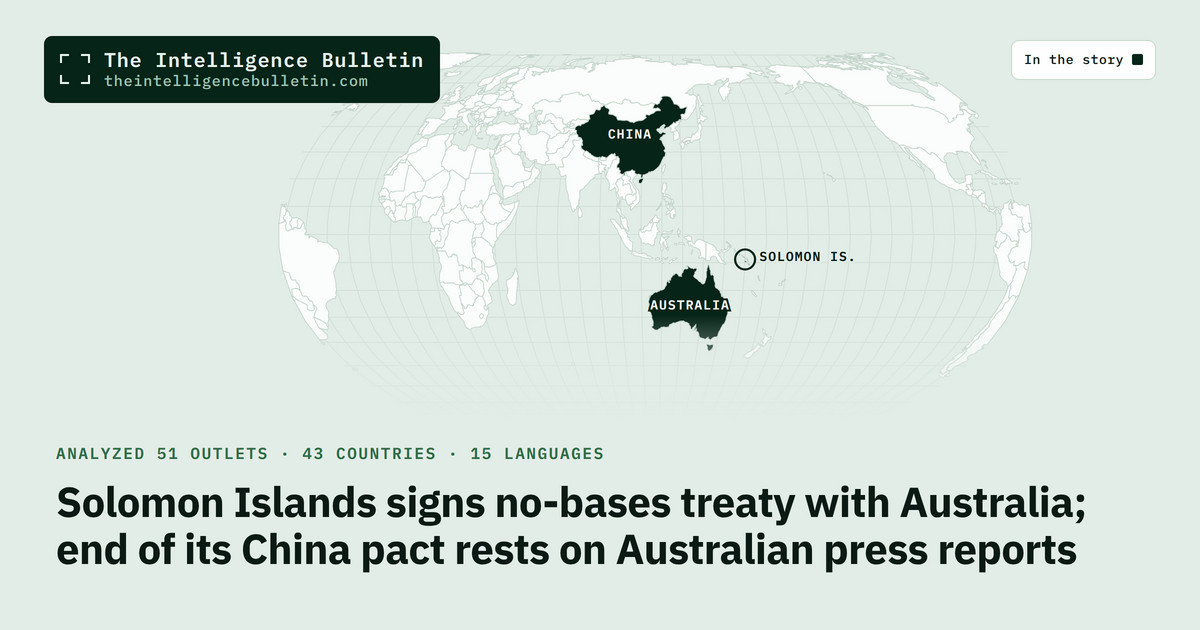
See the 43 countries
Argentina, Australia, Austria, Bahrain, Cambodia, Canada, China, Cyprus, Egypt, Fiji, Germany, Ghana, Hong Kong, Hungary, India, Israel, Lithuania, Malaysia, Netherlands, New Caledonia, New Zealand, Nigeria, Pakistan, Poland, Portugal, Qatar, Russia, Saudi Arabia, Singapore, Solomon Islands, Somalia, South Africa, South Korea, Spain, Syria, Taiwan, Thailand, Turkey, Tuvalu, United Kingdom, United States, Uruguay, Vietnam
Solomon Islands signed a treaty in Canberra legally barring foreign military bases and steering security cooperation to Pacific Islands Forum members. ABC and Sydney Morning Herald sources say Honiara won’t renew its 2022 China pact; Prime Minister Wale declines to confirm, citing non-disclosure.
Across the press: ABC and the Sydney Morning Herald report Honiara dropping its China pact; the Solomon Times carries opposition leader Sogavare calling its status ‘unclear.’
Source base: 5 outlets quoted (Solomon Islands, Australia, Singapore, New Zealand, Taiwan), selected from 51 analyzed. 4 read in full, 1 by its headline only.
- 1 of 5 · ABC News (Australia) onlyThe treaty does not explicitly bar outside security partners such as China; it directs Solomon Islands to seek security cooperation from Pacific Islands Forum members and permits other partnerships for needs the Forum cannot meet, provided regional security is safeguarded.ABC, quoting treaty text; RNZ’s joint-statement account, that Honiara ‘would look to Forum members’ and keeps its capacity to choose partners, is consistent but less specific
- 1 of 5 · ABC News (Australia) onlyAsked in Canberra, Wale declined to confirm that the China pact would end, saying a non-disclosure clause covers the China security pact and policing agreement.ABC, quoting Wale at Parliament House
- 2 of 5 · reported separatelyAlbanese and Wale signed the Australia–Solomon Islands Treaty in Canberra on November 25, under which Solomon Islands commits never to host a foreign military or security base and to keep sensitive infrastructure free from militarization, foreign interference and unauthorized access.ABC, quoting the treaty text; RNZ, quoting the leaders’ joint statement
- 3 of 5 · reported separatelyWale’s government has told Beijing it will not renew the 2022 China security pact when it expires in April 2027.ABC’s own sources; RNZ citing ABC; Taipei Times citing a Sydney Morning Herald report that Beijing was told last month
- 3 of 5 · reported separatelyOpposition leader Manasseh Sogavare, who signed the 2022 Beijing pact, has publicly challenged the treaty push, warning against dropping the China deal and questioning the trip’s cost and the treaty’s difference from the 2017 security treaty.Solomon Times, reporting Sogavare’s statement; ABC and RNZ, reporting his Monday warning
- Coming days and weeksBeijing’s first on-record reaction to the signed treaty, which this reporting does not yet contain.
- April 2027The 2022 China security pact reaches its expiry date, when a lapse or renewal would become visible.
Full analysis
What happened Why it matters How each country tells it Room for disagreement Our assessment Sources and evidence
What happened
In Canberra on Wednesday, November 25, Australian Prime Minister Anthony Albanese and Solomon Islands Prime Minister Matthew Wale signed the Australia–Solomon Islands Treaty. ABC News quoted the treaty text directly. Under it, Honiara undertakes never to "permit its territory to be used for any foreign military or security base." It also commits that "its sensitive infrastructure shall remain free from militarisation, any form of foreign interference or unauthorised access." RNZ, working from the leaders’ joint statement, reports the same commitments. ABC adds that the treaty requires Solomon Islands to consult Australia on national security and sensitive infrastructure.
The security clauses come with money and access. Albanese said Australia would open migration pathways for Solomon Islanders to work in aged care and child care. Australia will also liberalize visa arrangements and fund development priorities, including Wale’s free education policy. According to RNZ, the joint statement commits Australia to building "a stronger, modern, and self-reliant" Royal Solomon Islands Police Force and to supporting the country’s border management system.
The clause that bears most directly on China is narrower than the headlines suggest. ABC reports that the treaty does not explicitly ban security partnerships with outside players. Instead, Solomon Islands will "ensure security cooperation comes from Pacific Islands Forum [PIF] members." If it forms partnerships for "security needs unable to be met by PIF members," it must safeguard regional security. RNZ’s version is consistent but less specific: Honiara would look to Forum members while keeping its capacity to determine its own security needs and partnerships. Albanese said the text states "very clearly that Australia remains the Solomon Islands’ security partner of choice."
The target in everyone’s mind is the Framework Agreement on Security Cooperation with Beijing. Manasseh Sogavare signed it as prime minister in April 2022, and its text has never been published. Taipei Times, in copy that reads as agency text, reports that leaked drafts allowed the deployment of China’s military. Albanese took office the month after that deal was signed. Wale took office in May and promised in June to review it. By Taipei Times’s count, the Canberra meeting was his fourth with Albanese in five months, following a September announcement that the two sides aimed to finalize a pact.
On the eve of the signing, two Australian outlets reported that Wale’s government had told China it would not renew the 2022 agreement when it expires in April 2027. ABC reported this on its own sources. The Sydney Morning Herald, as cited by Taipei Times, said Beijing was informed last month. RNZ attributes its account of the same point to ABC. Asked at Parliament House, Wale would not confirm it: "unfortunately, there is a non-disclosure clause in the treaty with China, the security pact and the policing agreement." He did say that under the previous government, Solomon Islands had been "a source of uncertainty and doubt in the region."
The only Chinese government voice in this reporting predates the signing. Asked about the Herald’s report, foreign ministry spokesman Guo Jiakun said China’s cooperation with Pacific island countries "is not for geopolitical contest nor bloc confrontation."
In Honiara, the treaty landed in domestic politics. The Solomon Times reports Sogavare, now opposition leader, questioning the 24-member delegation Wale took to Canberra. By his count, it included ministers, MPs, political appointees and three ministerial spouses, and he demanded that its full cost be published. He set the trip against families still rebuilding eight months after Tropical Cyclone Maila, despite a SBD$75 million program meant to rebuild about 1,300 houses, and against a National Referral Hospital short of water. He asked how the treaty differs from the 2017 bilateral security treaty. He also asked why it was being fast-tracked while the China arrangement’s status, review and future direction remained "unclear." ABC reports that he warned on Monday that scrapping the China policing pact could undermine development ties with Beijing. Wale survived an aborted no-confidence motion earlier this year. He said his cabinet and caucus had been unanimous: "I welcome another motion of no confidence. I look forward to it."
Why it matters
For Canberra, the treaty completes what Taipei Times calls a security arc to Australia’s north. It follows deals with Fiji, Nauru, Papua New Guinea, Tuvalu, Vanuatu, Indonesia and East Timor, many of which name Australia as primary security partner. Oliver Nobetau of the Lowy Institute, quoted by RNZ from an ABC interview, called Solomon Islands turning from China "the holy grail" of Albanese’s Pacific engagement. Former high commissioner Lachlan Strahan’s remark to ABC identifies what is actually new. Sogavare "was true to his word not to allow a Chinese base," he said, "but it is much better to have a formal legal commitment to such a bar."
That distinction is the one to hold. The legally binding part is the no-bases pledge and the Forum-first rule. The part that would make this a reversal of 2022 is the lapse of the Beijing pact. That lapse is not in the treaty, Honiara has not stated it on the record, and it rests on two Australian outlets’ sourcing. The treaty also leaves a marked door for needs the Forum cannot meet. China is not a Forum member, so any future Chinese policing help would have to pass through that clause. The text as reported does not say who decides whether regional security has been safeguarded.
The reporting also lacks a vantage that matters. No mainland Chinese press account or post-signing Beijing reaction appears in it. Lianhe Zaobao’s article could not be read beyond its headline, which says only that the treaty is "seen as" a check on China.
How each country tells it
- Solomon Times · Solomon Islands · original reportingLeads with opposition leader Manasseh Sogavare attacking the cost of Prime Minister Wale’s 24-member Canberra delegation and asking how the ‘proposed’ treaty differs from the 2017 Australia–Solomon Islands security treaty, and why it is being fast-tracked while the China arrangement’s status is ‘unclear.’
- ABC News (Australia) · Australia · original reportingReports the signing as a historic Australian diplomatic win and quotes treaty language directly: no foreign military or security base, sensitive infrastructure free from ‘militarisation,’ a duty to consult Australia on security and sensitive infrastructure, and labor-mobility and education funding.
- Lianhe Zaobao · Singapore · original reportingIts headline says the comprehensive treaty is ‘seen as’ a check on China, attributing the strategic reading to others rather than asserting it.
- RNZ · New Zealand · original reportingBuilt mainly on the leaders’ joint statement, it leads with the concrete term of keeping foreign military bases out and stresses the treaty’s language on Solomon Islands’ sovereignty and Pacific Islands Forum-led security.
- Taipei Times · Taiwan · wire copyWritten on the eve of signing, it frames the deal as the final link in an Australian ‘security arc’ meant to limit Chinese access, citing a Sydney Morning Herald report that Honiara told Beijing last month it would not renew the 2022 pact.
Room for disagreement
The strongest case against counting on a clean break comes from the Solomons itself. Strahan, who calls the treaty a major step forward, also told ABC that "Solomons’ politics is inherently volatile." He said that Wale’s numbers are strong because he "recently peeled away several members of the opposition." He warned that with weak parties and many independents, configurations shift "sometimes quite suddenly." Sogavare’s position, quoted by RNZ, is that Honiara "must be able to work with China, Australia, the United States and other countries." The Solomon Times carries him insisting the opposition is not questioning ties with Australia. That is a platform a successor government could stand on without tearing up the treaty, renewing or replacing a Beijing arrangement through the PIF-unmet clause. A government that never announced the lapse would not have to announce its reversal.
Our assessment
It is likely that the 2022 China security pact lapses in April 2027 without renewal, but the treaty’s no-bases clause, not the lapse, is what is built to outlast Wale. The warrant for the lapse is two independent reporting chains, ABC’s and the Herald’s, converging on the same decision. Wale’s on-record response was a confidentiality citation rather than a denial, and he paired it with a pointed rebuke of his predecessor’s "uncertainty and doubt." Interests cut both ways. ABC describes Canberra as careful not to boast while privately counting a major win, and Australian sourcing suits that win. Wale benefits from appearing to deliver without breaching his Beijing confidentiality. Sogavare benefits from keeping the question "unclear." What makes the no-bases bar the sturdier outcome is that it sits in a signed, legally binding text that a new government would have to break openly. The lapse, by contrast, is an unannounced choice that a new government could quietly undo.
What would change this: a successful no-confidence motion before April 2027 that installs a government aligned with Sogavare, or any public word from Honiara or Beijing that renewal talks are under way.
Sources and evidence
Press quoted
- Will the Solomon Islands government formally and publicly confirm that the 2022 security pact and the separate Chinese policing agreement will lapse in April, rather than leaving that to Australian press reports?
- What does the obligation to consult Australia on national security and sensitive infrastructure require in practice, and will the full treaty text be published?
- How will Beijing respond now that the treaty is signed, given that the only Chinese comment in these reports came before the signing?
That’s how the world told the story.
Get our daily open-source intelligence on world events in your inbox — one email a day, up to six stories.
Subscribe freeNo spam. One-click unsubscribe. See the latest email →