 AI-generated analysis published under the editorial responsibility of Rohit Sinnas. How it works →
See the 57 countries
Afghanistan, Argentina, Armenia, Australia, Austria, Azerbaijan, Bahrain, Bangladesh, Belgium, Brazil, Bulgaria, Canada, China, Cyprus, Egypt, France, Germany, Greece, Hungary, India, Iran, Iraq, Italy, Jordan, Kazakhstan, Kenya, Lebanon, Libya, Macedonia, Madagascar, Netherlands, Nigeria, Oman, Pakistan, Poland, Portugal, Qatar, Romania, Russia, Serbia, Slovakia, Slovenia, Somalia, South Korea, Sudan, Switzerland, Syria, Tajikistan, Tunisia, Turkey, Tuvalu, Ukraine, United Arab Emirates, United Kingdom, United States, Uzbekistan, Yemen
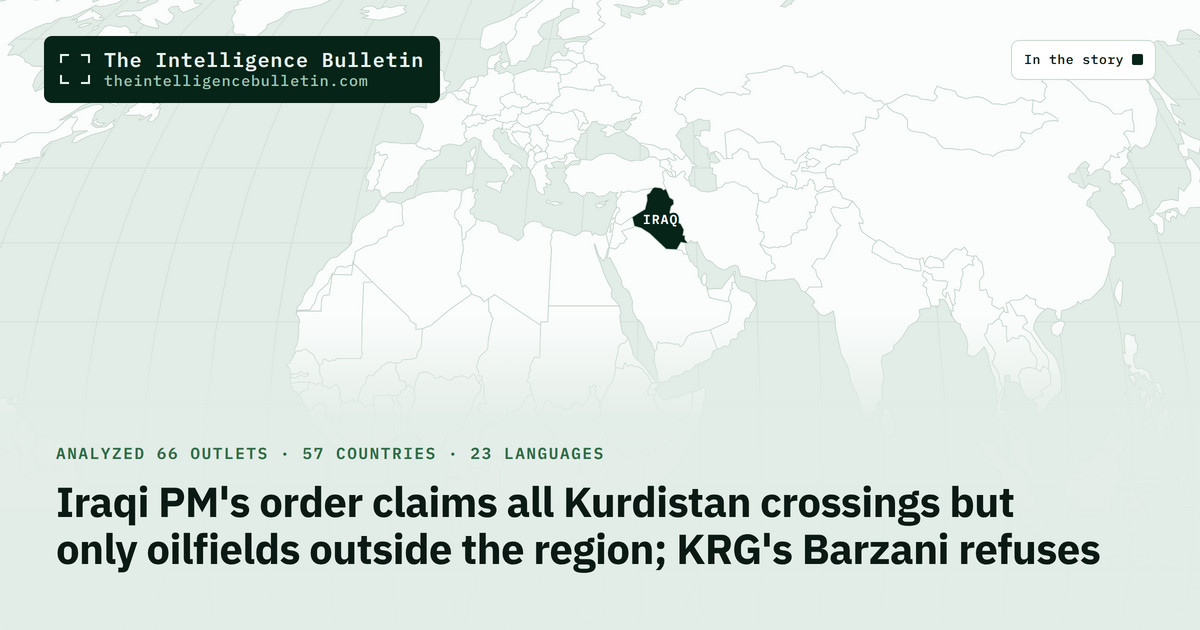
Iraqi Prime Minister Ali al-Zaidi on November 24 ordered federal control of all Kurdistan Region border crossings, oil-export approvals and Kurdish-held fields in four provinces; KRG Prime Minister Masrour Barzani called it unacceptable but kept talks open. No source reports enforcement yet.
Across the press: Only Al-Montasaf, citing one unnamed source, reports a Peshmerga resistance warning; Masrour Barzani’s on-record Erbil remarks, reported by Non14, kept the door to talks open.
Source base: 5 outlets read in full (Iraq, Turkey, United Arab Emirates, Russia, Yemen), selected from 66 analyzed.
- 1 of 5 · Al-Montasaf onlyErbil told Baghdad that any attempt to send federal security forces into the region would meet Peshmerga resistance, and mediation is under way.Al-Montasaf, citing an unnamed source
- 1 of 5 · The National onlyDays before the order, Baghdad’s four demands, carried to Erbil by PMF chairman Falih al-Fayyadh, sought army units on the region’s borders, a neutral international company to run its crossings with Iran and Turkey, and exclusive federal control of the region’s entire oil sector.The National, citing four sources in Baghdad and Kurdistan
- 3 of 5 · reported separatelyOn November 24, Prime Minister Ali al-Zaidi ordered the federal Oil Ministry to take over management of its fields in Kirkuk, Nineveh, Salahuddin and Diyala provinces that sit in areas under Kurdish security control.Non14 News; Prime, relaying 964media’s publication of a statement by spokesman Sabah al-Numan; Al-Montasaf, unattributed
- 3 of 5 · reported separatelyThe same order transfers all border crossings in the Kurdistan Region to the federal Border Ports Commission and makes the federal Oil Ministry the only authority that can approve exports of crude and oil products.Non14 News; Prime via 964media; Al-Montasaf
- 2 of 5 · reported separatelyKRG Prime Minister Masrour Barzani publicly rejected the decisions as unacceptable and contrary to earlier understandings with Baghdad.Non14 News, reporting his Erbil press conference; Al-Montasaf, quoting him as calling it ‘completely unacceptable’
- Coming daysWhether Border Ports Commission staff or federal guards actually take over any Kurdistan crossing or Kurdish-held field, the first test of enforceability.
- As mediation proceedsWhether the mediation Al-Montasaf reports produces a deal or collapses, which decides whether the dispute stays political.
- Formation of the new KRG cabinetWhether Kurdish parties close ranks as Masrour Barzani urged, shaping how much resistance Erbil can sustain.
Full analysis
What happened Why it matters How each country tells it Room for disagreement Our assessment Sources and evidence
What happened
On Tuesday, November 24, Iraqi Prime Minister Ali al-Zaidi issued a package of decisions aimed at the oil and borders of the Kurdistan Region. The federal Oil Ministry is to take over management of its fields in Kirkuk, Nineveh, Salahuddin and Diyala that lie in areas under Kurdish security control. The federal Border Ports Commission is to take over every border crossing inside the region. And only the federal Oil Ministry may now approve exports of crude and oil products. Russia’s Prime relayed the text from a statement by Sabah al-Numan, spokesman for the commander-in-chief, as published by the Iraqi platform 964media: "Transfer all border crossing points on the territory of Iraqi Kurdistan to the management of the Federal Border Ports Commission."
The order reaches past paperwork. Non14 and Prime both report that the Defense Ministry was told to close unofficial roads between the four provinces and the region. Prime alone reports that border guards must shut all unofficial crossings with neighboring states, including those in Kurdistan, and that the Interior Ministry must guard every oilfield and fit them with surveillance cameras. Non14 alone reports that a number of security and oil officials were dismissed or relieved and others referred for investigation. Non14 and Al-Montasaf tie the decisions to an investigation into oil smuggling at the federal North Oil Company. Prime places them after a nationwide anti-smuggling campaign launched about two weeks earlier, in which authorities set up special investigative commissions, detained suspects and suspended officials.
The days before were a steady climb. The National, writing before the order, reports an interview Oil Minister Basim Khudair gave a state news agency late on Monday, in which he said the Kurdistan Regional Government "has taken control" of North Oil Company fields, "in addition to smuggling operations from other areas," and that the ministry "believes that these fields should be managed federally." According to four sources the paper cites in Baghdad and Kurdistan, al-Zaidi had on Saturday sent four demands to Erbil through Popular Mobilisation Forces chairman Falih al-Fayyadh: army units on the region’s international borders, a neutral international company to run its crossings with Iran and Turkey, and exclusive federal control of its entire oil sector. Masoud Barzani, the Kurdistan Democratic Party leader, answered that the issues were "resolvable within the framework of the constitution." On Sunday, al-Zaidi’s office said the government was "proceeding with plans to extend state authority." Set beside those reported demands, Tuesday’s order hands crossings to Baghdad’s own commission rather than a neutral operator, while limiting the field takeover to four provinces outside the region’s own governorates.
Erbil answered within hours. At a press conference reported by Non14, KRG Prime Minister Masrour Barzani said what came from Baghdad "surprised us" because it broke with understandings from earlier talks and "cannot be accepted in any way." In the same appearance he said the door to negotiation remained open on a constitutional basis, cited progress on gas, complained of repeated unkept promises and appealed to the international community. With a new regional government still being formed, he urged Kurdish parties to set aside their differences and "all be Peshmerga" to protect the region. Al-Montasaf reports a joint KDP-PUK statement calling any violation of the region’s rights a "red line," and, citing one unnamed source, says Erbil warned that federal security forces entering the region would meet Peshmerga resistance, with mediation under way. The Turkish outlet İslami Davet published a translation of a message titled "President Barzani’s Message," which invokes the Anfal campaigns and chemical attacks, says the Kurds backed al-Zaidi from the start and cooperated in his anti-corruption drive, offers cooperation against smuggling through constitutional channels, and vows not to submit to unconstitutional decisions.
The quarrel is old. The Kurds hold that the constitution lets them sign oil deals without Baghdad; federal authorities call that illegal. In 2022 Iraq’s Federal Supreme Court struck down the region’s oil law and ordered it to hand all oil activity, including exports, to Baghdad, and a year later an arbitration ruling halted the region’s exports through Turkey.
Why it matters
The order turns a budget-and-courtroom fight into one over physical places: roads, crossings, wellheads and the cameras on them, which are precisely where federal personnel and Peshmerga would meet. That is the risk the anonymous warning in Al-Montasaf points to.
It also lines up with the money. The draft 2027 budget The National saw keeps the region at 12.7 percent of spending, requires at least 400,000 barrels per day through the state marketer SOMO, obliges Erbil to hand over non-oil revenue, and lets the Finance Ministry release monthly funds only after compliance. Federal export approval and federal crossings would give Baghdad the meters on both revenue streams the budget is trying to capture. Erbil faces this while its own parties are still negotiating a government.
The reporting leaves real gaps. No source carries a reaction from Ankara, though the crossings with Turkey and the suspended pipeline route are at stake, and none carries a word from Washington. The only Turkish-language item is a translation of a Kurdish statement. No source reports a federal reply to Barzani, and none describes any official yet taking over a crossing or field.
How each country tells it
- Non14 News · Iraq · original reportingBuilt around Masrour Barzani’s Erbil press conference, where he said Baghdad’s move ‘surprised us’ because it broke with understandings from earlier talks and ‘cannot be accepted in any way,’ followed by the fullest list of what Prime Minister Ali al-Zaidi ordered.
- İslami Davet · Turkey · carries Office of Masoud BarzaniUnder a headline mocking people who cheered the disarming of Kataib Hezbollah but now invoke ‘rights and law’ for Barzani, the body is a full Turkish translation of a message titled ‘President Barzani’s Message’ invoking Anfal, the chemical attacks and Kurdish sacrifice, and vowing the region will not submit to unconstitutional decisions.
- The National · United Arab Emirates · original reportingWritten before the order was announced, it reports Oil Minister Basim Khudair’s state-agency interview accusing the Kurdistan Regional Government of seizing North Oil Company fields, and Baghdad’s escalating demands on Erbil.
- Prime · Russia · carries 964mediaA Moscow-datelined business-agency item that leads with the handover of all Kurdistan border crossings to the Federal Border Ports Commission, quoting a statement by Sabah al-Numan, spokesman for the commander-in-chief.
- Al-Montasaf · YemenLeads with Erbil warning Baghdad that any attempt by federal security forces to enter will meet Peshmerga resistance, and adds that mediation is under way.
Room for disagreement
The strongest case against a negotiated fade is Baghdad’s own sequence: demands on Saturday, a pledge to extend state authority on Sunday, a minister’s accusation on Monday, a signed order on Tuesday. Each step was harder than the last. The order names ministries and tasks rather than principles, and the dismissals Non14 reports show it already has teeth inside federal ranks. Its legal footing is strongest exactly where it bites: fields owned by North Oil Company, in provinces outside the region, backed by the 2022 ruling and wrapped in an anti-smuggling inquiry that Barzani’s own message says Erbil supports. Facing a divided Kurdish leadership and holding the budget purse, al-Zaidi may judge that he can take the fields and crossings and let Erbil protest.
Our assessment
It is likely that the order serves as an opening position folded into the 2027 budget negotiation rather than a takeover carried out in full on the ground in the coming weeks. The warrant is on the record: Masrour Barzani paired his refusal with an explicit offer to keep talking and news of progress on gas, while the only threat of armed resistance rests on one unnamed source who also reports mediation. The overlap between the order’s export clause and the draft budget’s compliance conditions suggests Baghdad wants leverage it can trade, and its retreat on oil from the entire sector, as The National’s sources described the weekend demands, to four provinces signals calculation rather than maximalism. Baghdad has an interest in looking unstoppable and Erbil in looking immovable; neither posture yet matches what either has done. The crossings are the likeliest piece to stick, the Kurdish-held fields the likeliest to be bargained.
What would change this: federal border staff or security forces taking over a Kurdistan crossing or Kurdish-held field without an agreement, or the reported mediation collapsing.
Sources and evidence
Press quoted
- Will Oil Ministry staff or federal forces actually move into the fields in Kirkuk, Nineveh, Salahuddin and Diyala, and will the Peshmerga resist them as Al-Montasaf’s unnamed source warns?
- Which specific North Oil Company fields does the order cover, and who is pumping and selling their crude today?
- Does making the federal Oil Ministry the sole approver of exports stop any crude the Kurdistan Region now ships through Turkey, and how does it fit the draft 2027 budget’s requirement of at least 400,000 barrels per day through SOMO?
That’s how the world told the story.
Get our daily open-source intelligence on world events in your inbox — one email a day, up to six stories.
Subscribe freeNo spam. One-click unsubscribe. See the latest email →