 AI-generated analysis published under the editorial responsibility of Rohit Sinnas. How it works →
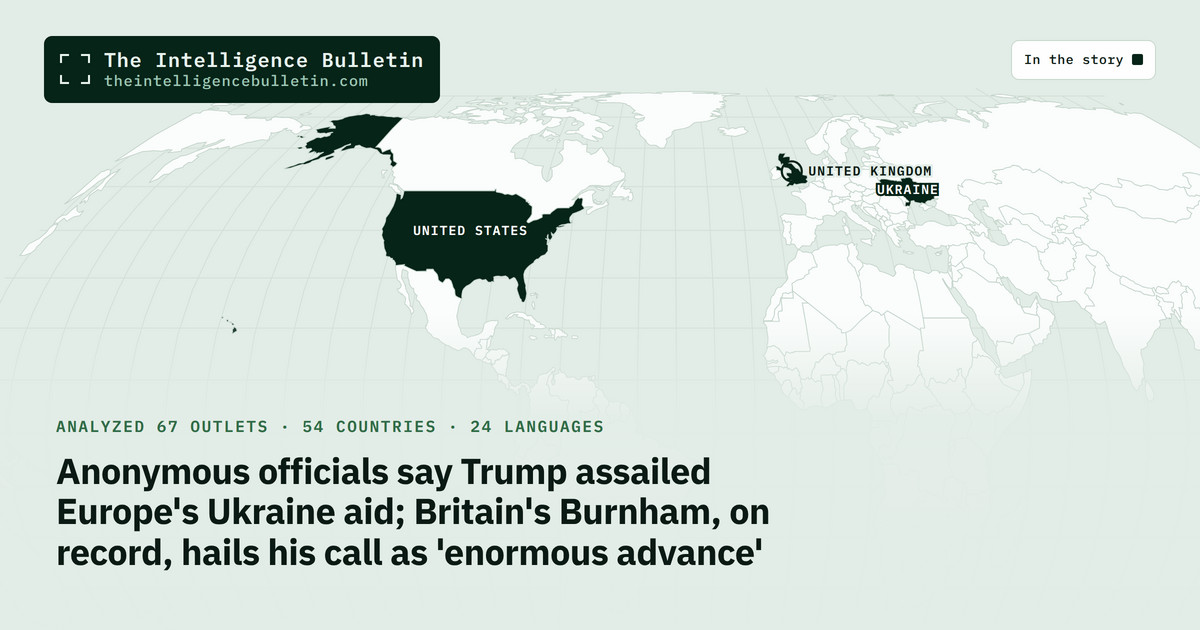
See the 54 countries
Argentina, Australia, Austria, Azerbaijan, Bangladesh, Bosnia and Herzegovina, Bulgaria, China, Croatia, Cuba, Cyprus, Czech Republic, Denmark, Egypt, Finland, France, Georgia, Germany, Greece, India, Indonesia, Ireland, Israel, Italy, Kenya, Latvia, Lithuania, Luxembourg, Moldova, Morocco, Nigeria, Norway, Oman, Pakistan, Philippines, Poland, Portugal, Qatar, Romania, Russia, Saudi Arabia, Serbia, Slovakia, Slovenia, South Africa, South Korea, Spain, Sweden, Switzerland, Trinidad and Tobago, Turkey, Ukraine, United Kingdom, United States
Trump phoned the Berlin Ukraine summit from Air Force One; anonymous officials say he attacked European plans to cover Ukraine’s €70bn 2027 gap. Burnham, on record, called it an advance. Clarín says Putin canceled his Moscow invitation; the Telegraph reports it open.
Across the press: Only Clarín quotes a participant on record, Burnham calling Trump’s call "an enormous advance," while the "tirade" account rests on anonymous officials.
Source base: 5 outlets quoted (United Kingdom, Germany, Poland, Argentina, Italy), selected from 67 analyzed. 4 read in full, 1 by its headline only.
- DisputedPutin’s invitation for European negotiators to come to Moscow remains open, with Russia having agreed to a multilateral format with Europe.Source: The Telegraph and Giornale di Sicilia report the invitation without any withdrawal, and Giornale di Sicilia and Deutschlandfunk quote Kushner saying Russia is ready to negotiate with Europe; Clarín reports that Putin canceled both the negotiations and the invitation after the Crimean bridge strike.
- 2 of 5 · one shared reportTwo officials described Trump’s remarks as a ‘tirade’ against plans to cover Ukraine’s €70bn 2027 gap, with Trump saying ‘Putin wants peace’ and that effort should go into negotiations instead of more funding, while a third said he only stressed what countries would save if the war ended.Unnamed officials, as carried by the Telegraph and Clarín in the same breakdown; only Clarín carries the ‘Putin wants peace’ line.
- 1 of 5 · Clarín onlyAsked whether Trump was too optimistic, British Prime Minister Andy Burnham said ‘not at all’ and said Trump’s phone call ‘highlighted an enormous advance,’ because no decision on Ukraine or European security is now taken without Ukraine and Europe present.Burnham on the record at the Berlin press conference, as quoted by Clarín; the Telegraph quotes other Burnham remarks from the same appearance but not these.
- 3 of 5 · reported separatelyTrump joined the Coalition of the Willing meeting in Berlin by phone from Air Force One, through Jared Kushner’s phone, and criticized European plans to keep financing Ukraine.The Telegraph citing unnamed sources; Clarín citing three officials; Giornale di Sicilia citing Politico Germany and Welt. The Telegraph and Clarín carry an identical three-source breakdown and may share one origin.
- 3 of 5 · reported separatelyKushner told the press in Berlin that Trump is open to giving Ukraine an Article 5-style security guarantee and wants a deal with Europe at his side rather than imposing one.Kushner on the record, as quoted by Clarín and Giornale di Sicilia; Deutschlandfunk carries the ‘Europe at his side’ line.
- Coming daysRussia’s promised "painful" response to the Kerch Bridge strikes will test whether any Moscow channel to Europe survives.
- Before ChristmasGerman Foreign Minister Wadephul expects peace talks to resume with seven European representatives, possibly in the United Arab Emirates.
- EU 2028–2034 budget negotiationsGermany’s push for qualified-majority voting on Ukraine aid would decide whether one government can block future funding.
- AnsweredThe Telegraph reports that Trump held a private one-on-one with Putin, who said it went ‘even better than expected,’ and Giornale di Sicilia, citing Politico Germany and Welt, says Trump told Berlin the talk went ‘well’ and would help peace in Ukraine; the format of the meeting is not described.
- AnsweredAccording to the Telegraph, the leaders announced four points, including that nuclear wars must ‘never’ be fought, with no breakthrough on arms reductions.
- AnsweredClarín says the war was a subject of debate at the Shenzhen summit, while the Telegraph says the agreements brought no breakthrough on Ukraine.
- Still openWhat did the Berlin summit actually conclude: was there a joint statement, and did Burnham formally announce the 1,000-drone package that British officials previewed? · What did Witkoff and Kushner tell the coalition about Shenzhen, and does Washington back Putin s proposal that European officials come to Moscow to discuss whether they join the talks?
- 19 Nov · As Berlin allies plan Ukraine s postwar force, Putin invites Europeans to Moscow but rules out Europe-Ukraine military ties
- 19 Nov · Per Chinese state media s text, Xi, Trump and Putin pledged more fuel in Shenzhen, not arms cuts
- 19 Nov · Kremlin says Putin briefed Xi on Ukraine before Trump talks; Xinhua s readout never mentions the war
- 18 Nov · Putin condemns sanctions and tariffs in Shenzhen as Xi pledges open trade and courts Trump before three-way talks
Full analysis
What happened Why it matters How each country tells it Where accounts conflict Room for disagreement Our assessment Sources and evidence
What happened
On November 19, hours after the first three-way talks among the leaders of the United States, China and Russia ended in Shenzhen, Donald Trump called into the Coalition of the Willing meeting in Berlin from Air Force One. His voice came through the phone of Jared Kushner, his son-in-law and special envoy. Kushner was at the Chancellery with fellow envoy Steve Witkoff, Volodymyr Zelensky and the leaders of the European governments backing Kyiv.
What Trump said is known only through people who heard it. The Telegraph and Clarín carry the same breakdown from three officials, close enough in wording that it may come from one source. Two of the officials described his remarks as a "tirade" against plans by the EU and Ukraine’s other supporters to cover the country’s €70 billion financing gap for 2027. The third said Trump was only stressing how much countries would save once the war ended. Clarín adds that two officials heard Trump say "Putin wants peace" and argue that effort should go into negotiations rather than more money for Ukraine. Giornale di Sicilia, citing Politico Germany and Welt, describes the call as a reassurance that his talk with Putin went "well" and would help peace, together with criticism of the EU for supplying further billions. No outlet quotes Trump himself. The Telegraph’s opening line, that he "told European leaders to withhold funding," goes beyond what its sources are quoted saying. Giornale di Sicilia’s headline quote, "Basta soldi per armi a Kiev," does not appear in its article.
The money at stake is specific. Deutschlandfunk reports that the European Commission has proposed a further €45 billion loan to cover part of Ukraine’s needs next year. Green lawmaker Hofreiter told the Augsburger Allgemeine that roughly €70 billion is missing, the same order as the gap the officials cited. Citing Reuters, the broadcaster also reports that the German government wants decisions on higher Ukraine aid in the EU’s 2028–2034 budget taken by qualified majority, which would remove any single member’s veto. Before the meeting, Britain pledged about €312 million in military aid, including more than 1,000 long-range attack drones.
Trump arrived from a summit he rated "a 12" out of 10. The Telegraph reports that the three leaders agreed on four points: reforming the UN, increasing energy flows, agreeing that nuclear wars must "never" be fought, and agreeing that international criminal courts should not "abuse" their powers. The paper reports no breakthrough on Ukraine. Putin said his separate meeting with Trump had gone "even better than expected." He then told a press conference that Russia would not tolerate coalition troops in Ukraine.
Berlin answered in public. Merz called Shenzhen "a photo opportunity" and handed each leader a piece of the Berlin Wall. Deutschlandfunk reports him saying that Europe would not be divided again. Clarín quotes him saying that talks among Ukraine, Russia, the US and several European countries are planned soon on neutral ground, possibly in the United Arab Emirates. Macron said the Shenzhen declaration "does not lead to a reorganisation of the world" and called for reopening Ukraine’s NATO membership. According to the Telegraph, Burnham called Putin’s security demands "unrealistic" with Kushner in the room.
Asked whether Trump was too optimistic, Burnham said "not at all," in Clarín’s account. He said Trump had spoken forcefully about the loss of life, including young Russians. He also said the call "highlighted an enormous advance," because no decision on Ukraine or European security is now taken without Ukraine and Europe present. Kushner told reporters that Trump is open to an Article 5-style guarantee for Ukraine, provided it serves US interests. He said Trump wants a deal with Europe at his side and does not intend to impose one. Giornale di Sicilia reports the debut of a new E5 format of France, Germany, Britain, Italy and Poland, meant to speak for Europe.
Why it matters
If the leaked account is right, Washington is leaning on the governments that now carry Ukraine’s budget just as they try to close it. The Commission’s proposal leaves roughly €25 billion of the 2027 gap unfunded. That remainder is where a US president’s skepticism would have the most effect, especially on governments already looking for reasons not to pay. Germany’s push for majority voting reads as insurance against exactly that.
The same afternoon produced two American messages. Officials describe a president arguing that money should give way to negotiation. Kushner, speaking in public, offered a NATO-style guarantee and a partnership with Europe. Which message becomes policy decides whether Europe is a funder being asked to step back or a negotiating party being brought in. The Telegraph adds that the Shenzhen pledge on energy flows could favor Russia, the world’s second-largest oil producer, if Washington lifts sanctions.
How each country tells it
- The Telegraph · United Kingdom · original reportingLeads hardest: Trump ‘told European leaders to withhold funding from Ukraine’ in an angry call, which two insiders called a ‘tirade’ against plans to close Ukraine’s €70bn 2027 financing gap.
- Deutschlandfunk · Germany · original reportingTells the day as the Chancellery’s own event: Merz vowing Europe will not be ‘divided again,’ Kushner saying Trump wants a deal with Europe at his side, and Berlin’s money plans for Ukraine.
- Rzeczpospolita · Poland · original reportingOnly the headline could be read; it casts the call as Europe hearing about ‘the end of aid for Ukraine’ after Trump’s talk with Putin, and its URL says Trump ‘questioned further aid’ and ‘spoke of peace with Russia.’
- Clarín · Argentina · carries PoliticoReconstructs the ‘tense call’ from three officials, adds that two of them quoted Trump saying ‘Putin wants peace’ and that efforts should go to negotiations instead of more funds for Ukraine, and gives a long account of the Berlin press conference.
- Giornale di Sicilia · Italy · carries Politico Germany and WeltPairs Putin’s invitation to Moscow with Trump’s call as two overtures received skeptically in Berlin, and attributes Trump’s criticism of new EU aid to Politico Germany and Welt.
Where accounts conflict
The first dispute is whether a negotiating channel with Moscow is open. TIB reported on November 19 that Putin had invited European officials to Moscow. The Telegraph reports the invitation, to "clarify their position," and mentions no withdrawal. Giornale di Sicilia quotes Kushner saying Russia has agreed to a multilateral format with the Europeans, and Deutschlandfunk carries his line that Russia is ready to negotiate with Europe. Clarín, by contrast, reports that Putin canceled both the negotiations and the invitation after the Ukrainian strike on the Crimean bridge. The Telegraph reports Putin promising a "painful" response to the third strike on the Kerch Bridge that week, but not a cancellation. No account quotes a Kremlin statement either way.
The second dispute is about what the call was. Two officials heard a tirade, and a third heard a pitch about savings. Burnham, the only participant quoted by name, heard an advance. Because the three-official breakdown is a single account, the real contrast is between anonymous descriptions and an on-record prime minister who has reason to keep the alliance looking intact.
Room for disagreement
The case that Europe’s money will bend is serious. The Telegraph reports that Putin has demanded NATO withdraw troops from Eastern Europe, and the Shenzhen points it lists were agreed without Europe. Rzeczpospolita, published in a country that now sits in the E5, headlined the story as Europe hearing about "the end of aid for Ukraine." Germany’s bid for majority voting is itself an admission that unanimity can fail. Giornale di Sicilia reports Meloni telling the leaders, "Francamente, non so cosa aspettarmi dai russi" ("Frankly, I don’t know what to expect from the Russians"). She also asked the E5 for a "clear mandate" on what Europe asks, what it offers and what it will never accept, a sign that the group has not yet settled what it would trade. And a president who tells a room paying for a war that "Putin wants peace" does not need to issue an order to discourage the doubters.
Our assessment
European governments are very unlikely to abandon Ukraine’s 2027 financing because of this call. Their funding steps are on the record and under way: the Commission’s loan proposal, Britain’s drone package and Berlin’s push to remove vetoes. The demand to stop rests on anonymous officials in a single breakdown, and no American has confirmed it on the record. Kushner, the US official who spoke publicly, struck the opposite tone. Burnham has an interest in calling the call an advance, and whoever leaked it has an interest in showing Trump as hostile. Neither settles the question. The source set includes no American, Russian or Ukrainian outlet, so it carries neither Washington’s nor Moscow’s account of the call or the invitation. Any effect of Trump’s pressure will appear at the margin, in whether the remaining €25 billion gets filled, not in a European retreat.
What would change this: Trump or the White House stating on the record that continued European aid stands in the way of his peace plan, or EU governments stalling the €45 billion loan.
Sources and evidence
Press quoted
- Did Trump actually ask Europe to stop or withhold the EU’s proposed €45bn loan and the wider €70bn financing, or did he argue only that peace talks should come before new money, given that no participant has described the call on the record in those terms?
- Does Putin’s invitation for European negotiators to come to Moscow still stand after the Crimean bridge strike, as most accounts imply, or did he withdraw it, as Clarín reports?
- Will Germany’s push to let the EU approve higher Ukraine aid by qualified majority in the 2028-2034 budget hold up now that Washington is openly arguing against more funding?
That’s how the world told the story.
Get our daily open-source intelligence on world events in your inbox — one email a day, up to six stories.
Subscribe freeNo spam. One-click unsubscribe. See the latest email →