 AI-generated analysis published under the editorial responsibility of Rohit Sinnas. How it works →
See the 57 countries
Albania, Argentina, Armenia, Australia, Austria, Azerbaijan, Bangladesh, Belarus, Belgium, Brazil, Bulgaria, Canada, China, Croatia, Cyprus, Denmark, Egypt, France, Greece, India, Ireland, Israel, Italy, Jamaica, Japan, Kyrgyzstan, Lebanon, Lithuania, Luxembourg, Malaysia, Moldova, Netherlands, Norway, Oman, Pakistan, Philippines, Poland, Portugal, Qatar, Romania, Russia, Saudi Arabia, Serbia, Singapore, Slovakia, Somalia, South Africa, Spain, Sri Lanka, Sweden, Switzerland, Taiwan, Turkey, Tuvalu, Ukraine, United Arab Emirates, United Kingdom
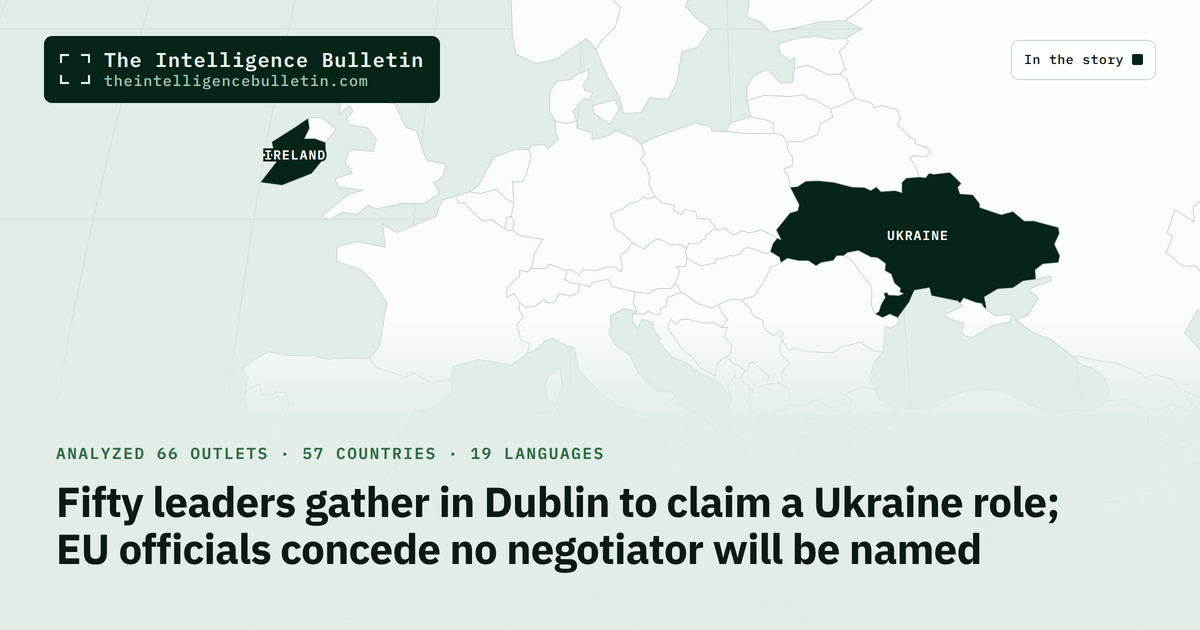
Roughly 50 leaders opened the European Political Community summit in Dublin on November 12, awaiting US envoys returning from Putin. EU officials said they expect no agreement on a European negotiator, and Russian officials argue that including Europe would set the talks back.
Across the press: Russia’s official daily and Lithuania’s public broadcaster both quoted EU officials conceding, before the summit opened, that Dublin would not produce a European negotiator.
Source base: 5 outlets read in full (Ireland, Russia, Ukraine, Lithuania, Canada), selected from 66 analyzed.
- 1 of 5 · Irish Mirror onlyBritish Prime Minister Andy Burnham was expected to announce further sanctions against Russia at the summit.PA Media via Irish Mirror
- 1 of 5 · Rossiyskaya Gazeta onlyRussian negotiators argue that bringing Europe into the talks would set them back: Medinsky says Europe has made no concrete peace proposal, and Ryabkov says European inclusion could mean ‘rollback and disruption.’Rossiyskaya Gazeta, quoting Vladimir Medinsky and Deputy Foreign Minister Sergei Ryabkov
- 5 of 5 · reported separatelyRoughly 50 leaders convened in Dublin on November 12 for the ninth European Political Community summit, with an informal EU leaders’ meeting to follow on Friday, November 13.PA Media via Irish Mirror; LRT’s own reporting; Rossiyskaya Gazeta; Kyiv Post citing The Journal; Canadian Press via Winnipeg Free Press
- 4 of 5 · reported separatelyUS envoys Steve Witkoff and Jared Kushner were to meet Putin in Moscow on November 12 and then travel to Dublin to brief Zelensky, who arrived on November 11 and met Taoiseach Micheál Martin.PA Media via Irish Mirror; Kyiv Post citing The Journal and AFP; LRT; Rossiyskaya Gazeta
- 2 of 5 · reported separatelyEU officials did not expect leaders in Dublin to agree on a single European negotiator, and Kushner said finding one person to represent Europe would be a bigger achievement than getting Russia to admit Europe to the talks.Rossiyskaya Gazeta citing an EU official quoted by the Financial Times; LRT citing a senior EU official briefing reporters in Brussels; both quote Kushner after Abu Dhabi
- November 12–13, after the Moscow meetingWitkoff and Kushner brief Zelensky in Dublin; Ukraine says the date of the next negotiating round depends on it.
- November 13The informal EU leaders’ meeting in Dublin discusses the powers of a European negotiator and the shape of a negotiating team.
- Within one to two weeks of the summitFinnish President Stubb says a technical-level meeting of Americans, Ukrainians, Russians and Europeans may take place, which would put Europe in the room.
- DecemberRossiyskaya Gazeta reports that names for a European negotiator are unlikely before then.
- AnsweredLithuanian President Nausėda told LRT that a prisoner release had been agreed, and Kyiv Post reports another major POW exchange was on the Abu Dhabi agenda. Neither gives numbers.
- AnsweredKyiv Post reports Medinsky said Russia regards all land its troops have reached as its own and sees no possibility of territorial exchange. LRT reports Russia demanded a review of Europe’s security architecture.
- AnsweredIn Abu Dhabi they were neither participants nor observers. Kyiv Post reports Britain, France, Germany, Italy, NATO and the European Commission held separate meetings with the Ukrainian and US teams but never directly joined the negotiations with Russia.
- AnsweredIt was consultation on the sidelines. Kyiv Post reports France was among the European parties holding separate meetings with the Ukrainian and US teams but not joining talks with Russia; individual French and EU representatives are not named.
- Still openWill Putin accept any European seat when Kushner raises it in Moscow, given Peskov s statement that there is no vision yet of a format with the EU?
- 11 Nov · Kushner heads to Putin; Kyiv s negotiator says Europe s seat is near, Moscow s calls Europeans tourists
- 11 Nov · Ukrainian MP tells Ukrinform a swap is only possible; AP calls defence minister Umerov a spy chief
- 10 Nov · US officials see territorial flexibility before Abu Dhabi talks, but Ukraine s own press never reports it
- 09 Nov · French Foreign Minister Says Europe Will Attend Abu Dhabi Talks as Peskov Denies Only Bilateral Security Contacts
Full analysis
What happened Why it matters How each country tells it Room for disagreement Our assessment Sources and evidence
What happened
Roughly 50 leaders gathered in Dublin on Thursday, November 12, for the ninth summit of the European Political Community. The EPC is the informal forum set up in 2022 after Russia’s full-scale invasion of Ukraine. Taoiseach Micheál Martin is hosting as part of Ireland’s six-month presidency of the EU Council, European Council President António Costa is chairing, and an informal meeting of EU leaders follows on Friday, November 13. The PA Media copy carried by the Irish Mirror gives the theme as "Europe – strong, secure and connected." The agenda covers the economy, Ukraine, hybrid threats, efforts to undermine democracy, and AI. The Irish Mirror calls the event the biggest security operation in the history of the Irish state. LRT quotes Garda Commissioner Liam Geraghty, via Politico, calling it bigger than a US presidential visit. Kyiv Post, citing The Journal, counts more than 300 garda motorcyclists and escorts for arriving leaders.
Events elsewhere overtook that agenda. TIB reported on November 11 that two days of US-mediated talks between Russia and Ukraine had just ended in Abu Dhabi. On the day the summit opened, US envoys Steve Witkoff and Jared Kushner were to see Vladimir Putin in Moscow and then fly to Dublin to brief Volodymyr Zelensky. Zelensky landed at Baldonnel military air base shortly before 4:15 p.m. on Wednesday and met Martin at Government Buildings. He said on Telegram that he had meetings scheduled with about 20 leaders. He told AFP there was "this window of opportunity, when all those participants who are now engaged in the negotiation process, genuinely want to achieve a result before 2027." Davyd Arakhamia, a member of Ukraine’s delegation, said a date for the next round should be set only after the envoys’ Moscow trip and their meeting with Zelensky, according to Kyiv Post.
Europe came to Dublin as an outsider to those talks. Kyiv Post reports that Britain, France, Germany, Italy, NATO and the European Commission held separate meetings with the Ukrainian and US teams in Abu Dhabi but "never directly joined the negotiations with Russia." It adds that Washington wants Europe included in future rounds. Kushner set the price after Abu Dhabi, in a remark carried by both Rossiyskaya Gazeta and LRT. If Europe could find one person to speak for it, he said, that would be a bigger achievement than persuading Russia to include it.
EU officials themselves say that person will not come out of Dublin. Rossiyskaya Gazeta quotes a European official speaking to the Financial Times: the question "has been discussed for too long, it is complicated. There are no expectations." Brussels, the official said, wants at least a "single coherent message." LRT quotes a senior EU official who briefed reporters in Brussels on Wednesday. Asked whether he expected agreement on a special representative, he said his answer would be "no." Rossiyskaya Gazeta reports that Friday’s meeting will cover only the powers of the post and the structure of a negotiating team, and that names are unlikely before December. Kremlin aide Yuri Ushakov told the paper that Europe "cannot yet" choose one.
LRT reports the names in circulation. They include Finnish President Alexander Stubb and Norwegian Prime Minister Jonas Gahr Støre, who called Putin together. LRT notes the obstacles: Norway is not an EU member, Stubb does not sit on the European Council, and their call drew criticism. Lithuanian President Gitanas Nausėda told LRT that Costa was "the simplest legal way." He said he did not want to speculate before the conversation had even taken place.
Rossiyskaya Gazeta alone sets out Moscow’s case against giving Europe a seat. Vladimir Medinsky, who led Russia’s delegation, says Russia has received "not a single concrete peace proposal" from European countries and does not "really understand what can be talked about with them." Deputy Foreign Minister Sergei Ryabkov warns that European inclusion could mean "rollback and disruption" of efforts he described as not useless. The paper also quotes EU foreign policy chief Kaja Kallas: Europe will back Ukraine whatever happens in the talks, and sanctions on Moscow will be strengthened. PA Media, alone among these reports, says UK Prime Minister Andy Burnham was expected to announce further sanctions against Russia in Dublin and to co-chair a security and defense roundtable.
Two arrivals show how wide the gathering was. Nausėda told LRT he does not expect a ceasefire. He predicted that Russia would use the coming winter "to torment the Ukrainian people," while noting that a prisoner release had been agreed. The Canadian Press, via the Winnipeg Free Press, reports that Mark Carney attended for one day as the only non-European leader. He held talks with Greece and Cyprus, which have not ratified the decade-old EU-Canada trade deal, before flying to Manila.
All five reports were filed before the summit opened or on its first day. None records what Dublin decided.
Why it matters
Kushner’s remark shifts the burden onto Europe. Washington says it wants Europe at the table, but if Europe cannot name someone to sit there, the question of whether Russia would accept a European seat never has to be answered. Moscow has said, through Ryabkov, that it would prefer not to answer it.
The subject Europe is shut out of is its own security. LRT reports that in Abu Dhabi, Russia demanded a review of Europe’s security architecture. Nausėda rejected that outright: there should be "no spheres of influence," and NATO’s role must stand. For a frontline state like Lithuania, that is the core concern. Under Arakhamia’s sequencing, Europe’s views reach the process as part of a briefing from American envoys coming back from the Kremlin. They do not arrive as a negotiating position of its own.
That leaves Europe with the tools it already controls: sanctions, as Kallas and PA’s account of Burnham’s plans indicate, and financial support for Ukraine. Neither depends on Moscow’s consent, and neither buys a seat.
How each country tells it
- Irish Mirror · Ireland · wire copyPresents the ninth European Political Community meeting as the largest security operation in Irish history and sets out the official theme, ‘Europe – strong, secure and connected,’ but most of its detail concerns British Prime Minister Andy Burnham’s plans, including expected new Russia sanctions.
- Rossiyskaya Gazeta · Russia · opinionCasts the Dublin leaders as ‘those waiting’ for whatever Witkoff and Kushner bring back from Putin, and says in advance that Europe will agree neither a common approach nor a negotiator.
- Kyiv Post · Ukraine · carries The JournalFollows Zelensky’s arrival and schedule of about 20 leader meetings, and treats Dublin as the step before he hears from the US envoys returning from Moscow, on which Kyiv says the date of the next round depends.
- LRT (Lithuanian National Radio and Television) · Lithuania · original reportingInterviews President Nausėda in Dublin. He doubts a ceasefire can be expected, rejects any ‘spheres of influence’ in a revised European security order, and names António Costa as the simplest legal choice to negotiate for Europe.
- Winnipeg Free Press · Canada · wire copyReports Mark Carney attending for one day as the only non-European leader at the table, holding bilateral talks with Greece and Cyprus over the unratified EU-Canada trade deal, and leaving that night for Manila.
Room for disagreement
The best case against this reading comes from Stubb, quoted by Rossiyskaya Gazeta. He says it is "quite likely" that Europeans will sit at the table, and that a technical-level meeting of Americans, Ukrainians, Russians and Europeans could happen within one to two weeks. If that happens, a technical format would bring Europe in without anyone first settling who speaks for it. Kyiv Post’s report that Washington wants Europe included gives Stubb some support.
The negotiator question may also be less open than it looks. The senior EU official quoted by LRT said that under the treaties, EU institutions should represent the bloc on collective matters. Nausėda’s remark about Costa points the same way. A default choice that already has a treaty basis could be adopted quickly once leaders stop arguing about names. And Rossiyskaya Gazeta, as the Russian government’s daily, has an interest in presenting Europe as divided, which is a reason to discount its framing.
Our assessment
It is very likely that Dublin closes on November 13 without Europe naming the single negotiator Washington says it needs. The warrant is strong. Two separate reporting chains carry EU officials ruling it out on the record: the Financial Times source quoted by Rossiyskaya Gazeta, and the Brussels briefing reported by LRT. Their accounts match Rossiyskaya Gazeta’s December timeline and Nausėda’s refusal to back any name. Rossiyskaya Gazeta’s interest in European disunity is real. But on this point its evidence comes from European officials, not Russian ones.
The larger consequence follows from that. The next round’s date will be set by what Witkoff and Kushner bring back from Moscow, and Europe’s main lever is sanctions, not a chair at the table. Stubb’s four-way technical meeting is the one route around that. It would need Russian agreement, which Medinsky and Ryabkov have publicly refused.
What would change this: a Russian acceptance, reported out of the Moscow meeting, of European participation in a technical round, or EU leaders adopting Costa as their default representative before December.
Sources and evidence
Press quoted
- What did Putin tell Witkoff and Kushner in Moscow, and did the envoys reach Dublin to brief Zelensky and European leaders? Every source here was written before the summit opened.
- Did Friday’s informal EU meeting agree on a mandate or team structure for a European negotiator, or settle on Costa, or did it defer names to December as Rossiyskaya Gazeta predicts?
- Did Britain actually announce new Russia sanctions in Dublin, and did the EU match Kallas’s pledge that sanctions ‘will be strengthened’?
That’s how the world told the story.
Get our daily open-source intelligence on world events in your inbox — one email a day, up to six stories.
Subscribe freeNo spam. One-click unsubscribe. See the latest email →