 AI-generated analysis published under the editorial responsibility of Rohit Sinnas. How it works →
See the 57 countries
Afghanistan, Argentina, Australia, Austria, Azerbaijan, Bangladesh, Barbados, Belarus, Brazil, Bulgaria, Canada, Chile, China, Colombia, Cuba, Denmark, Ecuador, Egypt, France, Germany, Greece, Guatemala, Hungary, India, Indonesia, Ireland, Israel, Italy, Japan, Kenya, Latvia, Malaysia, Mexico, Nepal, New Zealand, Nigeria, Norway, Oman, Pakistan, Peru, Philippines, Portugal, Romania, Singapore, Somalia, South Korea, Spain, Sweden, Switzerland, Taiwan, Ukraine, United Arab Emirates, United Kingdom, United States, Uruguay, Vietnam, Zimbabwe
Nvidia’s board planned to meet as soon as November 11 on Jensen Huang’s future; the Wall Street Journal alone reports it is preparing to oust him. The New York Times reports a second affair, with subordinate Kimberly Powell, which Reuters could not verify.
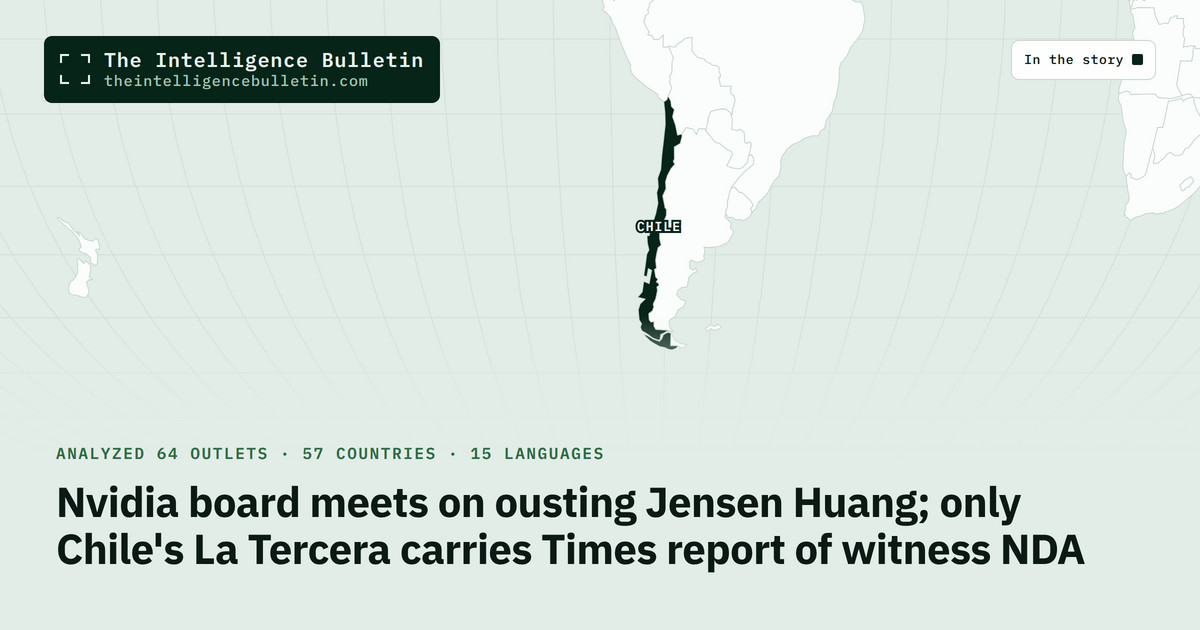
Across the press: Of five outlets, only Chile’s La Tercera relays the New York Times report that Huang’s security team offered a witness a nondisclosure agreement.
Source base: 5 outlets read in full (United States, Israel, Portugal, Chile, India), selected from 64 analyzed.
- 4 of 5 · one shared reportNvidia’s board is preparing to oust Jensen Huang, possibly as soon as Wednesday night, November 11.The Wall Street Journal, citing people familiar with the matter; relayed by Reuters, Bloomberg-based and local accounts.
- 5 of 5 · one shared reportHuang had an extramarital affair with Kimberly Powell, Nvidia’s vice president of healthcare, who is in his reporting line.The New York Times, citing five people who worked at Nvidia. Huang told the Times ‘I don’t think you should be talking to me directly’ and hung up, and Reuters said it could not verify the report.
- 1 of 5 · La Tercera onlyDuring Nvidia’s March GTC conference, a witness filmed Huang and Powell being affectionate at a nearby hotel, and Huang’s security team pulled that person aside and offered a nondisclosure agreement.The New York Times, citing two sources for the sighting and three people briefed on the incident for the NDA offer; relayed by La Tercera.
- 1 of 5 · The Jerusalem Post onlyAlice Huang, the businesswoman US intelligence suspects of working for China, has returned to China and is living in Beijing with the knowledge of security officials.Bloomberg News, citing people familiar with the matter, as relayed by Reuters, which could not verify it.
- 4 of 5 · reported separatelyThe board planned to meet as soon as Wednesday to decide Huang’s future and has been working with an outside firm to identify possible replacements, including an interim CEO.The WSJ (people familiar with the matter), a source confirmed to Reuters, and Bloomberg (a person familiar with the situation) are three separate reporting chains for the meeting. The successor search is Bloomberg’s alone.
- November 11–12Nvidia’s board meets on Huang’s future; any statement will confirm or undercut the Wall Street Journal’s report of an ouster.
- November 17Nvidia reports quarterly results, the first test of how investors price the company with its leadership in question.
- November 18The closed-door House briefing on Alice Huang is scheduled, and lawmakers have threatened a subpoena if Huang does not respond.
- Still openWill Nvidia s independent investigation or the FBI establish that Alice Huang actually obtained sensitive information, and will the classified US memo be released or verified beyond anonymous intelligence assessments? · Will Jensen Huang appear at the November 18 closed-door House briefing, and will he remain CEO if the inquiry confirms the affair but no security compromise?
Full analysis
What happened Why it matters How each country tells it Room for disagreement Our assessment Sources and evidence
What happened
Nvidia’s board of directors was set to meet as soon as Wednesday, November 11, to decide whether Jensen Huang keeps his job. Huang, 63, co-founded the company in 1993 and has been its only chief executive. Three separate reporting chains say the meeting was planned. The Wall Street Journal cited people familiar with the matter, a source confirmed it to Reuters, and Bloomberg cited a person familiar with the situation.
The sharper claim is the Journal’s alone: that the board is preparing to oust Huang and could do so as soon as Wednesday night. Bloomberg added that directors have been working with an outside firm to identify replacements and are considering an interim CEO. Nvidia did not respond to requests for comment on the meeting.
The trigger was a second relationship. On Wednesday afternoon the New York Times reported that Huang had an extramarital affair with Kimberly Powell, Nvidia’s vice president of healthcare, who sits in his reporting line. The paper cited five people who had worked at the company. Both are married to other people. In the Times account relayed by La Tercera, Powell is 48, joined Nvidia in 2008 and became healthcare vice president in late 2017. Asked about her by phone, Huang told the Times "I don’t think you should be talking to me directly" and hung up. Nvidia declined to comment and Powell did not respond. Reuters said it could not verify the report.
La Tercera, the Chilean daily, carried a part of the Times story that none of the other four articles in this set contain. According to two sources cited by the Times, Huang and Powell were seen being affectionate in March at a hotel near GTC, Nvidia’s annual developer conference in San Jose, where executives were holding meetings. A witness filmed them on a phone. Three people briefed on the incident told the Times that Huang’s security team pulled that person aside and offered a nondisclosure agreement. La Tercera also noted that Nvidia’s code of conduct asks employees to avoid conflicts of interest, including those arising from personal relationships.
The Powell report landed on a crisis already a month old. In October the Times reported that US officials had identified Alice Huang, a Chinese executive at Megaspeed, as an asset of Chinese intelligence. US intelligence alleges she helped facilitate shipments of Nvidia chips to Chinese firms. China denies the accusation.
TIB reported on November 7 that three House committee chairs had asked Huang to a closed-door briefing on November 18. On November 10 TIB reported that he had admitted to staff that he had been unfaithful to his wife. In that Sunday memo Huang took "full responsibility" without giving details. The same day the board opened an investigation, overseen by independent directors and run by the law firm Wachtell, Lipton, Rosen & Katz, and expressed confidence in him.
The FBI is examining whether national-security information was compromised, ABC7 reported. The station said Huang had neither answered Wednesday’s congressional deadline for the briefing nor proposed another date, and lawmakers have threatened a subpoena.
Two more reports widened the frame on Wednesday. In this set, both appear only in the Reuters dispatch run by the Jerusalem Post. Bloomberg reported that Alice Huang has returned to China and lives in Beijing with the knowledge of security officials; Reuters could not verify it. Axios reported that Commerce Secretary Howard Lutnick stalled President Donald Trump’s crackdown on companies suspected of diverting Nvidia chips to China. The White House and Lutnick’s office did not respond.
Trump has said he had not discussed the allegations with Huang. He nonetheless backed him, calling him, per SAPO, "an honorable man." The Washington Post, as relayed by OneIndia, reported that the White House will not involve itself in the board’s decision.
The market moved before the board did. ABC7 reported that Nvidia stock rose nearly 5% in regular trading Wednesday, then fell 7.5% after hours. Reuters later put the slide at more than 8% and Bloomberg at about 9%, readings taken at different points in the same falling session. Reuters calculated that if those losses held, Nvidia would have shed about $600 billion in market value since the board announced its investigation.
Why it matters
Under Nvidia’s bylaws, a majority of directors can remove Huang "with or without cause." Ten of the 11 directors are classed as independent. The legal path is short; what has changed is the reason to take it.
Sunday’s vote of confidence answered a question about a relationship that US intelligence describes as a recruitment effort. The board could argue it had seen no evidence of leaked secrets. The Powell report raises a different kind of problem: a relationship inside the chain of command. If the Times account holds, it also involves Huang’s security team offering a witness a confidentiality agreement. That is a matter of governance and disclosure, and a finding that no secrets leaked does not settle it.
The stakes run beyond one company. Nvidia is a roughly $4 trillion chipmaker and the dominant supplier of AI chips. Its quarterly results are due November 17, the day before the House briefing. "The market is starting to price Nvidia without its founder as the likely outcome, not a tail risk," said Armina Rosenberg of Minotaur Capital. She named CFO Colette Kress as the natural interim choice, but said there is no clear long-term technology leader. Nick Ferres of Vantage Point Asset Management warned that because Nvidia finances its customers, "sometimes all it takes is a slowdown" to tip a boom into bust.
On security, the Bloomberg and Axios reports, if they hold, shift the question from Huang’s judgment to Washington’s. A suspected intelligence asset is reported to have left the country with officials’ knowledge, and a crackdown on chip diversion is reported to have stalled.
The question of what the Trump administration knew is, in this reporting, asked rather than answered. ABC7 says the questions are growing but cites nothing, and the Axios account of Lutnick is the only reported fact that touches it. No outlet in this set is Chinese. Beijing’s denial reaches the reader as a single sentence in La Tercera.
How each country tells it
- ABC7 News · United States · carries The Wall Street JournalNvidia’s home-region station treats this as a Silicon Valley ‘fall from grace.’ It stitches together the Wall Street Journal ouster report, the New York Times account of the Powell affair, the after-hours stock drop and Huang’s missed congressional deadline.
- The Jerusalem Post · Israel · wire copyRuns a Reuters dispatch built around the board’s move, the bylaw allowing removal ‘with or without cause,’ the absence of an obvious successor, and the market fallout.
- SAPO · Portugal · carries ReutersA Portuguese rendering of the same Reuters material: the WSJ ouster report, the ‘about 8%’ slide and $600 billion loss, Powell, Alice Huang, and Huang’s Sunday memo.
- La Tercera · Chile · carries The New York TimesA detailed Spanish-language retelling of the New York Times story on the Kimberly Powell relationship. It does not mention the board’s ouster plans at all.
- OneIndia · India · carries BloombergBuilt mainly on Bloomberg: the board is working with an outside firm on successors, could meet Wednesday, and is weighing an interim CEO.
Room for disagreement
The strongest case against an ouster is that the board itself has said nothing. The only account of an intent to fire Huang rests on the Journal’s anonymous sources. Three days earlier, the same directors publicly backed him.
Rosenberg, whose fund holds Nvidia shares, said "Losing Jensen would be a real blow." Reuters noted there is no obvious successor at a company built around one founder for more than three decades. With hundreds of billions already gone from its market value, a board could choose an interim arrangement, a censure, or a wait for Wachtell’s findings.
The evidence on Powell is also thinner than it looks. The account rests on anonymous former employees, Huang has not confirmed it, and Reuters could not verify it. The NDA detail rests on three people briefed on the incident and reaches this set through one outlet. A meeting to decide is not a decision.
Our assessment
It is likely that Huang will no longer be Nvidia’s chief executive by the end of the year, whether removed or by resignation.
The warrant has three parts. The planned meeting is corroborated across three independent chains. Bloomberg reports an outside search firm and talk of an interim CEO, which a board does not commission in order to reaffirm a sitting chief executive. And the bylaws let ten independent directors act without Huang.
The NDA account weighs most. If directors learned of it only after Sunday’s endorsement, their own credibility now depends on how they respond. Inaction would leave them exposed before Congress and investors alike.
Each interested party wants the story read its way. The White House has backed Huang while saying it will stay out. Huang has framed the matter as personal, and his memo offered no details. Investors are quoted on both sides. Polymarket’s shift is a reading of the same reports, not independent evidence.
What would change this: a post-meeting board statement reaffirming Huang, or an on-record denial of the NDA account from Nvidia or the witness.
Sources and evidence
Press quoted
- Did Nvidia’s board meet on Wednesday night and vote to remove Huang, and who, if anyone, was named interim CEO ahead of the November 17 earnings?
- Did the board know about the Powell relationship, or the reported NDA offer to the witness at GTC, when it voiced confidence in Huang on Sunday?
- How did Alice Huang get from Singapore, where she was reportedly barred from leaving, to Beijing, and does that change the FBI’s inquiry into whether anything was compromised?
That’s how the world told the story.
Get our daily open-source intelligence on world events in your inbox — one email a day, up to six stories.
Subscribe freeNo spam. One-click unsubscribe. See the latest email →