 AI-generated analysis published under the editorial responsibility of Rohit Sinnas. How it works →
See the 56 countries
Afghanistan, Albania, Armenia, Austria, Belgium, Brazil, Bulgaria, China, Croatia, Cyprus, Egypt, France, Germany, Greece, Hong Kong, Hungary, India, Indonesia, Iran, Ireland, Israel, Jamaica, Kosovo, Latvia, Lebanon, Lithuania, Luxembourg, Macedonia, Madagascar, Malaysia, Mauritius, Mongolia, Morocco, Netherlands, Nigeria, Norway, Pakistan, Poland, Portugal, Romania, Russia, Saudi Arabia, Slovakia, Somalia, South Korea, Spain, Switzerland, Syria, Taiwan, Thailand, Turkey, Tuvalu, Ukraine, United Arab Emirates, United Kingdom, United States
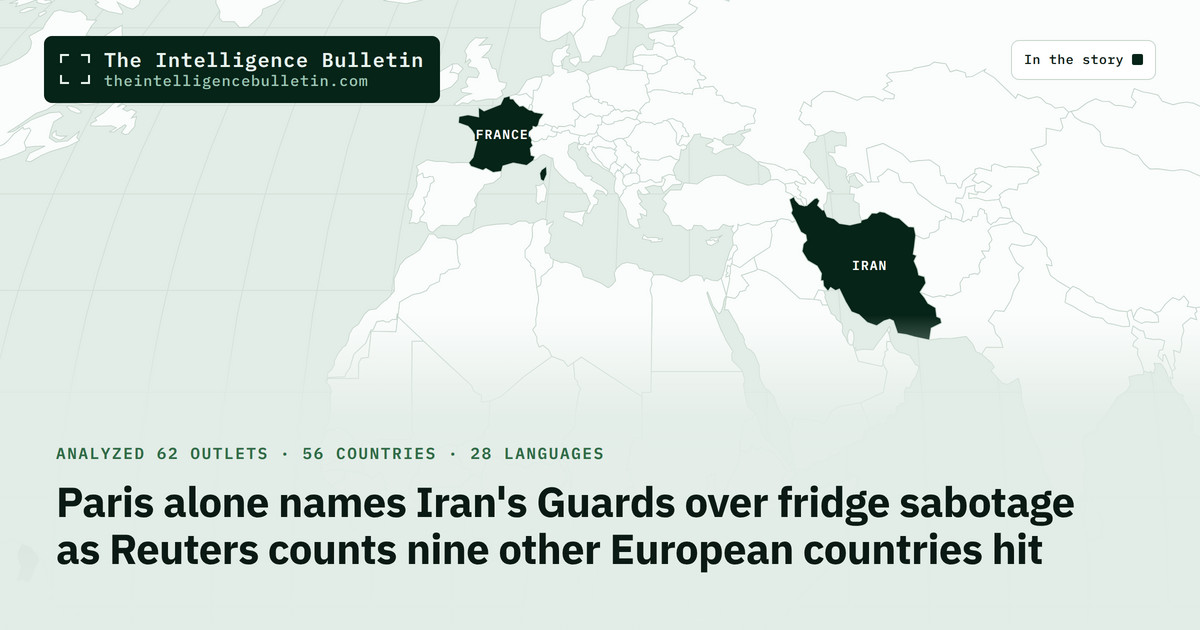
France’s Foreign Ministry blamed Iran’s Guards-linked Shahid Kaveh unit for October 11-12 supermarket refrigeration sabotage that caused fires and tens of millions of euros of losses; Iran’s foreign minister calls it unfounded. Per NRC, five other countries hit by similar hacks have named no culprit.
Across the press: Reuters, carried by Business FM, counts nine other European countries hit; NRC reports five of their intelligence services have named no culprit.
Source base: 5 outlets quoted (France, Armenia, Netherlands, Russia, Lebanon), selected from 62 analyzed. 4 read in full, 1 by its headline only.
- Denied on the recordIran’s Revolutionary Guards carried out the attacks.Source: French government via L’Opinion, NRC and Business FM (Reuters). Iranian Foreign Minister Abbas Araghchi, quoted by NRC, rejected the accusations as ‘unfounded’ and ‘one-sided’ and wrote on X that the French government cannot manage refrigerators and is blaming others for its own failures.
- 1 of 5 · NRC onlyFrance’s case rests on technical indicators, including Iranian IP addresses used in the attack.NRC reporting what Barrot cited. Tayyar.org relays a Sky News Arabia analyst saying the investigation relies on servers, identifiers and accounts named Cyber Avengers, Hydro Kitten and Storm 784, which no other source attributes to the French file.
- 4 of 5 · reported separatelyFrance’s Foreign Ministry on November 9 formally attributed the October 11-12 sabotage of supermarket refrigeration to Iran, specifically the Revolutionary Guards-linked cyber unit Shahid Kaveh.L’Opinion quoting the Quai d’Orsay communiqué. NRC reporting Barrot’s attribution. Business FM relaying Reuters (Revolutionary Guards). Tayyar.org relaying a Sky News Arabia analyst (Shahid Kaveh).
- 3 of 5 · reported separatelyThe sabotage hit hundreds of French supermarkets, caused fires and destroyed food worth several tens of millions of euros.L’Opinion quoting the French communiqué (fires, tens of millions of euros). NRC (hundreds of supermarkets). Tayyar.org relaying a Sky News Arabia analyst (about 700 stores, about 15 fires).
- 2 of 5 · reported separatelyRefrigeration systems were also hacked in several other European countries in recent weeks.NRC lists Belgium, Ireland, Sweden, Estonia and the Netherlands and says those countries’ intelligence services have named no culprit. Business FM, relaying Reuters, lists Belgium, Ireland, Luxembourg, the Netherlands, Finland, Sweden, Estonia, Italy and Portugal.
- AnsweredForeign Minister Abbas Araghchi rejected the accusations on X on Tuesday as ‘unfounded’ and ‘one-sided,’ saying the French government cannot manage refrigerators and is shifting blame for its own failures, according to NRC. No selected source reports any Iranian response to the arrest warrants specifically.
- Still openWhich countries and how many sites were hit in the early-November second European wave, when NOS lists the Netherlands, Belgium, Luxembourg and Sweden, Daily Sabah lists Britain, Germany, Italy, Portugal and the Netherlands, and Arab News says at least nine countries — and has that wave been linked to the same Iranian unit, or only to the October French attack? · Who are the individual head of Shahid Kaveh and his two deputies, and what specific EU-level sanctions is France seeking, since no selected piece names the suspects or details the measures?
Full analysis
What happened Why it matters How each country tells it Where accounts conflict Room for disagreement Our assessment Sources and evidence
What happened
On Monday, November 9, France’s Foreign Ministry formally accused the Islamic Republic of Iran of the cyberattack that, on the night of October 11 to 12, took control of refrigeration systems in hundreds of French supermarkets. The communiqué, quoted by L’Opinion, named Shahid Kaveh, a cyber unit linked to the Revolutionary Guards. It said the attacks caused considerable material damage, fires and food losses "estimées à plusieurs dizaines de millions d’euros." It called them the first cyber-offensive campaign on French soil run purely for sabotage, and it announced European sanctions. Reuters, in copy carried by the Moscow station Business FM, reports that Foreign Minister Jean-Noël Barrot threatened Tehran with EU-level sanctions and that an Iranian envoy was summoned the same day. TIB reported on November 9 that the Paris prosecutor had also opened a judicial investigation against Shahid Kaveh’s chief and two deputies and was seeking arrest warrants.
The method was crude and physical. According to Reuters, the attackers seized control of the refrigeration units and switched them to defrost. In some cases they heated the chambers above 50 degrees Celsius, spoiling everything inside. Reuters adds that hackers also broke into refrigerators of the French blood service. Hilal al-Obaidi, a researcher at the European Center speaking to Sky News Arabia in material carried by the Lebanese site Tayyar.org, put the toll at about 700 large stores and roughly 15 fires. That is an analyst’s count, not a figure from the French government.
On the evidence, NRC reports that Barrot pointed to technical indicators found by French investigators, among them Iranian IP addresses used in the attack. Al-Obaidi went further. He said the investigation rests on servers, identifiers and accounts using names such as "Cyber Avengers," "Hydro Kitten" and "Storm 784." No other source ties those personas to the French file. L’Opinion noted the surprise of the attribution itself, because Russia, the usual suspect in French cyber incidents, was not the one named.
Tehran answered on Tuesday. NRC reports that Foreign Minister Abbas Araghchi rejected the accusations as "unfounded" and "one-sided." Writing on X, he said the French government cannot manage refrigerators, let alone its population’s grievances, and is shifting the blame for its own failures onto others. The Armenian outlet 1in.am made Araghchi’s response its headline.
France was not the only country hit. NRC lists Belgium, Ireland, Sweden, Estonia and the Netherlands as places where cooling systems were hacked in recent weeks, and reports that intelligence services there have named no culprit. Reuters’ list is longer: those five plus Luxembourg, Finland, Italy and Portugal, nine countries beyond France. The two lists reconcile, since NRC’s five all appear among Reuters’ nine.
The backdrop is the war between Iran and the United States and Israel. NRC recounts that strikes by those two countries in February killed senior Iranian officials, including Supreme Leader Ali Khamenei, and that Iran retaliated against regional allies such as the United Arab Emirates. France at first kept its distance from the strikes. After an Iranian drone hit Cyprus in March, it sent the aircraft carrier Charles de Gaulle to the eastern Mediterranean. In September, Emmanuel Macron sent troops and air defenses to Saudi Arabia to protect energy infrastructure. NRC also points to the March wiper attack on the U.S. medical firm Stryker, claimed by the Iran-linked group Handala, as evidence of a wartime rise in Iranian cyber operations.
Why it matters
By France’s own description, this is a new category of attack on its territory: sabotage with no espionage motive, aimed at the food chain rather than at a hardened state target. Rafe Pilling of Sophos, quoted by NRC from the Financial Times, said the value lies in the signal as much as the damage. Disrupting refrigeration, he said, is very visible, has tangible consequences and can potentially be done at scale.
Peyman Jafari of the College of William & Mary gave NRC the strategic logic. As he describes Tehran’s view, Washington wants the Iranian economy hit so hard that people cannot buy bread, and Iran’s answer is that it can cause chaos in other countries too. In that reading, European grocery shelves become a way to press Washington. The attribution also feeds a campaign Paris was already running, since NRC notes France leads the push inside the EU for tougher sanctions on Tehran. Sanctions at EU level, however, need partners whose own investigations have so far named no one.
How each country tells it
- L’Opinion · France · original reportingExplains how and why Paris named Iran. It quotes the Foreign Ministry’s November 9 communiqué calling the October 11-12 attacks the first cyber-offensive campaign on French soil conducted purely for sabotage, and notes the surprise that Russia, the usual suspect, was not the culprit.
- 1in.am · ArmeniaIts headline makes Iranian Foreign Minister Araghchi’s response to the French charge the news.
- NRC · Netherlands · original reportingAsks what Tehran would gain. It reports that Barrot cited Iranian IP addresses among the technical indicators, carries Araghchi’s mocking denial, and quotes an Iran scholar who calls Iranian responsibility plausible but unproven.
- Business FM · Russia · carries ReutersUnder a flat ‘France accused Iran of attacks on refrigerators’ headline, it relays Reuters: Barrot blames the Revolutionary Guards, Iran’s chargé d’affaires was summoned on November 9, and EU-level sanctions were threatened.
- Tayyar.org · Lebanon · carries Sky News ArabiaCarries two analysts speaking to Sky News Arabia. They put the attack at about 700 large stores and roughly 15 fires, name hacker personas ‘Cyber Avengers,’ ‘Hydro Kitten’ and ‘Storm 784,’ and cast Iran as running a ‘fifth column’ of cells inside Europe and Britain.
Where accounts conflict
The central dispute is who did it. The French government, through the communiqué and Barrot, names the Revolutionary Guards’ Shahid Kaveh unit and cites technical indicators, including Iranian IP addresses. Araghchi calls the charge unfounded and one-sided and offers no counter-evidence beyond the claim that France is covering its own failures. Neither side’s material, as reported, has been published for outside examination.
A smaller discrepancy concerns who was summoned. NRC reports that France summoned the Iranian ambassador. Reuters, via Business FM, says it was Iran’s chargé d’affaires. The difference matters because it sets the diplomatic level at which Paris chose to protest.
Room for disagreement
The strongest case that this becomes a European accusation rests on the pattern. Nine countries reported the same kind of intrusion within weeks of the French attack. Pilling says Iranian state-backed groups routinely exploit weak or default passwords on internet-facing systems, which is exactly the access a single campaign could reuse from Helsinki to Lisbon. Jafari says Iran’s anger is aimed at Europe broadly, because American aircraft took off from European bases to bomb Iran. Al-Obaidi cites the head of Britain’s MI5 describing 50 arrests this year in Iran-linked cases. France also moved from attack to attribution in under a month, so the other governments may simply be slower rather than unconvinced.
Our assessment
It is unlikely that any other European government whose refrigeration was hacked will publicly name Iran in the coming weeks, which leaves this a French accusation that Paris is trying to turn into a European one through sanctions.
France’s attribution is the settled part of the story: it is reported through independent chains in L’Opinion, NRC, Reuters and Sky News Arabia, anchored in an on-record government communiqué. The spread of the hacks is also corroborated. The only reported statement on attribution elsewhere is NRC’s, and it says there is none. NRC also raises the possibility that the Danfoss systems were simply easy to penetrate, a weakness any intruder could exploit. Other governments would therefore need their own technical match before following Paris.
Each party has an interest in its framing. Paris, already the EU’s leading Iran hawk, gains from a European frame. Tehran gains from casting this as French incompetence. The Sky News Arabia commentators’ talk of a "fifth column" goes beyond anything a government has said.
What would change this: an intelligence service or prosecutor in another affected country attributing its own refrigeration incidents to Shahid Kaveh or to Iran.
Sources and evidence
Press quoted
- Will Belgium, Ireland, Sweden, Estonia, the Netherlands or any other country whose refrigeration systems were hacked link its own incidents to Shahid Kaveh, or does the attribution remain France’s alone?
- What evidence beyond Iranian IP addresses underpins the French case, and are the Cyber Avengers, Hydro Kitten and Storm 784 personas cited by Sky News Arabia’s analyst actually part of the official French file?
- What EU sanctions will France propose, and did it summon Iran’s ambassador, as NRC reports, or its chargé d’affaires, as Business FM’s Reuters copy says?
That’s how the world told the story.
Get our daily open-source intelligence on world events in your inbox — one email a day, up to six stories.
Subscribe freeNo spam. One-click unsubscribe. See the latest email →