 AI-generated analysis published under the editorial responsibility of Rohit Sinnas. How it works →
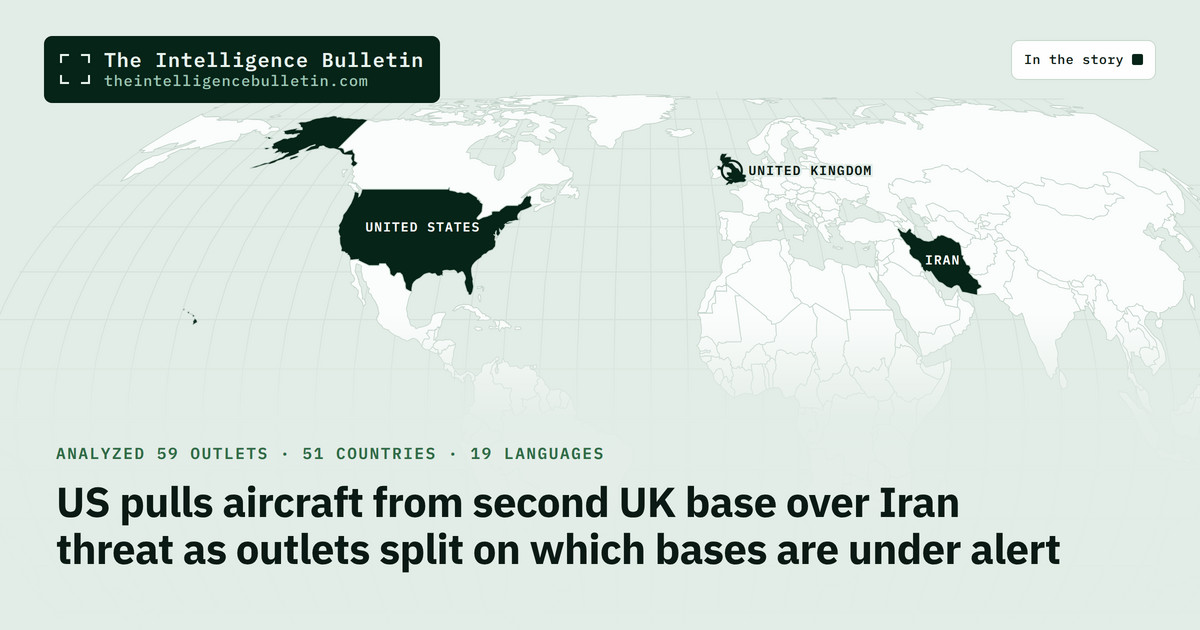
See the 51 countries
Afghanistan, Albania, Argentina, Armenia, Australia, Barbados, Bosnia and Herzegovina, Brazil, Bulgaria, Canada, China, Colombia, Cuba, Finland, France, Georgia, Germany, Ghana, Greece, Hungary, India, Iran, Israel, Jordan, Kenya, Lebanon, Malaysia, Netherlands, Nigeria, Norway, Oman, Pakistan, Poland, Romania, Russia, Singapore, Slovenia, South Africa, South Korea, Spain, Sri Lanka, Switzerland, Syria, Turkey, Tuvalu, Ukraine, United Arab Emirates, United Kingdom, United States, Uzbekistan, Vietnam
US moved tanker aircraft out of RAF Mildenhall on Monday after an Iranian threat, sending them to Germany and Spain, and raised the threat level to FPCON Charlie. Daily Star, Arutz Sheva and The National say the alert covers Mildenhall and Lakenheath; n-tv says Fairford.
Across the press: Three outlets carrying the same Wall Street Journal account put Mildenhall under FPCON Charlie; n-tv puts Fairford there instead.
Source base: 5 outlets read in full (United Kingdom, Germany, Israel, United Arab Emirates, Brazil), selected from 59 analyzed.
- 1 of 5 · The National onlyThe threat against Mildenhall involved a possible kamikaze or weaponized-drone attack on the base.The National, citing a security source and defence analysts; no other selected outlet carries this detail.
- 5 of 5 · reported separatelyUS military tanker aircraft were moved out of RAF Mildenhall on Monday after an Iranian threat.The Wall Street Journal, cited by Daily Star, n-tv, Arutz Sheva and The National; Sky News, via Veja, independently reported nine tankers and three Ospreys departing.
- 4 of 5 · reported separatelyThe relocated aircraft were sent to Germany, with some also moved to Spain and other destinations.The Wall Street Journal via n-tv, Arutz Sheva and Veja; Sky News via Veja; The National citing its own sources.
- 3 of 5 · reported separatelyTehran warned at the weekend that any response to new US strikes would be immediate, effective and not geographically limited.n-tv, Arutz Sheva and The National, each reporting Tehran’s statement.
- 4 of 5 · reported separatelyThe US withdrew B-1 bombers from RAF Fairford in October over a suspected Iran-linked plot, and two men were later charged.n-tv, Arutz Sheva, The National and Veja, citing prior reporting and British police action.
- Later this monthTrump travels to Shenzhen for the summit with Xi and Putin; whether the Iranian threat forces any change in US force posture or summit agenda will show how seriously Washington takes it.
- As the threat assessment resolvesUS officials are still debating whether the Mildenhall threat is immediate or general; a determination either way will shape whether further repositioning follows.
- In the coming weeksWhether the FPCON Charlie alert is extended, confirmed or downgraded at the disputed bases will resolve the Mildenhall-versus-Fairford question.
- If Iran escalatesAny drone attack on US aircraft or personnel in Europe, the scenario The National’s sources describe, would force a reassessment of Trump’s ‘quite unlikely’ strikes position.
- Still openDoes Trump s militarily effectively over declaration, carried directly only by Qatar Tribune, reflect a substantive US commitment to stop strikes when The National quotes only quite unlikely and good chance and Fox News reports no intensification but keeps strikes on the table? · Is the unconfirmed Israel Hayom claim that Iran dropped its demand to control Hormuz and collect transit fees real, and has it been presented to Qatar or Washington?
- 10 Nov · Trump, after Qatar talks, says new Iran strikes quite unlikely — but only Doha hears effectively over
- 09 Nov · Trump meets Qatar s PM; Iran s two-day proposal still on table while Rubio calls demands unacceptable
- 07 Nov · Trump confirms minor US strikes on Qeshm as a Qatari bridge deal splits AP and Al Jazeera reporting
- 09 Nov · France names Iran s Guards for fridge sabotage and vows sanctions; Kallas s strong EU response surfaces only in Arab News
Full analysis
What happened Why it matters How each country tells it Where accounts conflict Room for disagreement Our assessment Sources and evidence
What happened
On Monday, November 9, the United States moved refuelling aircraft out of RAF Mildenhall in Suffolk, England, after receiving an Iranian threat, and raised the base’s security status to Force Protection Condition Charlie, the level applied when intelligence suggests a terrorist attack is likely. The Wall Street Journal first reported the move, carried by Daily Star, n-tv, Arutz Sheva and The National. Sky News, via Veja, independently counted nine tankers and three Ospreys departing late Monday afternoon and overnight.
Two tankers diverted to Germany on Monday morning, and more tankers followed later in the day to Germany, Spain and other destinations, according to the Journal accounts. The National puts the total at up to 12 refuelling aircraft flown to US bases in Germany and Spain. US officials were still assessing whether the threat is immediate or a broader concern, the Journal reported, and a US Air Force spokesperson declined to discuss the movements, saying only that planes are routinely repositioned. The White House directed questions to the Pentagon, and the UK Ministry of Defence said it does not routinely comment on other nations’ activity.
The content of the threat is detailed by only one outlet. A security source told The National it was likely there was "credible intelligence" that Iran "was preparing to engage in a drone attack targeting Mildenhall." Defence analysts quoted by The National describe a two-stage plan: a diversionary operation to draw away base security, then an attack with weaponized or retrofitted quadcopter drones. Francis Tusa, editor of Defence Eye, says Iran could assemble around 20 quadcopters in the UK, arm them with smuggled explosives, and make a parked aircraft "unviable" with a 3kg warhead placed where the wing meets the fuselage. No other selected outlet carries this detail.
The build-up is documented. Tehran warned at the weekend that any response to new US strikes would be "immediate, effective and without geographic limitation" (n-tv, Arutz Sheva and The National). In October the US withdrew its B-1 bombers from RAF Fairford over what n-tv, Arutz Sheva, The National and Veja describe as a suspected Iran-linked plot; British counter-terrorism police said they intercepted a complex, multi-stage drone attack, and two men were later charged under the National Security Act. The Islamic Revolutionary Guard Corps said in July that RAF Fairford, and any base used to launch attacks on Iran, were legitimate targets, The National adds.
The alert level is where the reporting splits. Three outlets carrying the Journal’s account — Daily Star, Arutz Sheva and The National — report FPCON Charlie was raised at RAF Mildenhall and RAF Lakenheath. n-tv, also carrying the Journal, reports Charlie at RAF Fairford and RAF Lakenheath. The stakes are examined below, but the short version is that Mildenhall is the base emptied Monday and Fairford the one emptied in October, so a reader of one outlet cannot tell whether the heightened alert covers the base being evacuated now or the one already evacuated.
Secretary of State Marco Rubio, asked about the threat, said the administration had responded "by moving people away from the threat" (Daily Star, Arutz Sheva). President Donald Trump said on Monday that military action was "not really necessary" (n-tv) and described Iran as militarily "effectively over" (Daily Star); Arutz Sheva adds he called US forces "locked and loaded." TIB reported on November 10 that Trump told reporters after meeting Qatar’s prime minister that new strikes were "quite unlikely."
Why it matters
This is the second time in about a month that an Iranian threat has forced US aircraft out of a British base, and the first in this cluster to land on German soil explicitly. n-tv’s headline makes Germany the story: the tankers are being flown there, so Berlin is an affected party rather than a spectator. Daily Star frames it as a foreign war arriving on UK soil again, the only outlet here whose home country is the base’s host. Arutz Sheva, the Israeli outlet, reads the evacuation as evidence of Iranian reach and US exposure, and notes that the Gang of Eight congressional leaders received a classified briefing on Iranian threats on Monday. The National, the Gulf outlet, asks what US dispersal in Europe means for Gulf security guarantees: the same KC-135 tankers now spread across Europe were heavily involved in refuelling US bombers during the Iran war, and Middle East bases proved so vulnerable that the US lost seven tankers and one AWACS early warning aircraft. UK bases had previously been deemed safe. Veja, the only outlet outside the confrontation’s neighbourhood, casts Iran as the active agent whose threat makes the US withdraw, treating the pullout as a barometer of US-Iran tension.
Peter Ricketts, a former British national security adviser, calls the move "pretty dramatic action" and says the intelligence must have been "urgent enough" to require it, even if the decision came from an "abundance of caution." His concern, told to the BBC and quoted by The National, is that Washington does not want a security incident to force its hand "back into renewed conflict with Iran" — especially with Trump due to travel to Shenzhen this month for a summit with Xi Jinping and Putin. The National’s security source adds that Iran is now signalling it can strike US military sites in Europe, not just run "grey zone" economic warfare, after the supermarket freezer and blood bank sabotage attributed to Iran in the past week.
How each country tells it
- Daily Star · United Kingdom · carries The Wall Street JournalLeads with alarm that an Iranian threat has forced US aircraft out of a British base, framing it as a foreign war arriving on UK soil and putting scare quotes around ‘evacuates aircraft’.
- n-tv · Germany · carries The Wall Street JournalNames Germany as the destination for the relocated US tankers and reads the move as a concrete force-posture adjustment with direct consequences for US assets on German soil.
- Arutz Sheva (Israel National News) · Israel · carries The Wall Street JournalTreats the evacuation of a second British base as confirmation that Iran is forcing the United States to disperse its European aircraft, evidence of Iranian reach and US exposure.
- The National · United Arab Emirates · original reportingReads a British-base story through the Gulf’s fear of regional escalation, asking what a US withdrawal in Europe means for Gulf security guarantees and adding its own sources on a kamikaze-drone plot.
- Veja · Brazil · carries The Wall Street Journal and Sky NewsCasts Iran as the active agent — ‘the Iranian threat makes the US withdraw aircraft’ — and treats the pullout as an external barometer of US-Iran tension.
Where accounts conflict
The only substantive factual split is over which British bases sit under FPCON Charlie. Daily Star, Arutz Sheva and The National — three outlets all carrying the Wall Street Journal’s account — report the level was raised at RAF Mildenhall and RAF Lakenheath. n-tv, carrying the same Journal account, reports Fairford and Lakenheath. The difference changes what the alert means. If Mildenhall is under Charlie, the heightened readiness covers the base just emptied on Monday, the natural reading of the event. If Fairford is under Charlie, the alert applies to the base already emptied in October, and Monday’s evacuation at Mildenhall stands outside the raised alert. A reader relying on one outlet cannot tell which.
A smaller disagreement sits alongside it. Daily Star describes FPCON Charlie as the third-highest threat level; The National calls it the second-highest. The two cannot both be right, and the difference changes the reader’s sense of how close the US believes an attack is. The National’s description matches the standard five-level scale, in which Charlie is second only to Delta.
Room for disagreement
The strongest case against the assessment below is that Iran is escalating, not probing. Two UK bases in a month have been emptied over Iranian threats, the weekend warning promised a response "without geographic limitation," and the IRGC declared UK launch bases legitimate targets in July. Megan Sutcliffe of Sibylline tells The National that Iran has "staked its reputation on being able to credibly threaten the US as and where it is based." A single successful drone strike — the very method The National’s sources describe — would shatter the US claim that the war is militarily over and leave Trump’s hand forced back into conflict, the outcome Ricketts warns Washington is trying to avoid. The fact that the US keeps moving aircraft, twice now, is itself evidence that the threat is not receding, and Iranian cells in the UK are concentrated exactly where the US presence is, Sutcliffe notes — so dispersal to Germany and Spain may only shift the exposure rather than remove it.
Our assessment
Very unlikely that the repositioning from RAF Mildenhall leads to renewed US strikes on Iran in the near term. The move reads as precautionary force protection, not offensive preparation. The administration’s own framing points that way: Rubio describes "moving people away from the threat," Trump says military action is "not really necessary" and the war is militarily "effectively over," and Ricketts’s "abundance of caution" reading fits an urgent threat assessment against a political imperative to avoid being dragged back into conflict before the Shenzhen summit. The independent confirmation of the move across the Wall Street Journal and Sky News reporting chains establishes what happened; the disagreement over which bases are under FPCON Charlie shows the threat picture is still being sorted, not that a strike is imminent. Iran’s threat campaign is real and will likely continue, but the US response so far is dispersal and denial, not escalation.
What would change this: a successful Iranian drone attack, or unambiguous intelligence of one in final preparation, on US aircraft or personnel in Europe.
Sources and evidence
Press quoted
- What precisely is the threat to RAF Mildenhall — imminent or general — and what intelligence prompted the move to FPCON Charlie?
- Which bases are actually under FPCON Charlie, and how many aircraft left Mildenhall, given that n-tv names Fairford and Lakenheath while Daily Star, Arutz Sheva and The National name Mildenhall and Lakenheath, and aircraft counts range from up to 12 tankers to nine tankers and three Ospreys?
- Has Iran been directly linked to the Mildenhall threat, given that its ambassador to Britain denies involvement and no US official confirms the threat on the record?
That’s how the world told the story.
Get our daily open-source intelligence on world events in your inbox — one email a day, up to six stories.
Subscribe freeNo spam. One-click unsubscribe. See the latest email →