 AI-generated analysis published under the editorial responsibility of Rohit Sinnas. How it works →
See the 45 countries
Afghanistan, Australia, Austria, Azerbaijan, Bangladesh, Barbados, Belgium, Bulgaria, Canada, China, Dominican Republic, France, Germany, Greece, Hungary, India, Iran, Israel, Italy, Jamaica, Lebanon, Malaysia, Morocco, Netherlands, New Zealand, Nigeria, Pakistan, Poland, Portugal, Romania, Russia, Saudi Arabia, Serbia, Slovakia, Slovenia, South Africa, South Korea, Spain, Switzerland, Turkey, Ukraine, United Arab Emirates, United Kingdom, United States, Uzbekistan
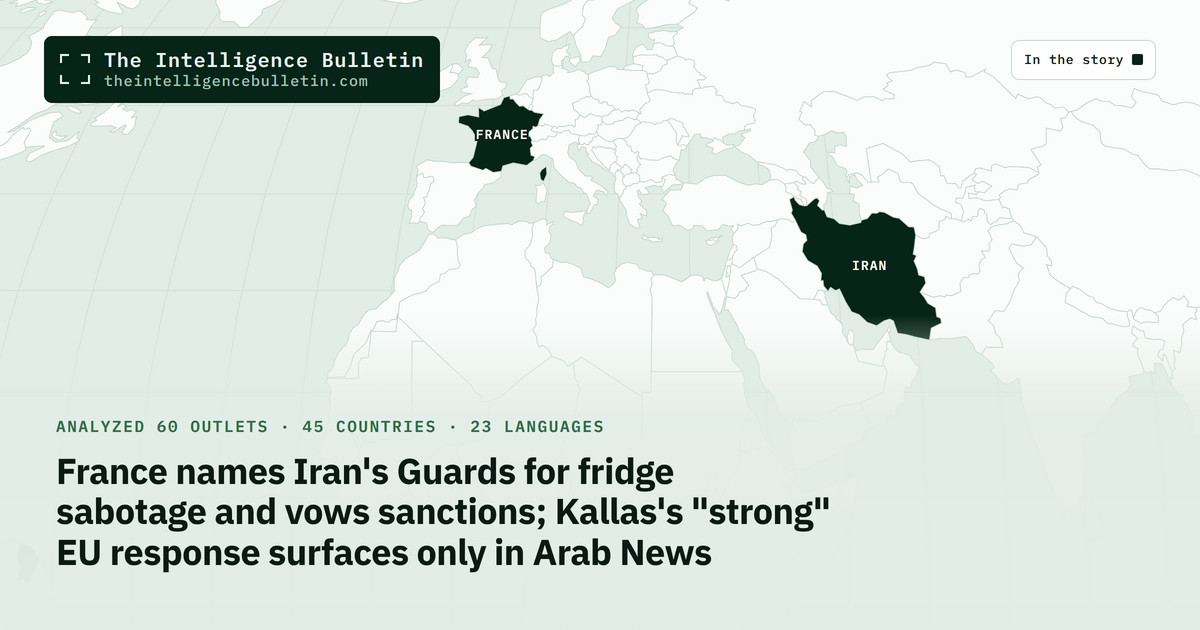
France attributes the October cyberattacks on supermarket fridges — heating them to about 50°C at roughly 700 sites — to Iran’s Revolutionary Guards, opening a probe and vowing EU sanctions; Tehran has not responded.
Across the press: RTL treats France’s attribution as settled law, while Turkey’s Daily Sabah never uses the verb "accuses," saying only "probes Iran-linked cyberattacks."
Source base: 5 outlets read in full (France, Netherlands, Turkey, Saudi Arabia, India), selected from 60 analyzed.
- 1 of 5 · Arab News onlyEU foreign policy chief Kaja Kallas has said the EU’s response ‘should be strong’.Arab News, quoting Kallas speaking after Barrot.
- 5 of 5 · reported separatelyFrance attributes the October 11-12 cyberattacks on supermarket refrigeration to Iran’s Islamic Revolutionary Guard Corps.French foreign minister Jean-Noël Barrot, quoted in all five outlets.
- 5 of 5 · reported separatelyThe Paris prosecutor has opened a judicial investigation against the head of the IRGC-affiliated Shahid Kaveh cyber unit, his two deputies and other unidentified persons, and arrest warrants are being sought.Paris prosecutor Laure Beccuau’s statement, carried by all five outlets; the arrest-warrant request is named by RTL and Daily Sabah.
- 4 of 5 · reported separatelyThe attack raised refrigeration temperatures to about 50°C and forced supermarkets to destroy perishable stock at roughly 700 sites.RTL (50°C, hundreds of stores), NOS (about 700 supermarkets, 50 degrees), Arab News (700 sites), Hindustan Times (about 700 retailers, 50°C for around six hours).
- 4 of 5 · reported separatelyFrance will seek European-level sanctions and has summoned the Iranian ambassador to lodge a protest.Barrot, reported by RTL, NOS, Arab News and Hindustan Times.
- In the coming daysTehran’s formal response to France’s attribution — the Hindustan Times noted it had not yet replied, and a denial would test the sanctions push.
- As investigating judges actWhether the Paris prosecutor’s request for arrest warrants against the Shahid Kaveh unit’s chief and deputies is granted.
Full analysis
What happened Why it matters How each country tells it Room for disagreement Our assessment Sources and evidence
What happened
On the night of October 11 to 12, hackers entered the refrigeration control systems of French supermarkets and turned the country’s cold chain against it. They forced the units into continuous defrost and pushed temperatures up until fridges and freezers reached around 50°C in some stores; NOS puts the number of affected supermarkets at about 700, a figure Arab News and the Hindustan Times carry as well, while RTL says hundreds. Chains including Intermarché and E.Leclerc had to throw away stock (NOS). In Paris, workers binned spoiled meat and melted ice cream, and some refrigeration units heated so far they caught fire (Hindustan Times); the Hindustan Times reports the exposure lasted around six hours. RTL names the units’ maker as the Danish firm Danfoss.
On Monday November 9, Paris prosecutor Laure Beccuau opened a judicial investigation against the head of the Shahid Kaveh group, an offensive cyber unit affiliated with the Electronic and Cyber Center of Iran’s Islamic Revolutionary Guard Corps, his two deputies, and any other person who may be identified. RTL lists the offences as fraudulent access to an automated data-processing system in an organised gang and degradation by a dangerous means in an organised gang, both aggravated by having been committed to serve a foreign power — Iran — plus criminal association. RTL and Daily Sabah both report that arrest warrants are being sought; Daily Sabah specifies international arrest warrants. The investigation is a joint effort by France’s anti-cybercrime office OFAC and the DGSI domestic intelligence service (RTL). The prosecutor’s case rests on IP addresses tracing to devices in Iran, use of Farsi, and a modus operandi characteristic of the unit (RTL, NOS).
Foreign minister Jean-Noël Barrot moved from investigation to accusation the same day. "I can confirm that this attack was carried out by the Islamic Revolutionary Guard Corps of the Islamic Republic of Iran," he said, in wording carried by Arab News and the Hindustan Times. Barrot called the attack unprecedented in scale and aggression, the first large-scale sabotage cyberattack on French soil and a major attack on the nation’s security, and vowed to implement sanctions at the European level and summon the Iranian ambassador to lodge a very strong protest (RTL, NOS, Arab News, Hindustan Times). Arab News notes Barrot put the French target count at 700 sites.
The French attack was not isolated. NOS reports that at the start of this month unknown attackers hit cooling systems at companies in the Netherlands, Belgium, Luxembourg and Sweden, with at least seventeen Dutch businesses affected — butcheries and neighbourhood shops among them — though large Dutch supermarkets escaped. In Belgium, dozens of supermarkets including Carrefour and Delhaize were sabotaged, and a butcher in Hove put his damage in the tens of thousands of euros (NOS). Arab News reports that on November 2 grocery stores across at least nine other European countries were hit. The Hindustan Times describes a later wave this month affecting more than 100 establishments across Europe and disrupting refrigeration at French blood banks, forcing staff to move blood supplies. Daily Sabah names Britain, Germany, Italy and Portugal among the countries reporting similar attacks. Tehran had not responded to France’s allegations as of the Hindustan Times’s filing.
Why it matters
Each outlet frames the event differently. RTL, France’s own broadcaster, treats the attribution as established legal fact and leads on the court file, not the diplomatic row: the investigation, the named unit, the exact charges. It is the only source quoting Barrot calling this the first large-scale sabotage cyberattack on French soil. The Dutch NOS keeps its distance in the headline — "France thinks Iran was behind the attack" — attributes the claim to French outlets BFM and France24, and brings the story home with the seventeen Dutch businesses hit and the Belgian butcher’s losses. Turkey’s Daily Sabah never uses the verb "accuses" at all: it says France "probes Iran-linked cyberattacks," credits the IRGC finding explicitly to Le Figaro, and casts the episode as a warning about vulnerable commercial infrastructure. Saudi Arabia’s Arab News states the IRGC attribution as settled and adds the one line no other outlet carries — EU foreign policy chief Kaja Kallas, speaking after Barrot, saying "our response should be strong." The Hindustan Times reads it as an infrastructure-warfare template, with the set’s most technical detail: outdated firmware left units vulnerable, some caught fire, and the second European wave touched French blood banks.
How each country tells it
- RTL · France · original reportingFrance’s own domestic press treating the attribution as established legal fact, leading with the judicial investigation opened against the Shahid Kaveh chief rather than the diplomatic row.
- NOS · Netherlands · carries BFM TV and France24The hedged European-ally reading that frames attribution as France’s belief under investigation, while adding the attack’s fallout at home — at least seventeen Dutch businesses hit.
- Daily Sabah · Turkey · carries Le FigaroA carefully distanced reading that keeps the link loose — ‘probes’, ‘Iran-linked’ — and casts the episode as a warning about vulnerable commercial infrastructure.
- Arab News · Saudi Arabia · wire copyThe Gulf reading that states the IRGC attribution as settled fact and adds the EU-level response via Kaja Kallas.
- Hindustan Times · India · wire copyAn infrastructure-warfare reading from a non-aligned capital, presenting an ‘unprecedented’ strike on critical infrastructure as a template for future attacks.
Room for disagreement
The strongest case against reading this as a settled escalation is that France’s attribution rests on indicators — IP addresses, language, modus operandi — that Iran can dismiss as circumstantial without producing anything. Tehran’s silence, noted only by the Hindustan Times, leaves that denial unwritten but available. More telling is the hedging outside France’s own press: Daily Sabah, a state-linked Turkish daily and Iran’s neighbour, refuses to write that France accuses anyone, keeping the link at "Iran-linked" and sourcing the IRGC finding to Le Figaro rather than the prosecutor. If a second EU member state were to view the evidence the same way, the European-level sanctions Barrot promised could stall into a French solo measure, and the episode would read as a contested attribution rather than an established fact.
Our assessment
It is very likely that France secures at least a first round of European-level sanctions. The attribution is corroborated across all five outlets through Barrot’s on-record confirmation, and the Paris prosecutor’s judicial investigation — with arrest warrants sought — anchors it in a legal process rather than a ministerial claim alone. Kallas’s "our response should be strong," carried by Arab News, signals the EU’s top diplomat is receptive before any member state has publicly objected. France has every interest in the reader seeing this as a proven IRGC operation, since that is what converts a national attribution into a collective European response; Arab News, running unhedged agency copy from a capital that treats the IRGC as a standing adversary, shares that interest, while Iran’s interest lies in the attribution being seen as unproven, which is precisely the reading Daily Sabah’s distancing and Tehran’s silence leave open.
What would change this: if Iran formally denies the operation and publishes technical counter-evidence, or a second EU government questions France’s evidence, the sanctions push would likely slow.
Sources and evidence
Press quoted
- Has Iran formally responded to the attribution and the requested arrest warrants, and what is its account — the set contains no on-topic Iranian source, and Hindustan Times says only that Tehran had not immediately responded?
- Which countries and how many sites were hit in the early-November second European wave, when NOS lists the Netherlands, Belgium, Luxembourg and Sweden, Daily Sabah lists Britain, Germany, Italy, Portugal and the Netherlands, and Arab News says at least nine countries — and has that wave been linked to the same Iranian unit, or only to the October French attack?
- Who are the individual ‘head of Shahid Kaveh’ and his two deputies, and what specific EU-level sanctions is France seeking, since no selected piece names the suspects or details the measures?
That’s how the world told the story.
Get our daily open-source intelligence on world events in your inbox — one email a day, up to six stories.
Subscribe freeNo spam. One-click unsubscribe. See the latest email →