 AI-generated analysis published under the editorial responsibility of Rohit Sinnas. How it works →
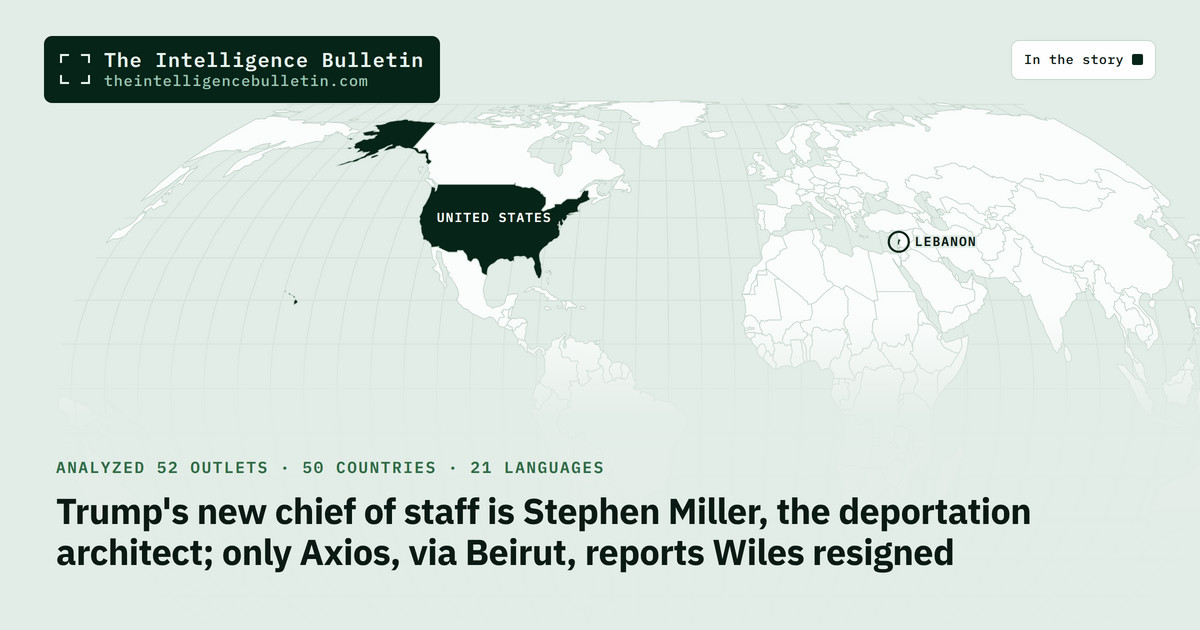
See the 50 countries
Albania, Argentina, Austria, Belgium, Bolivia, Brazil, Canada, Chile, China, Croatia, Cuba, Czech Republic, Denmark, Dominican Republic, Ecuador, Finland, France, Greece, Guatemala, Hungary, Israel, Kenya, Lebanon, Malaysia, Mexico, Moldova, Netherlands, New Zealand, Nigeria, Norway, Pakistan, Poland, Portugal, Puerto Rico, Qatar, Romania, Russia, Saudi Arabia, Singapore, Slovakia, Slovenia, Spain, Switzerland, Turkey, Tuvalu, United Kingdom, United States, Uruguay, Venezuela, Vietnam
Donald Trump announced Stephen Miller, his deputy chief of staff and hard-line immigration architect, will replace Susie Wiles as chief of staff November 9. Wiles stays in the political operation; Axios, via Ya Libnan, alone reports she resigned after the midterms and Trump blamed her.
Across the press: Only Axios, carried by Beirut’s Ya Libnan, reports Wiles resigned and Trump blamed her; the American, Hungarian and Vietnamese reports do not.
Source base: 5 outlets read in full (United States, Mexico, Lebanon, Hungary, Vietnam), selected from 52 analyzed.
- 1 of 5 · Ya Libnan onlyWiles submitted her resignation Thursday night, and the departure was a mutual decision driven by Tuesday’s election results, for which Trump blamed her.Sources told Axios, carried by Ya Libnan; no other outlet in the set reports the resignation or the blame.
- 5 of 5 · reported separatelyDonald Trump announced that Stephen Miller will replace Susie Wiles as White House chief of staff.Trump’s Truth Social announcement, quoted by Ya Libnan and carried by WGBH News, El Economista, 444 and Bao Tin Tuc.
- 3 of 5 · reported separatelyWiles will continue in Trump’s political operation after leaving the White House.Trump’s announcement and Wiles’s own social-media statement, reported by WGBH News, Ya Libnan and 444.
- 3 of 5 · reported separatelyThe staff change comes days after Republicans lost control of Congress in Tuesday’s midterms.WGBH News, Ya Libnan and Bao Tin Tuc all tie the replacement to the GOP midterm defeat; El Economista and 444 omit the connection.
- 4 of 5 · reported separatelyMiller is a longtime Trump adviser, currently deputy chief of staff, and the architect of the administration’s hard-line immigration policies.WGBH News, El Economista, 444 and Bao Tin Tuc profile Miller as the immigration hardliner and deputy chief of staff; Ya Libnan calls him a ‘maximalist champion’ of the agenda.
- Monday, November 9, 2026Miller formally takes office; his first staffing and scheduling decisions will show whether he consolidates control of the White House gatekeeper role.
- In the weeks after November 9Watch for new deportation actions or executive orders, since Miller has pressed for more ICE arrests and broader use of presidential decrees.
- January 2027Democrats take control of both chambers; Bao Tin Tuc reports they are forecast to investigate Miller’s role, shifting the conflict to oversight.
- Still openHow large will the Democrats eventual House majority be, since La República s live count shows 193 seats — 25 short of the 218 on which NBC s projected majority rests — even as NBC describes the result as possibly the party s largest in nearly two decades? · Which Texas record does James Talarico s win actually set: the first Democratic statewide office-holder since 1994, as the Liverpool Echo reports, or the first Democratic senator since 1992, as AFP s Africa Guinee dispatch reports?
Full analysis
What happened Why it matters How each country tells it Room for disagreement Our assessment Sources and evidence
What happened
President Donald Trump announced on Friday, November 6, 2026, that Stephen Miller, his deputy chief of staff, would replace Susie Wiles as White House chief of staff, effective Monday, November 9. The announcement came four days after NBC projected that Democrats had won both chambers of Congress in Tuesday’s midterms, which TIB reported on November 4. Trump’s Truth Social statement, quoted by Beirut’s Ya Libnan, praised Wiles and said she would move to the Trump political operation: "I am pleased to announce that Mr. Stephen Miller, the current Deputy Chief of Staff of the Trump Administration, and one of my most trusted advisors, will become the Chief of Staff starting Monday, November 9, 2026."
Wiles answered with her own social media statement, carried by WGBH News: "Serving President Trump in the White House has been the honor of a lifetime. I’m so proud to have been a part of what we’ve accomplished together from securing our border and cutting taxes to strengthening our economy and putting America First." She added that her commitment to "the President and the mission" will not change.
Only Axios, relayed by Ya Libnan, supplies the mechanics of the departure. It reports that Wiles submitted her resignation Thursday night, that the departure was a mutual decision but driven by Tuesday’s election results, and that Trump blamed her. No other outlet in the set — WGBH News, El Economista, 444 or Bao Tin Tuc — says she resigned or that Trump blamed her. The Axios account carried by Ya Libnan adds a bitter twist: the decisions Wiles opposed, the Iran war and the brutality of immigration enforcement, drove the midterm shellacking that cost her the president’s confidence.
Wiles was the first woman to hold the post and Trump’s longest-serving chief of staff, after he cycled through four in his first term. WGBH News notes she had gone public with a breast cancer diagnosis in March 2026 and said months later that she showed no evidence of the disease.
Miller is not a new face. WGBH News identifies him as the architect of Trump’s hard-line immigration policies; Hungary’s 444 calls him the most powerful unelected American and says all the second administration’s contested measures are traceable to him. He joined Trump’s 2016 campaign as a speechwriter and previously worked for then-Senator Jeff Sessions of Alabama. AFP’s profile, carried by Mexico’s El Economista, presents Miller as the designer of the presidential-decrees system Trump has used to justify raids and tariffs, and says his ideas are now majority thinking inside the administration. Bao Tin Tuc, from Vietnam’s state news agency, traces the record further: the 2018 zero-tolerance family separations, the attempt to end DACA, the 2017 travel ban, the ICE target of at least 3,000 arrests a day announced in May 2025, and support for military action in the Western Hemisphere, including the capture of Venezuela’s Nicolás Maduro and a January claim that the United States could take Greenland by force.
Why it matters
The appointment is a policy statement, not a personnel footnote. Axios’s reporting, through Ya Libnan, frames the trade explicitly: Wiles was one of the administration’s few moderating forces, Miller one of its "most maximalist champions"; the signal is that Trump may double down on the hardline policies that helped Republicans lose Congress. Wiles understood how to navigate Trump rather than try to control him; Miller’s value is command of the levers of executive power and a record of using them aggressively. The effective date, November 9, gives the new chief almost no transition period.
For governments watching American policy, the implications are concrete. El Economista’s AFP explainer says Miller considers immigration restriction essential to "saving Western civilization," pushed the administration to invoke a 200-year-old wartime law to deport undocumented migrants, and was reported to have said in May 2026 that the White House was "evaluating" suspending habeas corpus for migrants. Bao Tin Tuc adds that Miller has been at the center of the administration’s deportations of visa holders and permanent residents who criticized Israel, and that Democrats will control both chambers from January 2027 and are forecast to investigate his role. Hungary’s 444 reaches for historical comparisons to Mussolini, Goebbels and Stalin, reading the elevation as a turn toward authoritarian governance. Ya Libnan’s headline, for a Lebanese audience, foregrounds Miller as "far-right pro-Israel," making the change a signal about Washington’s regional posture.
For Americans, the midterm defeat is the immediate context: the president responded to losing Congress by elevating the adviser most identified with the policies voters rejected, and Democrats now have a target in the gatekeeper office that controls the president’s schedule, staffing and information.
How each country tells it
- WGBH News · United States · original reportingReports the swap as domestic political fallout: the GOP’s midterm defeat comes first, then Wiles’s departure and Miller’s immigration hardline background.
- El Economista · Mexico · wire copyRuns an AFP explainer on who Stephen Miller is, foregrounding his history as architect of Trump’s deportation apparatus and his rhetoric about saving Western civilization.
- Ya Libnan · Lebanon · carries AxiosLeads with Miller as ‘far-right pro-Israel’ and frames the appointment as Trump doubling down on hardline policies after midterm losses.
- 444 · Hungary · original reportingFrames the appointment through the comparison of Miller to Goebbels, Mussolini and Stalin, presenting him as the most powerful unelected man in America and the force behind all of Trump’s contested measures.
- Bao Tin Tuc · Vietnam · original reportingA personality profile of Miller as ‘the powerful figure behind President Trump,’ tracing his biography and policy record and noting Democrats are forecast to investigate his role after taking Congress.
Room for disagreement
The strongest case against reading this as a lurch toward hardline policy is that Miller’s formal title is catching up with the power he already exercised. Axios says he was already a co-equal of Wiles in some respects and that no one in Trump’s government knows the levers of power better. 444 says every contested measure of the second term is traceable to him. If that is true, November 9 changes the org chart more than the agenda. Wiles is not leaving Trump’s orbit: she moves to the Trump political operation, and her statement stresses an unchanged commitment to the president and the mission. Trump publicly praised her even as he replaced her. Once Democrats take the House and Senate in January, investigations into Miller’s role may absorb time and force the administration to defend its actions, but they cannot by themselves stop deportations or executive orders. So the more plausible counter is a continuation of the existing trajectory under a new title, not a new escalation.
Our assessment
This change is very likely to harden, not soften, the administration’s immigration-first and executive-action posture. The most important warrant is the convergence of independent reporting chains: WGBH News, AFP via El Economista, Hungary’s 444 and Vietnam’s Bao Tin Tuc all describe Miller as the architect of the deportation campaign and the strategic force behind the administration’s use of presidential power; Axios via Ya Libnan adds that Trump chose him after a defeat in which he blamed Wiles. Trump’s own announcement calls Miller one of his most trusted advisers and makes the promotion effective immediately. The interests in the room cut the same way: Axios’s inside sourcing wants to explain a personnel decision and Wiles’s allies would prefer her exit look mutual, but neither interest requires the substantive direction of the promotion to be read as a lurch. The Democrats’ January takeover and forecast investigations are likely to harden the administration’s posture rather than moderate it, because Miller’s record is to answer pressure with escalation: more arrests, more executive orders, more public combat.
What would change this: if Wiles remains a co-equal political operator at Trump’s side rather than a departing figure, or if the Democratic investigations force Miller to share the gatekeeper role with more conventional managers, the shift would look more like title-shuffling than the policy turn the reporting describes.
Sources and evidence
Press quoted
- Did Susie Wiles resign, was she dismissed, or was the departure genuinely mutual, and did Trump blame her personally as Axios reports?
- What will change in actual immigration, trade and foreign policy under Miller, beyond the general signal of a harder line?
- Will Miller retain direct control of immigration enforcement as chief of staff, or will that portfolio pass to a new deputy?
That’s how the world told the story.
Get our daily open-source intelligence on world events in your inbox — one email a day, up to six stories.
Subscribe freeNo spam. One-click unsubscribe. See the latest email →