 AI-generated analysis published under the editorial responsibility of Rohit Sinnas. How it works →
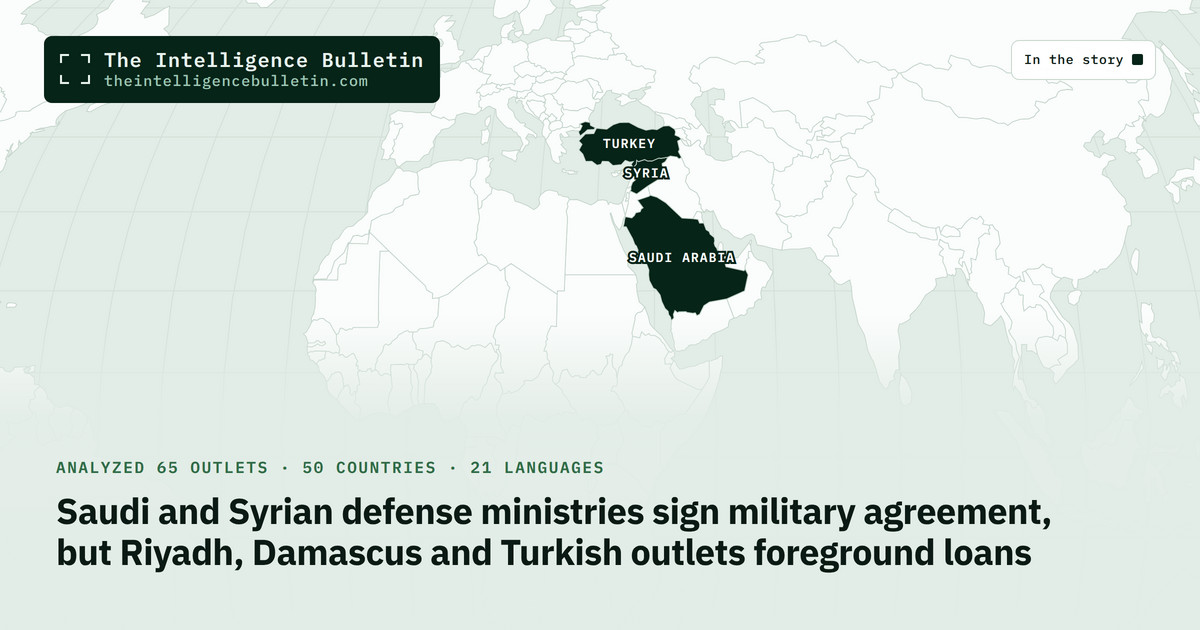
See the 50 countries
Albania, Argentina, Armenia, Austria, Azerbaijan, Bangladesh, Bosnia and Herzegovina, Brazil, Bulgaria, Canada, China, Croatia, Cuba, Dominican Republic, Egypt, Germany, Greece, Hungary, India, Iraq, Israel, Italy, Jordan, Kenya, Libya, Macao, Madagascar, Mexico, Morocco, New Zealand, Nigeria, Oman, Pakistan, Philippines, Qatar, Russia, Saudi Arabia, Serbia, Slovakia, South Sudan, Spain, Switzerland, Syria, Thailand, Turkey, Tuvalu, Ukraine, United Arab Emirates, United Kingdom, United States
Syrian President Ahmed al-Sharaa met Crown Prince Mohammed bin Salman on Wednesday during a visit that produced a defense cooperation agreement, reported by The Jerusalem Post and Navbharat Times but absent from Arab official coverage, and $403.6 million in Saudi concessional loans for Syrian reconstruction.
Across the press: The Jerusalem Post and Navbharat Times carry the military agreement and Houthi question, while Al Watan, Aksalser and yeniakit foreground the $403.6 million loan package.
Source base: 5 outlets read in full (Saudi Arabia, Syria, Turkey, Israel, India), selected from 65 analyzed.
- 2 of 5 · one shared reportSaudi Arabia’s and Syria’s defense ministries signed a military cooperation agreement on Wednesday during Syrian President Ahmed al-Sharaa’s visit to Riyadh.The Jerusalem Post and Navbharat Times both report the signing, drawing on official Saudi-Syrian announcements; no selected Arab source in the set carries the agreement text or details.
- 2 of 5 · one shared reportSyria is considering helping Saudi Arabia in its war against the Iranian-backed Houthis, and a Syrian diplomat says any military-cooperation request would be handled through bilateral agreements.The Jerusalem Post, citing Reuters; Navbharat Times, citing a Syrian diplomat.
- 4 of 5 · reported separatelyThe Saudi Fund for Development signed six concessional loan agreements with Syria’s Finance Ministry worth $403.6 million, with a 20-year term and five-year grace period, covering power, health, housing, civil defense, water and digital finance.yeniakit.com.tr, citing Syrian Information Ministry-run Damas Radio; The Jerusalem Post, citing the Syrian Foreign Ministry; Navbharat Times, citing Saudi Gazette; Al Watan carries only the headline and snippet on leadership-directed development projects in Syria.
- 4 of 5 · reported separatelySyrian President Ahmed al-Sharaa met Crown Prince Mohammed bin Salman during an official visit to Riyadh, their second meeting in a month.Aksalser, relaying SANA, reports the arrival and aim to meet the crown prince; The Jerusalem Post and Navbharat Times report the meeting and the second-in-a-month count; yeniakit.com.tr mentions the "critical visit."
Full analysis
What happened Why it matters How each country tells it Room for disagreement Our assessment Sources and evidence
What happened
Syrian President Ahmed al-Sharaa flew into Riyadh on Wednesday at the invitation of King Salman, landed at King Khalid International Airport accompanied by Foreign Minister Asaad Hassan al-Shaibani, and was received by Prince Faisal bin Bandar bin Abdulaziz, the emir of the Riyadh region, along with Saudi officials, as Syria’s Aksalser reported in a relay of the Syrian Arab News Agency. SANA described the trip as an official visit aimed at meeting Crown Prince Mohammed bin Salman and at enhancing bilateral relations, developing joint cooperation and discussing regional developments. The Jerusalem Post and Navbharat Times report that the meeting took place, the second between the two leaders within a month.
During the visit, the Saudi and Syrian defense ministries signed a military cooperation agreement, The Jerusalem Post and Navbharat Times report, drawing on official Saudi-Syrian announcements. Neither outlet gives the agreement’s text, and both note that its details have not been made public; no Arab source in the set carries it. What did travel widely was the development package signed the same day. The Saudi Fund for Development signed six concessional loan agreements with the Syrian Finance Ministry worth $403.6 million, on a 20-year term with a five-year grace period, as reported by yeniakit.com.tr citing Damas Radio, by The Jerusalem Post citing the Syrian Foreign Ministry, and by Navbharat Times citing Saudi Gazette.
yeniakit’s itemization runs sector by sector: $90 million to rehabilitate the Aleppo thermal power plant, $100 million to repair damaged hospitals and health buildings, $105 million to establish 25 civil defense and disaster management centers, $60 million to repair 10,000 housing units, $30 million to install around 300,000 smart water meters in Damascus and Idlib, and $18.6 million for digital transformation and financial services. The Jerusalem Post carries the healthcare, power, housing and civil defense lines; Navbharat confirms infrastructure, health, housing and financial services. yeniakit, whose account is sourced to the Syrian Information Ministry-run Damas Radio, adds memoranda of understanding covering industry, agriculture and environmental protection, plus $10.6 million in support for Syria’s participation in Expo 2030 Riyadh, and calls the package the first development financing directed to the Syrian state. Al Watan in Saudi Arabia carries only the headline and a snippet on leadership-directed development projects in Syria.
Navbharat Times, citing Saudi Gazette, records further same-day memoranda: one between the Saudi Industry and Mineral Resources Ministry and the Syrian Industry and Trade Ministry on industrial cooperation, and two between the Saudi and Syrian environment and agriculture ministries.
The military side of the day reaches readers through the two outlets watching from outside the deal. The Jerusalem Post, citing Reuters, reports that Syria was considering helping Saudi Arabia in its war against the Iranian-backed Houthis, and notes that Syrian Foreign Minister Asaad al-Shaibani has said Damascus was considering joining the Mecca Pact among Turkey, Saudi Arabia and Pakistan, with Egypt also interested. Navbharat Times reports a Syrian diplomat saying any military-cooperation request would be handled entirely through bilateral agreements. The two leaders, Navbharat adds, discussed reducing regional tension, prioritizing diplomacy, and preventing activities that threaten movement and waterway security in the Red Sea, the Bab al-Mandeb strait and the Strait of Hormuz.
Behind the visit sits a rapid thaw. Navbharat frames the post-Assad break: after Bashar al-Assad’s ouster in December 2024, Sharaa’s government is seen as aligned with Saudi Arabia and the United States, hence the frequent meetings. The Jerusalem Post recalls February’s announced investment deals — a nearly $1 billion telecommunications project to be built in two stages over 18 months to two years, 7.5 billion Saudi riyals (nearly $2 billion) committed to developing two Aleppo airports, and a flynas Syria airline joint venture, 51 percent Syrian and 49 percent Saudi-owned flynas.
Why it matters
This is the Arab world’s rehabilitation of Damascus moving from political recognition to concrete transactions, with defense now in the same frame as reconstruction. For Sharaa’s government, the six concessional loans are a lifeline and a legitimacy marker: reconstruction financing that treats the Syrian state as a direct counterparty, at a moment when the new leadership needs the cover that Gulf patronage confers as it steps away from the Iran-Russia axis Assad depended on. For Riyadh, the package is the visible half of a relationship it can present as leadership-directed development — Al Watan’s framing — while a military channel, if real, answers a security pressure: the Houthi missile and drone campaign against Saudi Arabia that Navbharat places at the center of the story.
Each outlet renders the same day through its own lens. Saudi Arabia’s Al Watan frames it as a new phase of development and cooperation, foregrounding the $403 million in leadership-directed development projects. Syria’s Aksalser, relaying SANA, presents a protocol arrival and an official visit aimed at meeting the crown prince, with no mention of the loans or the military agreement. Turkey’s yeniakit, working from Damas Radio, reads the moment as the point where bilateral cooperation became concrete projects, enumerating the loan lines and calling the visit critical. The Jerusalem Post bundles the military pact with the loans, the Houthi war and Syria’s interest in the Mecca Pact into a deepening axis watched from Israel’s security vantage. Navbharat Times attaches the agreement to the Yemen war and asks whether the road is now clear to send troops against the Houthis, explicitly framing Sharaa’s government as Saudi- and US-aligned after Assad’s fall.
How each country tells it
- Al Watan · Saudi Arabia · original reportingFrames the Riyadh–Damascus step as "a new phase of development and cooperation" led by Saudi leadership, foregrounding a $403 million package for development projects in Syria.
- Aksalser · Syria · carries Syrian Arab News Agency (SANA)Reports the Syrian president’s arrival in Riyadh with Foreign Minister Asaad al-Shaibani as an official visit aimed at meeting Crown Prince Mohammed bin Salman, including details of the airport reception.
- yeniakit.com.tr · Turkey · carries Damas Radio (Syrian Information Ministry)Reads the visit as the moment bilateral cooperation became concrete projects, enumerating the $403.6 million loan lines across electricity, health, housing, water and civil defense.
- The Jerusalem Post · Israel · original reportingTreats the visit as a deepening Syria–Saudi axis by bundling the "military pact" with $403 million in loans, the Houthi war and Syria’s possible interest in the Mecca Pact.
- Navbharat Times · India · carries Saudi GazetteAttaches the agreement to the Yemen war, asking whether the path is now clear to send troops against the Houthis, and frames al-Sharaa’s government as Saudi- and US-aligned after Assad’s fall.
Room for disagreement
The strongest case that the military story is overread sits in the reporting itself. Neither The Jerusalem Post nor Navbharat Times has seen the agreement’s text, and both concede its details are not public. The Syrian diplomat’s statement to Navbharat — that any military-cooperation request would be handled through bilateral agreements — reads as a holding line, not a commitment. The Arab official accounts foreground reconstruction for a reason that could simply be accuracy: the concrete, signed, enumerated product of the visit is the loan package, while the military agreement is an announcement without disclosed substance. On the Houthi question, both outlets carry it as consideration — one via Reuters, the other via a diplomat — and consideration, not agreement, is what the record shows. A reader could conclude the defense pact is aspirational and thin, and that the real story is the $403.6 million.
Our assessment
The military cooperation agreement is likely to stay largely below public view while the $403.6 million reconstruction package becomes the working core of the Saudi-Syrian relationship. The warrant is the corroboration structure: the loan package is converged upon by three independent reporting chains — Damas Radio through yeniakit, the Syrian Foreign Ministry through The Jerusalem Post, and Saudi Gazette through Navbharat Times — all tied to primary announcements, while the military agreement rests on two outside observers and has no published text. Riyadh and Damascus both have an interest in the development framing: Saudi Arabia can present itself as the reconstruction patron of a rehabilitated Arab neighbor, and Sharaa’s government can show Gulf finance as the dividend of its realignment. The outside outlets foreground the military because they are asking what the axis means for Iran’s position and the Yemen war — questions the two capitals are not yet answering in public.
What would change this: publication of the agreement’s text or an announced Syrian military commitment to the Houthi campaign.
Sources and evidence
Press quoted
- What does the signed defense cooperation agreement actually commit each side to, and why have its details not been made public?
- Has al-Sharaa concretely committed Syria to military help against the Houthis, or is this only a consideration, and what would Riyadh give Damascus in return?
- Why do the Saudi, Syrian and Turkish reports in this set omit the defense agreement while Israeli and Indian reports foreground it: are these separate documents, or the same package being framed differently?
That’s how the world told the story.
Get our daily open-source intelligence on world events in your inbox — one email a day, up to six stories.
Subscribe freeNo spam. One-click unsubscribe. See the latest email →