 AI-generated analysis published under the editorial responsibility of Rohit Sinnas. How it works →
See the 39 countries
Algeria, Azerbaijan, Brazil, Burkina Faso, Burundi, Cameroon, Canada, Chad, China, France, Gabon, Greece, India, Israel, Italy, Jordan, Kenya, Kuwait, Libya, Malawi, Malaysia, Mali, Mauritius, Morocco, Nigeria, Pakistan, Portugal, Qatar, Saudi Arabia, Serbia, Somalia, South Sudan, Sudan, Thailand, Tunisia, Turkey, Uganda, United Kingdom, United States
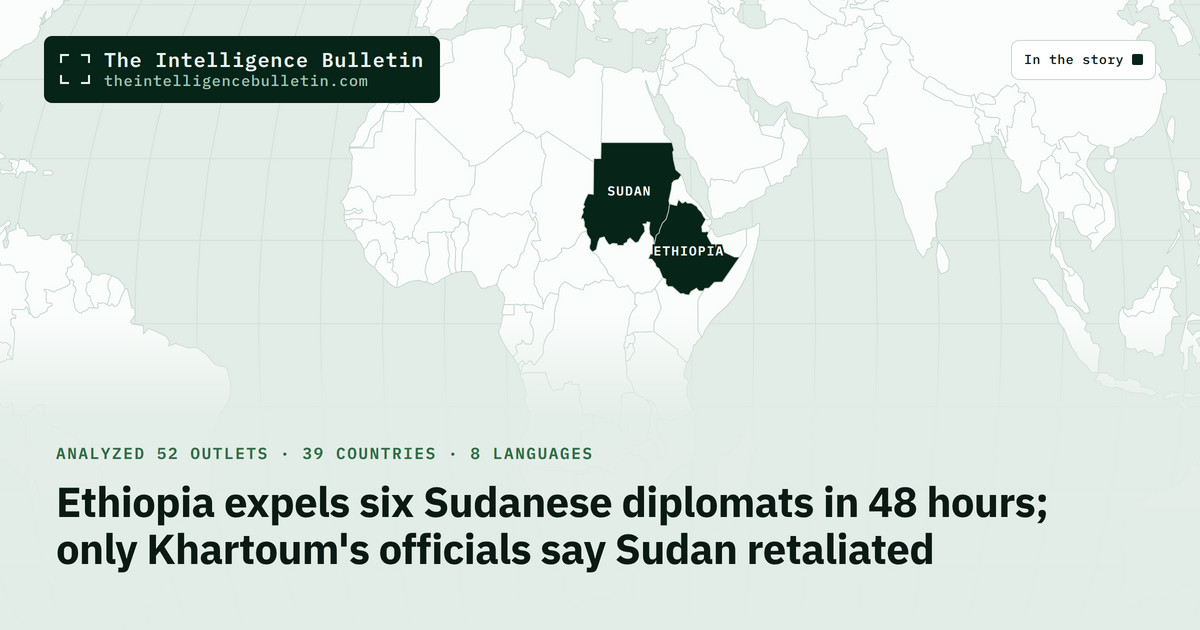
Ethiopia ordered six Sudanese consular staff at Assosa to leave within 48 hours, Reuters and Sudanese officials report. Sudan’s officials say their country retaliated against Ethiopian staff in Gedaref, a claim no other source corroborates.
Across the press: Hürriyet’s ‘tit-for-tat’ headline rests on AFP’s dispatch alone — Reuters text, carried by Sudanile, reports only the Ethiopian expulsion.
Source base: 5 outlets read in full (Sudan, Kenya, Saudi Arabia, Turkey, Mali), selected from 52 analyzed.
- 1 of 5 · Hürriyet Daily News onlySudan retaliated by declaring Ethiopian consular staff in Gedaref persona non grata, also giving them 48 hours to leave.AFP (carried by Hürriyet Daily News) cites two anonymous Sudanese government officials.
- 5 of 5 · reported separatelyEthiopia ordered six Sudanese consular staff at its Assosa consulate to leave within 48 hours.Reuters (carried by Sudanile) cites an anonymous senior Ethiopian official; AFP (carried by Hürriyet Daily News) cites an unnamed Sudanese government official.
- 4 of 5 · reported separatelySudan’s Transitional Sovereignty Council documented repeated RSF-linked attacks it says were launched from Ethiopian territory — 70 attacks per the AFP chain and Mali Actu, 187 one-way drones and nearly 500 civilian casualties per The Standard — and filed complaints with the UN Security Council and the African Union.Reuters (via Sudanile) reports Sunday’s UNSC/AU complaint; Hürriyet Daily News’s AFP text and Mali Actu, citing presidential adviser Amjad Farid, give 70 attacks; The Standard gives 187 drones and nearly 500 civilian casualties.
- 3 of 5 · reported separatelyEthiopia accuses Sudan — along with Egypt and Eritrea — of backing Tigray rebels who attacked government forces in September, and all three states deny it.Reuters (via Sudanile) states Ethiopia’s accusation and the three states’ denials; The Standard and Mali Actu carry the same counter-accusation.
- 2 of 5 · reported separatelyOvernight drone strikes were reported on Al-Damazin, capital of Blue Nile state bordering Ethiopia’s Assosa area.The Standard reports residents of Al-Damazin heard drone strikes throughout the night; Al Watan’s headline leads with ‘Drones struck Al-Damazin’.
- Nov. 6Deadline for the expelled Sudanese consular staff to leave Assosa, and if the AFP account is accurate, for Ethiopian staff in Gedaref to leave Sudan.
- No date givenAn on-record Ethiopian statement explaining the expulsion or disputing Sudan’s account, which would test whether the rupture is bilateral or one-sided.
- Next U.N. Security Council sessionDiscussion of Sudan’s formal complaint against Ethiopia, which Khartoum filed on Nov. 1 and which documented 70 attacks or 187 drones depending on the source.
- OngoingRSF offensive toward Al-Damazin in Blue Nile state, where residents reported overnight drone strikes on Nov. 4, keeping military pressure on the border.
- Still openWhat is Ethiopia s on-the-record response to this specific complaint, beyond the past general denials Mali Actu mentions? · Which account of responsibility is correct — Khartoum s claim that the drones launched from Ethiopian territory, or the Saudi outlet s military-source report that the RSF carried out the strikes?
Full analysis
What happened Why it matters How each country tells it Where accounts conflict Room for disagreement Our assessment Sources and evidence
What happened
On Nov. 4, Ethiopia ordered six Sudanese consular staff at its consulate in Assosa, a border town in the Benishangul region, to leave the country within 48 hours. The order came from a senior Ethiopian official who spoke to Reuters on condition of anonymity and gave no reason, according to the dispatch carried by Sudan’s Sudanile. Two unnamed Sudanese government officials told AFP, carried by Turkey’s Hürriyet Daily News, that Ethiopia had declared the staff persona non grata on Nov. 2 and that Sudan responded in kind, ordering Ethiopian consular staff in Gedaref, across the border, to leave within 48 hours as well. Only the AFP account reports the Sudanese retaliation. Mali Actu, a Malian outlet, adds that Ethiopia also closed the Assosa consulate.
The expulsions follow a formal complaint Sudan filed with the U.N. Security Council and the African Union’s Peace and Security Council on Nov. 1, accusing Ethiopia of allowing the paramilitary Rapid Support Forces to use its territory to launch drone strikes on civilian infrastructure. Sudan’s Transitional Sovereignty Council, in a report cited by the AFP chain and by Mali Actu through presidential adviser Amjad Farid, documented 70 such attacks between February and October. Kenya’s The Standard reports the same council document as 187 one-way attack drones launched from Ethiopian territory, killing or injuring nearly 500 civilians. The Sovereignty Council has not published the full report in any of the five sources.
Ethiopia denies the accusation and has accused Sudan, along with Egypt and Eritrea, of backing Tigray rebels who attacked government forces in September; all three states deny the charge, according to Reuters via Sudanile and The Standard. Overnight on Nov. 4, residents of Al-Damazin, the capital of Sudan’s Blue Nile state across the border from Assosa, reported hearing drone strikes throughout the night, The Standard reports. Saudi daily Al Watan’s headline leads with drones striking Al-Damazin before noting that Ethiopia "punishes" Sudan’s consulate. Farid told Mali Actu that Sudan is committed to its right to defend its territory but is making every effort to avoid an open war with Ethiopia. U.N. data cited by Reuters via Sudanile put the displacement from Sudan’s civil war at more than 14 million people since April 2023.
Why it matters
The rupture lands in a border region already split by two civil wars: Sudan’s army against the RSF, and Ethiopia’s federal forces against Tigray rebels. Each capital now formally accuses the other of arming its enemy, and the closure of a consulate removes one of the few channels that could manage that accusation. Kenya, which hosts refugees from both conflicts, carries the plainest account, sourced to a Sudanese government official; its neutral retelling reflects Nairobi’s stake in keeping the dispute from spilling across its own borders. Turkey’s Hürriyet Daily News, whose government maintains defense and diplomatic relations with both Addis Ababa and Khartoum, frames the expulsions as a balanced tit-for-tat, which preserves Ankara’s room to mediate. Sudanile, Sudan’s domestic outlet, leads with the accusation underneath the expulsion, presenting it as Ethiopia punishing Sudan for alleged rebel support rather than as a mutual action. Al Watan, a Saudi daily whose government is a party to Sudan’s war, leads with the security threat — the drones over Al-Damazin — and treats the diplomatic move as a consequence. Mali Actu, the only source outside the Arab world and the immediate neighborhood, lifts the story to continental altitude, calling it a warning about stability in the Horn of Africa rather than either side’s grievance.
How each country tells it
- Sudanile · Sudan · wire copyThe principal’s domestic read, whose headline pins the expulsion on ‘new accusations of aiding the Rapid Support Forces’, so the story arrives as Ethiopia punishing Sudan for alleged rebel support rather than as a reciprocal tit-for-tat.
- The Standard · KenyaA neighbouring daily reporting at arm’s length, sourcing the expulsion to a ‘Sudan govt source’ and delivering the plainest account: consular staff ordered out, the 187-drone report, and the Tigray counter-accusation.
- Al Watan · Saudi ArabiaThe Gulf read, whose headline leads with ‘Drones struck Al-Damazin’ and only then notes that Ethiopia ‘punishes’ Sudan’s consulate — the expulsion as security consequence, not as the story.
- Hürriyet Daily News · Turkey · wire copyAnkara’s angle settles on reciprocity — ‘Ethiopia, Sudan expel diplomats after attacks claim’ — foregrounding that both states expel and that the trigger is a disputed claim.
- Mali Actu · MaliA Sahelian read that lifts the story to continental altitude — ‘Tensions in East Africa’ — and names the closed Assosa consulate as the concrete symbol of the rupture.
Where accounts conflict
The retaliation is the sharpest conflict. AFP’s two officials say Sudan declared Ethiopian consular staff in Gedaref persona non grata and gave them 48 hours. Reuters’ dispatch, carried by Sudanile, mentions no Sudanese response, and neither The Standard, Al Watan’s headline, nor Mali Actu reports one. The entire tit-for-tat reading thus rests on a single chain of unnamed Sudanese officials.
The trigger is equally disputed. Reuters’ anonymous Ethiopian official gave no reason for the expulsion. AFP’s Sudanese officials tie it to Ethiopia’s move against the Assosa staff after Sudan documented RSF support. Mali Actu notes that Ethiopian authorities have not officially motivated the decision. No Ethiopian source, on the record or off, appears in any of the five accounts.
The timing also differs. AFP says Ethiopia declared the Assosa staff persona non grata on Nov. 2 and gave 48 hours, which would have expired on Nov. 4; Reuters reports the order as given on Nov. 4, with 48 hours to run. Neither text reconciles the gap.
Room for disagreement
The case against reading this as a spiral comes from the Sudanese side itself. Presidential adviser Amjad Farid told Mali Actu that Sudan is making every effort to avoid open war with Ethiopia, and a reciprocal expulsion of a handful of consular staff may be exactly the symbolic ceiling both governments can live with. Hürriyet’s balanced frame, which reflects Turkish interests in both capitals, could signal that a mediator is already positioned. And because no Ethiopian official has spoken on the record, the possibility remains that Addis Ababa’s move is a standalone administrative step, not a response to Khartoum’s complaint at all. If that is true, the tit-for-tat narrative in Hürriyet’s headline overstates the rupture, and the story is a one-sided echo of Khartoum’s grievance rather than a genuine bilateral breakdown.
Our assessment
The diplomatic freeze is likely to deepen before either side steps back. The initial expulsion is corroborated by two independent reporting chains, Reuters and AFP, so the event itself is solid. Sudan’s formal complaint to the U.N. Security Council and African Union is documented by three separate sources and gives Khartoum an institutional stake in pressing its case publicly. The retaliatory expulsion rests on a single chain, but the absence of any Ethiopian denial is itself informative: Addis Ababa, which has accused Khartoum, Cairo and Asmara of arming Tigray rebels, has not corrected the record. Each side’s accusation of proxy support predates this episode, so a single consular closure is unlikely to reset the pattern; the RSF’s offensive toward Al-Damazin, reported overnight across the border, ensures the military pressure continues regardless of diplomacy.
What would change this: an on-record statement from Addis Ababa explaining the expulsion or disputing Sudan’s account would test whether the rupture is bilateral or a product of Khartoum’s framing alone.
Sources and evidence
Press quoted
- What reason did Ethiopia give for the expulsion — or did it give none, given the Reuters dispatch says the anonymous official offered no reason and the Ethiopian PM’s spokesperson did not respond?
- Did Sudan’s reciprocal expulsion of Ethiopian consular staff from Gedaref actually occur, since only the AFP chain (via Hürriyet) reports it and Reuters’s dispatch mentions no Sudanese retaliation?
- Who flew the overnight drone strikes on Al-Damazin, and what damage or casualties did they cause?
That’s how the world told the story.
Get our daily open-source intelligence on world events in your inbox — one email a day, up to six stories.
Subscribe freeNo spam. One-click unsubscribe. See the latest email →