 AI-generated analysis published under the editorial responsibility of Rohit Sinnas. How it works →
See the 47 countries
Algeria, Azerbaijan, Bangladesh, Brazil, Burundi, Canada, China, Cyprus, Czech Republic, Egypt, Ethiopia, France, Germany, Greece, Haiti, Iraq, Israel, Italy, Jordan, Kuwait, Lebanon, Libya, Madagascar, Malaysia, Mali, Morocco, Nigeria, Oman, Paraguay, Qatar, Russia, Saudi Arabia, Serbia, South Africa, Sri Lanka, Sudan, Switzerland, Syria, Togo, Tunisia, Turkey, Uganda, United Arab Emirates, United Kingdom, United States, Yemen, Zimbabwe
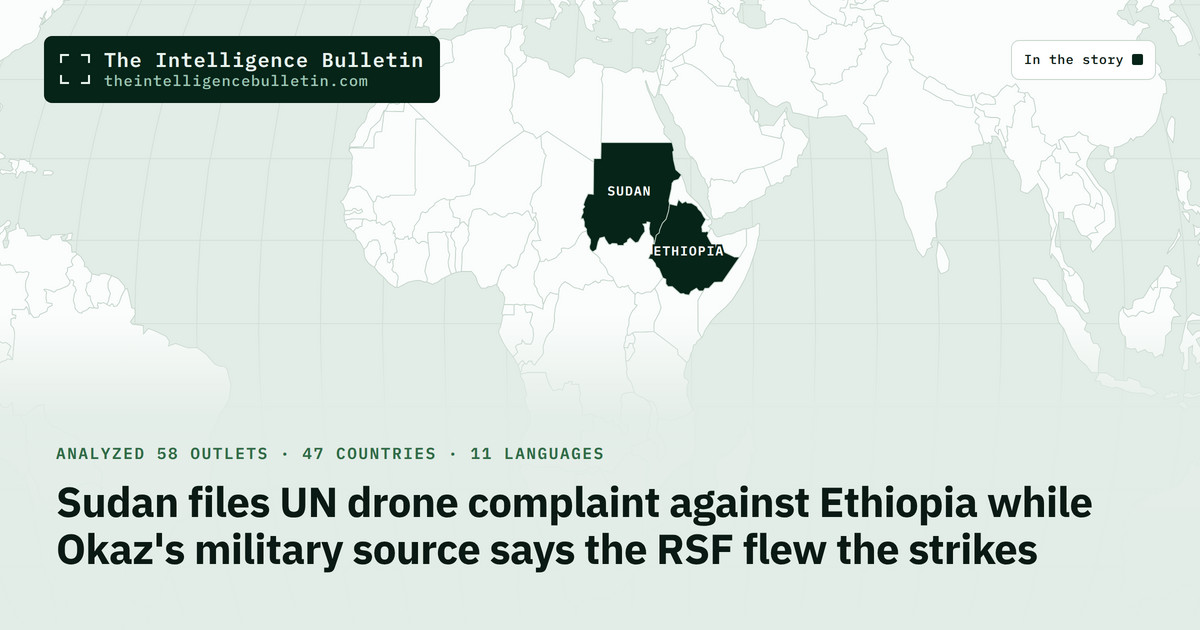
Sudan has filed UN and AU complaints alleging Ethiopian-launched drone attacks have killed hundreds and knocked out power stations across the country’s east. A Saudi outlet’s military source attributes last week’s strikes to the Rapid Support Forces, leaving responsibility for the campaign disputed.
Across the press: Four outlets carry Khartoum’s claim that drones launched from Ethiopia, while Okaz’s military source says RSF drones struck the stations.
Source base: 5 outlets read in full (Sudan, Egypt, Qatar, Saudi Arabia, Mali), selected from 58 analyzed.
- DisputedResponsibility for the drone campaign is disputed: Sudanese, Egyptian and Qatari-carried accounts blame Ethiopia, while Okaz’s military source names the Rapid Support Forces as the attackers.Source: Al Taghyeer, El Watan News and Al Jazeera carry the Ethiopian-responsibility claim; Okaz reports from a military source that RSF drones struck the stations.
- 1 of 5 · El Watan News onlySudan has filed a formal complaint against Ethiopia before the UN Security Council and the African Union Peace and Security Council over cross-border drone attacks.El Watan News, citing Al Qahera News, which quoted Sudan’s Ministry of Foreign Affairs.
- 1 of 5 · Al Jazeera onlyThe attacks killed 484 civilians and 176 soldiers between February and October 2026 and involved 187 drones in 70 attacks.Al Jazeera, citing a Sudanese Sovereignty Council report prepared with military and general intelligence.
- 4 of 5 · reported separatelyDrone attacks launched from Ethiopian territory have struck Sudanese civilian sites and vital infrastructure, including power and water stations, during 2026.Sudanese officials in accounts carried by Al Taghyeer, El Watan News, Al Jazeera and Mali Actu.
- 3 of 5 · reported separatelyCoordinated drone strikes last week hit multiple power stations in Gedaref, Gezira and White Nile states, causing widespread outages.Al Taghyeer and Okaz report the strikes in overlapping detail; Al Jazeera also notes recent power-station attacks in those states.
- In the coming weeksEthiopia’s formal response to the UNSC and AU complaints; its past denials will be tested against the 1.7km launch-point evidence.
- In the next monthWhether drone strikes on power stations in army-held states pause or continue, testing whether the filing changes facts on the ground.
- As the AU process unfoldsWhether the AU seeks mediation between Khartoum and Addis Ababa before the complaint escalates further.
Full analysis
What happened Why it matters How each country tells it Where accounts conflict Room for disagreement Our assessment Sources and evidence
What happened
Sudan has filed formal complaints against Ethiopia before the United Nations Security Council and the African Union Peace and Security Council, El Watan News reported, citing Al Qahera News, which quoted Sudan’s foreign ministry. The ministry said Ethiopia attacked civilian sites and power stations from inside its own territory, killing civilians and disrupting essential services, and demanded Addis Ababa halt the hostilities and bear responsibility for their consequences.
The filing followed a Saturday briefing in Port Sudan where deputy foreign minister Muawiya Osman Khalid set out the accusations to accredited diplomats. Al Taghyeer and Mali Actu both carried the briefing. Khalid said Ethiopian territory is being used as a launchpad for drones striking power, water, fuel and hospital infrastructure, and that the pace has escalated in recent months. He accused Ethiopia of waging a proxy war for other parties and regional states led by the UAE, using the militia as the arm executing the attacks. The Asosa base in western Ethiopia has become a center for supplying the militia with weapons, equipment and passage for foreign fighters, he said, and the most dangerous element is the use of Ethiopian territory and bases as drone launchpoints.
A Sovereignty Council report prepared by the foreign ministry with military and general intelligence adds figures. Al Jazeera reports that the report documents 70 attacks between February and October 2026 involving 187 drones launched from areas inside Ethiopia, killing or wounding 484 civilians and killing 176 soldiers in Blue Nile, Khartoum and elsewhere, and hitting hospitals, residential areas and fuel and electricity facilities. The report draws on drone wreckage, flight data and military records. A control computer recovered from a drone downed in Damazin, Blue Nile, in September held a flight path indicating launch from a point 1.7 kilometers inside Ethiopian territory. One attack last month on displaced families in Wad al-Mahi killed 30 civilians, 26 of them women and four children.
The latest wave of strikes hit power stations last week. Al Taghyeer reports more than 13 power distribution stations across Gedaref, Khartoum, Gezira, Red Sea, Sennar, White Nile and South Kordofan states were attacked or damaged, cutting power to a number of cities. Okaz reports a Sunday strike on the main conversion station at Al-Dabba in Northern State that cut power to the city entirely, plus hits on two fuel stations nearby, and says coordinated drone attacks on five power stations last week — two in Gedaref, two in Gezira and one in White Nile — knocked out electricity across wide areas of those army-held states.
The campaign sits inside a war between Sudan’s army and the Rapid Support Forces that began in April 2023, which Al Jazeera reports has displaced around 13 million people with tens of thousands dead and famine spreading. The United Nations has warned that drone attacks killed more than 1,100 people since the start of the year, including more than 300 in the past month alone.
Why it matters
The filing converts a long-running allegation into a formal legal-diplomatic process. Sudan is seeking what the report, as carried by Al Jazeera, describes as accountability and compensation for the damage and destruction, and the complaint places Ethiopia before the Security Council and the AU Peace and Security Council for the first time. The specificity of the evidence — above all the recovered control computer showing the 1.7-kilometer launch point — raises the cost of a flat denial, and Khalid’s naming of the UAE as the head of the proxy coalition draws a major regional patron into the open dispute.
For civilians, the stakes are measured in services lost. The UN figure of more than 1,100 drone deaths this year and Okaz’s report of a city left entirely without power sit inside a country where, Okaz notes, more than 20 million people face acute hunger and nearly 33.7 million need humanitarian assistance to survive. The targeting of energy infrastructure threatens access to health care and basic services for millions, as the UN warnings both outlets cite make plain.
The complaint also fixes the war’s regional dimension in public view. Mali Actu frames Khartoum’s accusations as a marked verbal escalation that, in its Horn of Africa analysts’ reading, lights up the regionalization of Sudan’s civil war, with cross-border sponsorship and historic rivalries among Red Sea and Nile states threatening wider instability, even though Addis Ababa has in the past denied interference and reaffirmed its commitment to Sudan’s territorial integrity.
How each country tells it
- Al Taghyeer · Sudan · original reportingCarries the Sudanese Foreign Ministry’s charge from the Port Sudan diplomatic briefing that Ethiopian territory is a launchpad for drones hitting power, water, fuel and hospital infrastructure, and that Ethiopia is waging a proxy war with the UAE.
- El Watan News · Egypt · carries Al Qahera NewsReports that Sudan has lodged a formal complaint against Ethiopia with the UN Security Council and the African Peace and Security Council over attacks on civilian sites and power stations.
- Al Jazeera · Qatar · original reportingLeads on the Sovereignty Council’s reported figures of 70 attacks, 187 drones, 484 civilians killed or wounded and 176 soldiers killed, plus evidence from drone wreckage and flight data pointing to launch points inside Ethiopia.
- Okaz · Saudi Arabia · original reportingReports a specific RSF drone strike on the Al-Dabba power station and coordinated RSF attacks on five other power stations, citing a military source.
- Mali Actu · MaliFrames Khartoum’s formal accusation that the Asosa base supplies the RSF as a dangerous regionalization of Sudan’s civil war, with a Horn of Africa and continental security lens.
Where accounts conflict
The reporting disagrees over who bears responsibility for the drone campaign. The four outlets carrying Sudanese official accounts — Al Taghyeer, El Watan News, Al Jazeera and Mali Actu — report Khartoum’s claim that the drones launched from Ethiopian territory and that Ethiopia bears international responsibility for cross-border operations. That case rests on the Sovereignty Council report’s flight data showing the 1.7-kilometer launch point, recovered wreckage, and Khalid’s assertion that Ethiopian bases serve as the launch platform.
Okaz reports the same attacks with a different attribution. Its military source says a long-range drone belonging to the Rapid Support Forces struck the Al-Dabba main conversion station on Sunday, and that last week’s coordinated strikes on five power stations in Gedaref, Gezira and White Nile were RSF operations. The Saudi daily names the RSF as the attacker throughout and never mentions Ethiopia.
The accounts are not necessarily irreconcilable: Khalid’s own briefing names the militia as the arm executing the attacks, so both accounts agree the RSF flew the drones. The disagreement is whether Ethiopian territory served as the launch platform — the state-responsibility question the complaints hinge on. As published, a reader is left with two different culprits for the same campaign.
Room for disagreement
The strongest case against treating the complaint as a turning point rests in Okaz’s attribution and Ethiopia’s past denials, which Mali Actu notes. If the RSF is running its own long-range drone campaign, the Security Council may view the attacks as part of Sudan’s civil war rather than cross-border aggression by a member state, and take no action. Ethiopia has previously denied interference and reaffirmed its commitment to Sudanese territorial integrity, giving Addis Ababa a ready defense, and the flight data in Sudan’s report is Khartoum’s own evidence, not independently confirmed in any of the reporting reviewed here.
Our assessment
The complaint is very unlikely to halt the drone campaign or draw early Security Council action against Ethiopia, because the attribution dispute gives Council members grounds to defer and the war’s internal character makes state responsibility easy to contest. The filing’s real effect is to force the question of Ethiopian complicity into a forum where Addis Ababa must answer with more than a denial, and to put the Asosa base and the UAE’s alleged role on the record alongside unusually specific evidence. We expect Ethiopia to fall back on its past refusals of interference, continued strikes on power infrastructure in army-held states, and a slow AU process, while the RSF’s role — which Khartoum’s own briefing admits as the executing arm — remains the shared fact underneath both accounts.
What would change this: an independent UN or AU finding confirming the launch points inside Ethiopia, or an Ethiopian acknowledgment of the flights.
Sources and evidence
Press quoted
- What is Ethiopia’s on-the-record response to this specific complaint, beyond the past general denials Mali Actu mentions?
- Which account of responsibility is correct — Khartoum’s claim that the drones launched from Ethiopian territory, or the Saudi outlet’s military-source report that the RSF carried out the strikes?
- Can the Sudanese report’s figures of 187 drones, 70 attacks and 484 civilian casualties be independently documented, given that the UN’s separate warning counts more than 1,100 drone-related deaths this year?
That’s how the world told the story.
Get our daily open-source intelligence on world events in your inbox — one email a day, up to six stories.
Subscribe freeNo spam. One-click unsubscribe. See the latest email →