 AI-generated analysis published under the editorial responsibility of Rohit Sinnas. How it works →
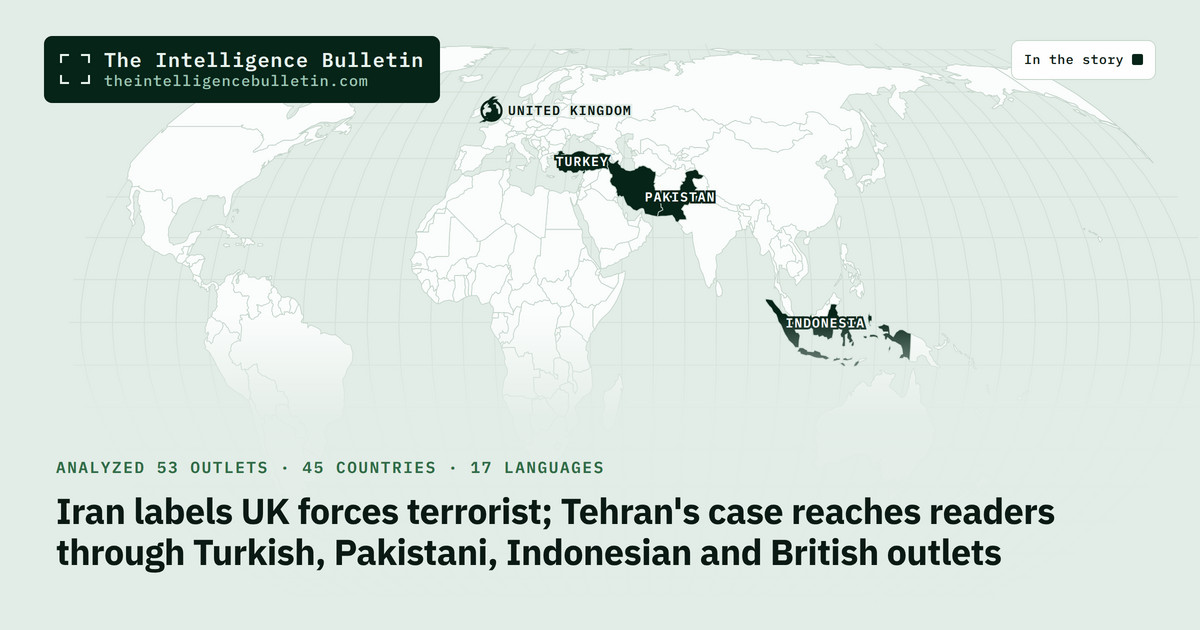
See the 45 countries
Afghanistan, Armenia, Australia, Austria, Bosnia and Herzegovina, Bulgaria, China, Cyprus, Egypt, France, Germany, Greece, Haiti, Hungary, India, Indonesia, Iran, Iraq, Ireland, Jamaica, Kenya, Lebanon, Malawi, Mauritius, Netherlands, New Zealand, Philippines, Poland, Qatar, Romania, Russia, Saudi Arabia, Senegal, Slovakia, Somalia, South Korea, Sri Lanka, Switzerland, Turkey, Tuvalu, Ukraine, United Arab Emirates, United Kingdom, United States, Vietnam
Iran’s Foreign Ministry designated Britain’s Royal Navy and RAF as terrorist organisations and MI6 as a hostile group, citing the UK’s July listing of the IRGC. The British government, quoted by Metro, rejected the designations, which four non-Iranian outlets reported without dispute.
Across the press: Anadolu and Republika treat Iran’s designation as a neutral legal step, while Metro leads with British forces as targets and the government’s rejection.
Source base: 5 outlets read in full (United Kingdom, France, Turkey, Pakistan, Indonesia), selected from 53 analyzed.
- 1 of 5 · Metro onlyThe British government rejects Iran’s designations and says the UK will continue to defend its people, national security and interests with allies.A UK Government spokesperson quoted by Metro.
- 4 of 5 · reported separatelyOn Sunday, Iran’s Foreign Ministry announced the designation of Britain’s Royal Navy and Royal Air Force as terrorist organizations and MI6 as a hostile group.Iranian Foreign Ministry statement, as reported independently by Metro, Anadolu Agency, Aaj News and Republika.
- 4 of 5 · reported separatelyIran framed the designation as retaliation for the UK’s 13 July 2026 decision to place the Islamic Revolutionary Guard Corps under the State Threats Act 2026.Iranian Foreign Ministry statement carried by the same four outlets; Anadolu says the ministry cited London’s ‘malicious’ actions.
- 4 of 5 · reported separatelyTehran accused London of participating in the US-Israeli war against Iran by providing access to military, logistical bases and facilities under British jurisdiction.Iranian Foreign Ministry statement, reported by Metro, Anadolu, Aaj News and Republika.
- Within daysA further UK government statement or parliamentary response to the designation, potentially outlining security measures for British forces in the region.
- Coming weeksAny increase in attacks on British military assets or bases, which counter-terrorism specialist Roger Macmillan warned the designation could legitimise.
- Next round of Qatari mediationWhether Iran’s designation complicates or scuttles ongoing US-Iran talks, given Tehran’s demand for Washington to first end its naval blockade.
- Still openDid the Tehran meeting produce any concrete commitment from Iran on reopening the Strait of Hormuz, or only an agreement to continue consultations? · What are the seven conditions Iran has tied to reopening the strait and returning to negotiations, and do the mediators consider any of them acceptable?
- 31 Oct · Barrack says very close via Gulf News; Nile News and three others record Iran s rejection.
- 28 Oct · Qatar tells Iran to reopen Hormuz and show good faith; Tehran calls the same talks very good
- 26 Oct · Tehran hosts Saudi, Pakistani and Turkish officials — Riyadh announces de-escalation, Iranian officials announce an order without the US
- 31 Oct · Iran s media say four tankers struck mines in Hormuz; the Reuters-AFP wire Arab News ran says three were halted
Full analysis
What happened Why it matters How each country tells it Where accounts conflict Room for disagreement Our assessment Sources and evidence
What happened
On Sunday, Iran’s Foreign Ministry announced that Britain’s Royal Navy and Royal Air Force were designated terrorist organizations and MI6 a hostile group, effective 1 November 2026. The announcement, carried in the ministry’s statement on the official government website Irangov.ir, was reported independently by Britain’s Metro, Turkey’s Anadolu Agency, Pakistan’s Aaj News and Indonesia’s Republika. The ministry said the decision was taken under a resolution by Iran’s Supreme National Security Council and followed the UK’s designation of the Islamic Revolutionary Guard Corps under the State Threats Act 2026 on 13 July. Tehran also accused London of participating in the US-Israeli war against Iran by providing access to military, logistical bases and facilities under British jurisdiction. The statement added that the measures were adopted in accordance with international law and the principle of reciprocity, and that the British government would bear responsibility for their consequences.
Aaj News reported that the blacklisting of the Royal Navy and RAF was made under Iran’s reciprocal law created after the United States listed the IRGC, and that MI6 was designated a hostile group on charges of espionage, sabotage and cooperation with Israel. Anadolu noted that the ministry described London’s actions as malicious. The British government’s response reached readers only through Metro, which quoted a spokesperson saying: "We utterly reject these designations. The UK will always stand for freedom and democracy, and we will continue to defend our people, our national security and our interests alongside our allies and partners."
The designation comes as the war between the US-Israel coalition and Iran, which began on 28 February 2026 with the killing of Supreme Leader Ayatollah Ali Khamenei, has simmered through a June memorandum and subsequent exchanges of strikes. Republika supplied the most complete backstory, including that the US launched airstrikes on Iranian coastal infrastructure after Iran allegedly attacked cargo ships in the Strait of Hormuz, and that Iran retaliated with strikes on US bases in Kuwait and Bahrain. Metro added that British forces have been involved throughout, with the RAF shooting down more than 100 Iranian-made drones targeting British and coalition bases, Iran firing missiles at British bases in Diego Garcia and Cyprus, and the warship HMS Dragon deployed to safeguard shipping in the Strait of Hormuz.
Why it matters
The designation has concrete stakes beyond diplomatic insult. Counter-terrorism specialist Roger Macmillan, quoted by Metro, warned that Iran’s move could "legitimise and encourage" proxy attacks against the UK, including against defence infrastructure and military sites, and that the terror label can induce fear even without immediate acts. Because Iran frames the designation as a legal act under its own reciprocity law, British military personnel and assets become formal targets under Iranian law, a shift that could embolden Iran-aligned groups in the region.
The move also lands amid active mediation. Qatar has been shuttling between Washington and Tehran, and the prior week saw senior Saudi, Turkish and Pakistani officials in Tehran pressing for de-escalation. Iran’s designation of a permanent UN Security Council member’s armed forces as terrorist organisations complicates any diplomatic track, especially while Tehran demands the US first end its naval blockade. For the UK, the designation is a direct challenge to its forces’ legitimacy in the region, and the government’s rejection, carried only by Metro, signals it will not alter its posture. For Iran, the designation demonstrates resolve to its domestic audience and to regional allies, showing that it will answer Western legal moves with its own.
How each country tells it
- Metro · United Kingdom · original reportingBritain’s free daily reports the designation from the receiving end, leading with the RAF and Royal Navy as objects of Iran’s scare-quoted ‘terrorist’ label and treating it as an affront aimed at British forces.
- National Council of Resistance of Iran (NCRI) · France · original reportingThe selected NCRI brief is an opposition exile daily roundup that, in the text retrieved, does not report the Royal Navy and RAF designation at all; it instead attacks the clerical regime over executions, economic collapse, and a Frankfurt award dispute.
- Anadolu Agency · Turkey · original reportingTurkey’s state news agency reports the designation at maximum distance, with scare quotes around ‘terrorist’ and ‘hostile group’, as one exchange in the broader US-Israel-Iran war.
- Aaj News · Pakistan · original reportingPakistan’s Urdu-language outlet reports the designation baldly as news for a neighbour with ties to both sides, naming the British forces and MI6 with neither British outrage nor Iranian celebration.
- Republika · Indonesia · original reportingIndonesia’s Islamic-oriented daily reports the designation as plain fact with no British alarm or Iranian celebration, while supplying unique background on the war’s origins.
Where accounts conflict
No material factual conflicts emerged among the four outlets that reported the designation. The accounts agree on the date, the targets, the effective date, and the reasons cited by Tehran. The one source that did not report the designation at all, the Paris-based exile opposition outlet NCRI, is not a conflicting account but an absence: its November 1 brief spent its space on a Frankfurt award dispute over Reza Pahlavi, executions of political prisoners, and Iran’s economic crisis, with no mention of the Royal Navy or RAF. That absence is itself a finding about whose voice is absent from the selected set, not a dispute over the facts.
Room for disagreement
The strongest case against taking this designation as a meaningful escalation is that it is symbolic and legally unenforceable against a foreign military. Iran cannot arrest Royal Navy sailors or bring the RAF before its courts. The UK has been actively engaged in the conflict for months, and British bases and ships have already been struck by Iranian missiles, so the designation may add little operational risk beyond what already exists. The British government’s rejection, as carried by Metro, is standard diplomatic language, not a threat of retaliation, and the UK has not announced any change in its force posture. Moreover, mediation efforts remain alive: TIB reported on 31 October that Qatari mediators returned to Tehran with a draft peace proposal, and Iran’s security chief had called earlier regional talks "very good". If diplomacy advances, this designation could be quietly reversed or deprioritised, as such reciprocal listings often are when broader agreements are reached.
Our assessment
The designation is very likely to intensify informational and proxy warfare between London and Tehran over the coming months, while an outright state-on-state military clash between Britain and Iran remains unlikely. The designation itself is corroborated across four independent reporting chains, and the most concrete operational warning comes from counter-terrorism specialist Roger Macmillan, quoted in Metro, who said the move could legitimise and encourage proxy attacks on UK defence and military sites. Britain’s existing military footprint in the region, from HMS Dragon to RAF airbases, gives such proxies ample targets, and the legal framing under Iranian reciprocity law provides a rhetorical cover. Iran has every interest in appearing to act decisively against the West without triggering a direct NATO response, while the UK’s rejection, though firm, stops short of military escalation.
What would change this: a confirmed attack on British forces that Iranian state media directly attributes to the new terrorist designation, or a UK announcement of new strikes on Iranian assets, would move the call toward direct confrontation. Without that, the designation is likely to remain a war of words and legal posturing with asymmetric edges.
Sources and evidence
Press quoted
- What does the Iranian designation actually authorise in practice under Iranian law, and does Tehran intend to treat British service members or dual nationals as terrorists?
- Why does the official Iranian statement place MI6 under a separate espionage and cooperation law rather than the reciprocal-terrorism law, and will that distinction carry different legal or military consequences?
- Is this designation tied to any immediate operational shift against UK forces or assets, or is it purely declaratory, given that Metro reports Iran has already targeted British bases at Diego Garcia and Cyprus?
That’s how the world told the story.
Get our daily open-source intelligence on world events in your inbox — one email a day, up to six stories.
Subscribe freeNo spam. One-click unsubscribe. See the latest email →