 AI-generated analysis published under the editorial responsibility of Rohit Sinnas. How it works →
See the 5 countries
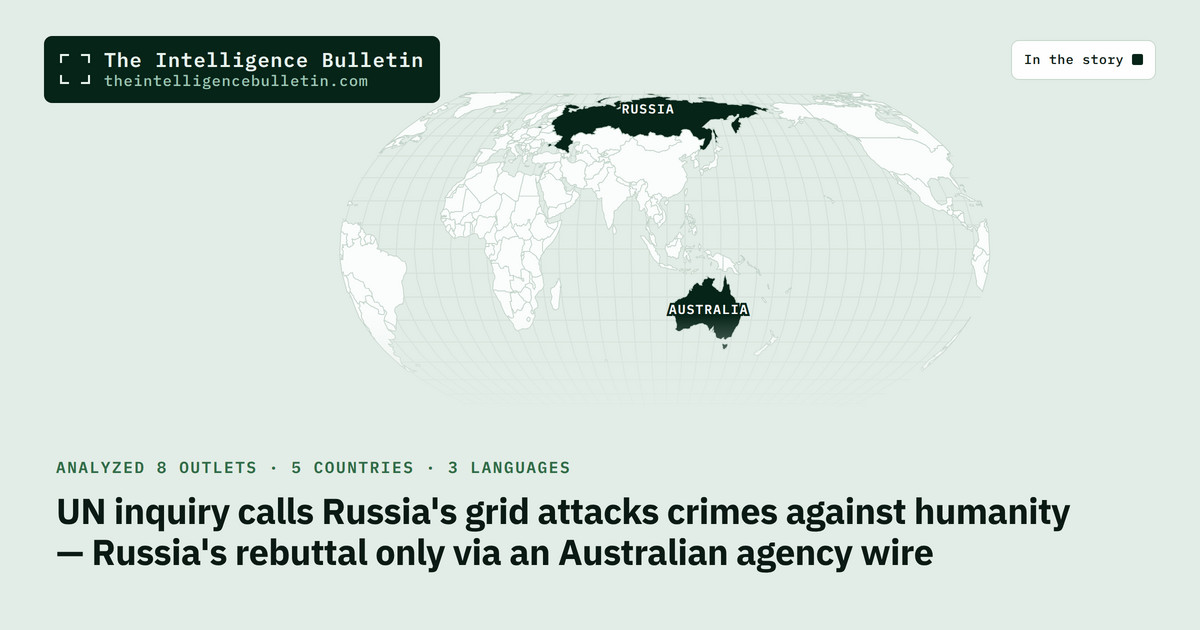
Australia, Germany, Turkey, Ukraine, United States
UN commission found Russian authorities committed war crimes and crimes against humanity by attacking Ukraine’s energy grid, leaving millions without heat and power, and trafficked men from 29 countries into service. Russia’s UN Mission called the findings ‘falsified data’; only Australian Associated Press carried it.
Across the press: Interfax-Ukraine and Anadolu report the UN verdict without any Russian response; only The Standard’s Australian agency copy carries Russia’s ‘falsified data’ rebuttal.
Source base: 3 outlets read in full (Ukraine, Turkey, Australia), selected from 8 analyzed.
- 1 of 3 · Anadolu Agency onlyThe attacks were carried out under a Russian state policy intended to deprive civilians of essential services, which the commission classifies as crimes against humanity.Anadolu Agency, citing the commission’s report.
- 1 of 3 · The Standard (Warrnambool) onlyRussia’s UN Mission said it did not recognise the commission’s mandate and claimed its findings were based on ‘falsified data’, while Russia maintains it strikes only military or military-related targets.The Standard (Warrnambool) via Australian Associated Press, reporting Russia’s UN Mission statement and longstanding Russian position.
- 3 of 3 · reported separatelyThe UN Independent International Commission of Inquiry on Ukraine concluded that Russian authorities committed war crimes and crimes against humanity by deliberately attacking Ukraine’s energy infrastructure.Reported by Interfax-Ukraine, Anadolu Agency and The Standard (Warrnambool), all citing the commission’s report to the UN General Assembly.
- 2 of 3 · reported separatelyMillions of people in Ukraine faced lengthy outages of heating, electricity, water and gas and intolerable living conditions, especially during the winter of 2025-2026.Anadolu Agency and The Standard (Warrnambool) via Australian Associated Press, citing the commission’s findings.
- 2 of 3 · reported separatelyRussian authorities recruited men from 29 countries into the armed forces through deception or coercion, forcing them to sign Russian-language military contracts.Anadolu Agency and The Standard (Warrnambool) via Australian Associated Press, citing the commission’s report; Interfax-Ukraine reports the trafficking finding without the 29-country figure.
- First sustained cold of winter 2026-2027Whether strikes on the grid repeat at the scale the commission documented, after Erik Mose warned attacks have already intensified again.
- Still openWhich start date governs the operation — the White House s Oct. 29 or the two militaries Oct. 27 — and do they denote different phases such as a shooting halt versus civilian visits and evacuation? · Did Kyiv formally accept the White House s preferred destination clause allowing evacuees to choose Russia, and what safe-passage or de-mining guarantees did Moscow give?
- 24 Oct · Melania Trump’s White House says truce starts Oct. 29; Russian and Ukrainian armies say Oct. 27
- 22 Oct · A Russian missile barrage hits Kyiv as Zelensky offers the frontline freeze Washington wanted
- 21 Oct · Ukraine s St Petersburg attack hits VK and oil port; Russia s own casualty counts conflict
Full analysis
What happened Why it matters How each country tells it Where accounts conflict Room for disagreement Our assessment Sources and evidence
What happened
On Monday 26 October, the UN Independent International Commission of Inquiry on Ukraine submitted its first report focused on the impact of Russian attacks on Ukraine’s energy infrastructure, concluding that Russian authorities committed war crimes and crimes against humanity by deliberately targeting the grid. The commission was authorised by the Geneva-based Human Rights Council shortly after Russia’s full-scale invasion in February 2022.
The conclusion, covered by Interfax-Ukraine, Anadolu Agency and The Standard of Warrnambool via Australian Associated Press, holds that the strikes were intentionally directed against civilian objects — war crimes — and inflicted "great suffering to civilians" — crimes against humanity. Commission chair Erik Mose delivered the verdict by video at a UN news conference. Millions of people in Ukraine faced "lengthy outages of heating, electricity, water, and gas, and had to cope with intolerable living conditions," the commission said in passages carried by Anadolu and The Standard, particularly during the winter of 2025-2026. The Standard’s account spells out what that meant: elderly residents without elevators to reach shelters during missile and drone attacks, hospital patients without critical devices to keep them alive, millions suffering in "frigid winter darkness."
Interfax-Ukraine places the strikes in a longer arc, reporting that waves of attacks — hundreds of drones and missiles deployed at once — had mounted since the fall of 2022. Mose warned, in a line Anadolu carried, that "as the cold season approaches, the attacks have intensified once again, raising serious concerns about the threats to civilians’ lives and health." Anadolu alone reports the commission’s sharper finding that the attacks were carried out under a "state policy" intended to "deprive civilians of essential services" — the classification that moves the conduct from war crimes against civilian objects into crimes against humanity.
The Standard alone carries the methodology: the findings rest on accounts from 255 Ukrainians who endured winter conditions in Kyiv and eight other regions in 2025-26, plus government officials, doctors and civic organisations.
The commission also traced foreign recruitment into the Russian armed forces. Anadolu and The Standard report that men from 29 countries were recruited through deception or coercion and forced to sign Russian-language military contracts before frontline deployment; Interfax-Ukraine reports the trafficking finding without the figure. The Standard adds that the men "came mostly from vulnerable and marginalised communities, with a poor economic background and a low education level," lured by agents abroad posing as legitimate, government-endorsed businesses, then forced to sign Russian-language Defence Ministry documents they did not understand. "The recruits were shocked to discover that they would be serving for the Russian armed forces," the commission said in that account.
Russia’s answer appears in only one of the three reports. The Standard, running Australian Associated Press copy, carries Russia’s UN Mission statement that Russia does not recognise the commission’s mandate and claims the findings are based on "falsified data." The same article records Russia’s standing position that its forces strike only military or military-related targets.
Why it matters
The significance runs in three directions. Legally, this is the commission’s first report focused squarely on the grid, and the crimes-against-humanity designation is the sharpest it has attached to that campaign: it converts a pattern of strikes into an allegation of state policy aimed at depriving civilians of heat, water, power and gas. Interfax-Ukraine leads with exactly that escalation, and it matters because crimes against humanity carry a different gravity and accountability route than discrete war crimes. Practically, the timing is a warning rather than a retrospective: Mose’s observation that attacks have already intensified as another cold season approaches signals the commission is describing an ongoing operation, not a closed file. For civilians — the elderly in elevators, the hospital patients on critical devices named in The Standard’s wire — the report records that their suffering is evidence, not collateral. For Russia, the finding attaches legal weight to a targeting doctrine Moscow has always presented as legitimate military necessity; because Russia refuses to recognise the commission’s mandate, the dispute is about standing to judge, not evidence.
How each country tells it
- Interfax-Ukraine · Ukraine · original reportingTreats the UN inquiry as domestic news and leads with the harsher legal upgrade, that Russian attacks on Ukraine’s energy infrastructure amount to crimes against humanity, ahead of the generic war-crimes verdict.
- Anadolu Agency · Turkey · original reportingReports the commission’s ruling from a mediator’s distance, foregrounding the crimes-against-humanity label while attributing it to an outside UN body.
- The Standard (Warrnambool) · Australia · wire copyCarries the bare agency verdict that Russia committed war crimes and crimes against humanity, while uniquely including the Commission’s methodology and Russia’s on-record rejection.
Where accounts conflict
The substantive dispute in the reporting is between the commission and the Russian state. The commission, resting its conclusion on 255 Ukrainian accounts as reported by The Standard, says Russian authorities deliberately struck civilian energy objects under a state policy to deprive civilians of essential services — war crimes and crimes against humanity. Russia’s UN Mission says it does not recognise the commission’s mandate and dismisses the findings as based on "falsified data," while Russia maintains its forces strike only military or military-related targets. The two positions cannot both be true, and they rest on different foundations: the commission on testimony gathered across nine Ukrainian regions plus officials and doctors; Russia on a rejection of the commission’s standing to investigate. That rebuttal appears only in The Standard’s Australian Associated Press copy.
Room for disagreement
The strongest case that this report changes little comes from the record itself. Russia’s UN Mission has already called the commission illegitimate and dismissed its findings, and Moscow has never altered a targeting pattern in response to a UN finding — the commission’s own warning, carried by Anadolu, that the grid campaign has already intensified as another winter approaches is evidence it continued even as the report was written. There is no enforcement mechanism: the commission can name crimes but cannot indict, and earlier UN-backed inquiries on the war have produced reports without tribunals acting on them. On that view, the crimes-against-humanity label is a rhetorical escalation, not a material one — the strikes will go on, the winter will test the grid again, and the report will sit alongside findings Moscow has ignored. The named evidence for this case is Russia’s UN Mission statement and Mose’s observation about renewed attacks, both on the record.
Our assessment
The crimes-against-humanity finding is likely to become the settled international legal description of Russia’s energy-grid campaign, while changing nothing on the ground before winter. The warrant is corroboration: three independent reporting chains — Interfax-Ukraine, Anadolu Agency and Australian Associated Press — all carry the commission’s verdict, and two independently report the 29-country trafficking figure, so the conclusion is not the artefact of a single outlet. The methodology The Standard’s wire describes, through 255 Ukrainian accounts and supporting officials, gives the finding an evidentiary spine a bare announcement would lack. Ukraine’s own agency has every interest in the reader seeing the escalation, and it leads with exactly that; Russia has an equal interest in its dismissal, yet that dismissal reached readers only through one Australian regional masthead’s agency copy — the global audience mostly met the verdict unchallenged. The missing piece is enforcement: no tribunal has adopted the finding, and without one its power is descriptive.
What would change this: the International Criminal Court or another prosecuting body formally adopting the crimes-against-humanity characterisation, turning a symbolic verdict into an indictable process.
Sources and evidence
Press quoted
- What evidence and legal reasoning in the full report supports the conclusion that the attacks were a state policy aimed at depriving civilians of essential services, and how does that distinguish crimes against humanity from individual war crimes?
- Has Kyiv or any UN member state announced formal follow-up action at the General Assembly, Human Rights Council or ICC on the basis of this report?
- What is Moscow’s substantive answer beyond the UN Mission’s rejection of the mandate, and why does that response appear only in the Australian agency copy?
That’s how the world told the story.
Get our daily open-source intelligence on world events in your inbox — one email a day, up to six stories.
Subscribe freeNo spam. One-click unsubscribe. See the latest email →