 AI-generated analysis published under the editorial responsibility of Rohit Sinnas. How it works →
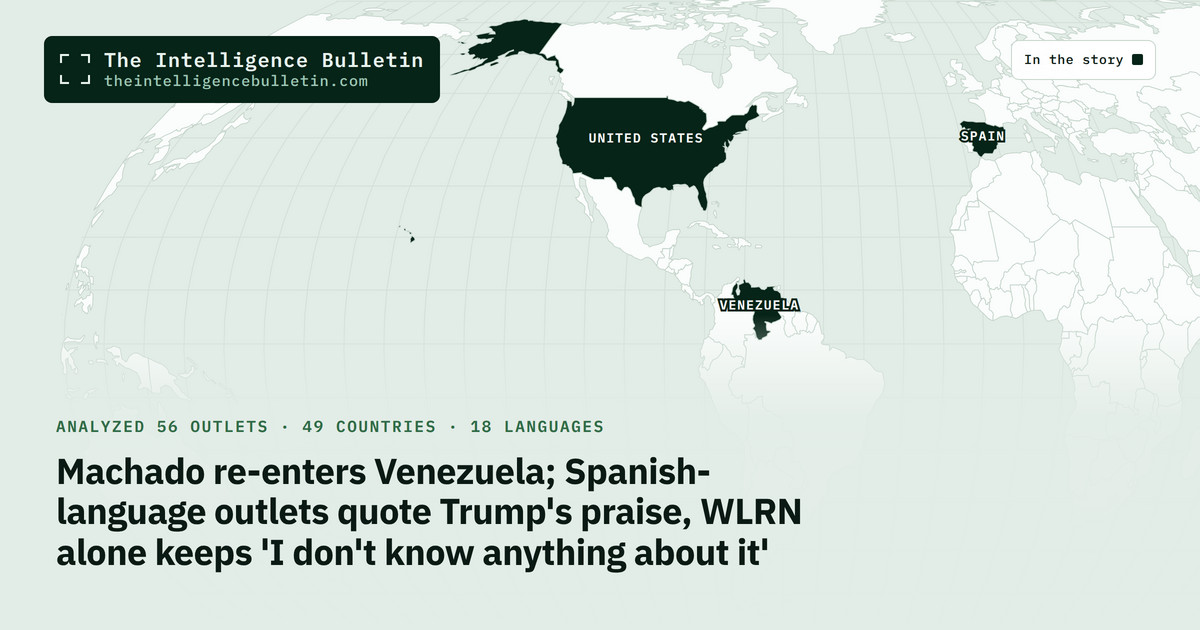
See the 49 countries
Argentina, Australia, Austria, Barbados, Bosnia and Herzegovina, Brazil, Chile, Colombia, Cuba, Denmark, Dominican Republic, Ecuador, Egypt, El Salvador, Finland, France, Germany, Haiti, India, Indonesia, Ireland, Israel, Italy, Japan, Kenya, Lithuania, Mexico, Morocco, Netherlands, Norway, Oman, Paraguay, Philippines, Poland, Portugal, Romania, Russia, Slovakia, Spain, Sri Lanka, Sweden, Switzerland, Turkey, Tuvalu, Ukraine, United Kingdom, United States, Uruguay, Venezuela
María Corina Machado returned to Venezuela Sunday after nearly a year out, appearing at a Lara sanctuary. Trump called her ‘a very nice woman’ but, per WLRN, added ‘I don’t know anything about it’; whether Washington blocked earlier returns is disputed, with Rubio denying it.
Across the press: WLRN quotes Trump’s ‘I don’t know anything about it’; EFE notes he offered no details, Pulzo and Clarín print only his praise.
Source base: 5 outlets quoted (Venezuela, United States, Russia, Colombia, Argentina), selected from 56 analyzed. 4 read in full, 1 by its headline only.
- Denied on the recordMachado’s earlier attempts to return were repeatedly thwarted — seven times according to Clarín — with Trump widely blamed for blocking her, while Secretary of State Rubio has gone on record denying the US ever asked other governments to block her return.Source: WLRN reports Trump widely blamed for thwarting her attempts and Rubio insisting the US was not blocking her; Clarín reports seven frustrated attempts; RIA Novosti relays Rubio’s denial that Washington asked other governments to block her and his line that media reports are not established fact.
- 1 of 5 · Clarín onlyShe entered by land through the Colombia–Táchira border post and drove 847 kilometers to Caracas, making stops in Barquisimeto, Chivacoa, Valencia, Guacara and Maracay.Clarín alone reports the overland route and its details.
- 5 of 5 · reported separatelyMaría Corina Machado returned to Venezuelan territory on Sunday, October 25, announcing it on X with ‘I am here. With you’ and appearing at the Divina Pastora sanctuary in Santa Rosa, Lara state.All five sources report the return, citing her X post, images from her team, and Edmundo González’s X post confirming she is on Venezuelan territory.
- 4 of 5 · reported separatelyMachado had been out of Venezuela for nearly a year — roughly ten or eleven months — after leaving clandestinely in December 2024 to receive the Nobel Peace Prize in Oslo.El Carabobeño (EFE), WLRN, Pulzo and Clarín all state or imply the exile’s duration and its start with the clandestine Nobel trip.
- 4 of 5 · reported separatelyTrump reacted by calling her ‘a very nice woman’ who gave him her Nobel Prize, voicing hope she is safe, and adding ‘we’re doing really well in Venezuela’.Four outlets quote the same Washington pool remarks; only WLRN preserves his opening words ‘I don’t know anything about it,’ while EFE paraphrases that he offered no details on the return.
- Immediate weeks after October 25Whether Delcy Rodríguez’s government seeks to restrict Machado’s activity or permits her open organizing, which WLRN reports was a feared risk.
Full analysis
What happened Why it matters How each country tells it Where accounts conflict Room for disagreement Our assessment Sources and evidence
What happened
María Corina Machado came home on Sunday, October 25, after nearly a year outside Venezuela — ten months by Pulzo’s count, eleven by Clarín’s, "casi un año" in the EFE wire. The Nobel Peace Prize laureate announced "I am here. With you" on X around noon and, within the hour, was inside the sanctuary of the Divina Pastora in Santa Rosa, Lara state, where supporters of her party, Vente Venezuela, received her with embraces. Edmundo González, the opposition’s 2024 presidential candidate and himself in exile in Spain, wrote on X that Venezuela’s "sovereign voice returns."
Only Clarín reconstructs how she crossed back: by land through the border post between Colombia and Táchira state, then an 847-kilometer drive to Caracas with stops in Barquisimeto, Chivacoa, Valencia, Guacara and Maracay, crowds gathering within twenty minutes at the cry "ahí viene María Corina" and pressing to touch her hands. EFE, by contrast, says no details have been divulged about the route or about whether Washington played any role.
The exile she ended began in December 2024, when she left clandestinely for Oslo to accept the Nobel, having already spent nearly a year in hiding after denouncing fraud in the presidential election the CNE gave to Nicolás Maduro without publishing full results. The ground shifted while she was away: on January 3 U.S. special forces arrested Maduro in Caracas and took him to New York on drug-trafficking charges, and his vice president, Delcy Rodríguez, now holds power as interim president, having backed an oil deal giving the Pentagon a 35 percent stake in the parent of NABEP, holder of rights over 17 Venezuelan fields.
Clarín counts seven frustrated attempts to return before this one, and WLRN reports Trump was widely blamed for thwarting them because a Machado homecoming would complicate his talks with Rodríguez. Secretary of State Marco Rubio denies it on the record: early this month he said the United States never asked any other government to block her, and on Sunday he credited her safe return to "U.S. supported reconciliation talks" that have already freed hundreds of political prisoners and returned hundreds of exiles.
Trump’s own Sunday remarks split the source record. WLRN is the only outlet to carry his opening words — "I don’t know anything about it" — before he called her "a very nice woman," recalled that she gave him her Nobel medal, said he hoped she was safe, and added, "we’re doing really well in Venezuela." EFE paraphrases instead that he offered no details. Pulzo and Clarín quote only the flattering lines.
U.S. congressmen quoted by Pulzo — Carlos Giménez among them — held Rodríguez and her circle responsible for any harm to Machado, and opposition figures from Juan Pablo Guanipa to former Colombian president Iván Duque pressed for an election date. Machado herself told the New York Times last week, in an interview carried by WLRN, that the moment is a "win-win" for a transition, citing a million Venezuelans in the U.S., sixty-five percent of whom tell pollsters they would return home under democracy.
Why it matters
What is at stake is whether a return that no one blocked becomes a return that no one can restrain. WLRN frames the story through South Florida’s enormous diaspora — nearly a quarter of Venezuela’s population has fled — for whom Machado in the country means a date for elections and, as the Miami nonprofit head Maria Alejandra Marquez puts it, the only way "the country can start moving forward." But that outlet’s own analysts temper the hope. Imdat Oner, a former Turkish diplomat now at Florida International University, expects elections in 2028 rather than 2027, predicts Machado "will likely have to be cautious and careful on mobilizing people," and speculates one condition of her homecoming is that she stop criticizing Trump’s oil mega-deal — which she has attacked over its central figure, Alejandro Betancourt, a regime-linked businessman accused of massive corruption. The analyst Orlando Vieira Blanco tells Clarín her return "changes the problem but doesn’t resolve it," because she was leading pressure from outside and now must deliver results at a moment when she is "not in the epicenter of decision-making." Rubio’s framing — return as the product of reconciliation talks, with hundreds still in prison — points the same way: the return is real, and it is managed.
How each country tells it
- El Carabobeño · Venezuela · wire copyLeads with Donald Trump’s reaction to Machado’s reappearance at a church in Lara state, treating her return as accomplished fact and foregrounding the US angle.
- WLRN Public Radio · United States · original reportingReads the return from South Florida’s Venezuelan diaspora as renewed hope for an election timetable, while carrying on-record skepticism about the backroom conditions behind it.
- RIA Novosti · Russia · original reportingFrames the homecoming as a ‘secret’ event known only from media reports, then centers Rubio’s on-record denial that Washington blocked her and earlier failed attempts via Aruba, Curaçao and a canceled Panama sailing.
- Pulzo · Colombia · original reportingReads the return as Washington’s story: Trump’s reaction plus named US congressmen who warn that Delcy Rodriguez’s circle will be held responsible for her safety, alongside opposition demands for an election date.
- Clarín · Argentina · original reportingNarrates the mechanics of the return: seven frustrated attempts, an ‘operación diplomática’, and an 847-kilometer overland drive from the Colombia–Táchira border to Caracas with stops where crowds received her.
Where accounts conflict
The blocking question is a live disagreement, not a settled fact. WLRN reports Trump was "widely blamed" for thwarting Machado’s earlier attempts because her popularity threatened his oil negotiations; RIA Novosti relays Rubio’s on-record denial that Washington ever asked other governments to block her and his line that media reports "are not established fact." Clarín’s seven frustrated attempts sit against the narrower documented trail RIA carries from the Dutch paper Volkskrant: two attempts through Aruba and Curaçao refused by the Netherlands, and a Panama sailing cancelled for an alleged engine failure. Trump’s own words on Sunday divide along the same fault: WLRN alone preserves "I don’t know anything about it," EFE paraphrases that he offered no details, and Pulzo and Clarín leave the ignorance out entirely, so a reader of the Spanish-language wire sees a president informed and approving while a reader of Miami public radio sees one indifferent. The Russian agency goes further and declines to treat the return itself as confirmed, headlining it as a "secret" event known from media reports.
Room for disagreement
The strongest case that this return changes less than it appears comes from the analysts on the record and the president’s own words. Oner argues there were "clearly some behind-closed-doors negotiations here," that Washington "will still be the main actor" and that Machado will not push hard for a quick timetable; Vieira Blanco says she must now answer to a population expecting results while not sitting where decisions are made. Trump’s "I don’t know anything about it" — preserved only by WLRN — suggests the return was not his priority even as Rubio claims it as the fruit of his diplomacy. On this reading, Machado has been admitted back on terms that keep her visible but not decisive, an asset to a transition whose pace is set in Washington and whose economic prize is the oil deal, and her base’s hope for a fast election date will outrun what she is positioned to deliver.
Our assessment
It is likely that Machado will operate openly and un-arrested in Venezuela, but that an election date will come slower than her supporters expect, with 2028 more probable than 2027, because the reporting’s independent analysts converge on the same managed, conditional reading from opposite ends of the hemisphere — Oner in Miami and Vieira Blanco cited by Clarín in Argentina — and because the on-record denials and Trump’s preserved indifference show a return negotiated, not forced. The warrant is the corroboration of the event across four independent reporting chains plus Clarín’s ground detail, against which the only substantive dispute is Washington’s prior role, and Rubio has an interest in presenting the return as his reconciliation policy’s success while Trump has an interest in appearing to have had no involvement.
What would change this: Rodríguez’s government moving to restrict Machado’s activity, or Washington publicly endorsing a 2027 election calendar, either of which would overturn the managed-return reading in opposite directions.
Sources and evidence
Press quoted
- What conditions were attached to Machado’s return — negotiated with Washington and Delcy Rodríguez’s interim government — and do they constrain her ability to mobilize for a fast election timetable?
- Did Washington actually block her previous return attempts, as her movement’s critics claim and the seven frustrated attempts suggest, despite Rubio’s repeated on-record denials?
- Will her presence force Rodríguez’s government to set an election date, and how real is the arrest risk to her from the regime holdovers that US congressmen name?
That’s how the world told the story.
Get our daily open-source intelligence on world events in your inbox — one email a day, up to six stories.
Subscribe freeNo spam. One-click unsubscribe. See the latest email →