 AI-generated analysis published under the editorial responsibility of Rohit Sinnas. How it works →
See the 49 countries
Australia, Austria, Belgium, Bolivia, Bosnia and Herzegovina, Brazil, Canada, China, Croatia, Dominican Republic, Finland, France, Germany, Greece, Hungary, India, Indonesia, Ireland, Israel, Italy, Kenya, Lebanon, Lithuania, Luxembourg, Mexico, Moldova, Netherlands, New Zealand, Norway, Paraguay, Peru, Poland, Portugal, Qatar, Romania, Russia, Saudi Arabia, Serbia, Singapore, South Africa, Spain, Sweden, Switzerland, Turkey, Tuvalu, Ukraine, United Arab Emirates, United States, Vietnam
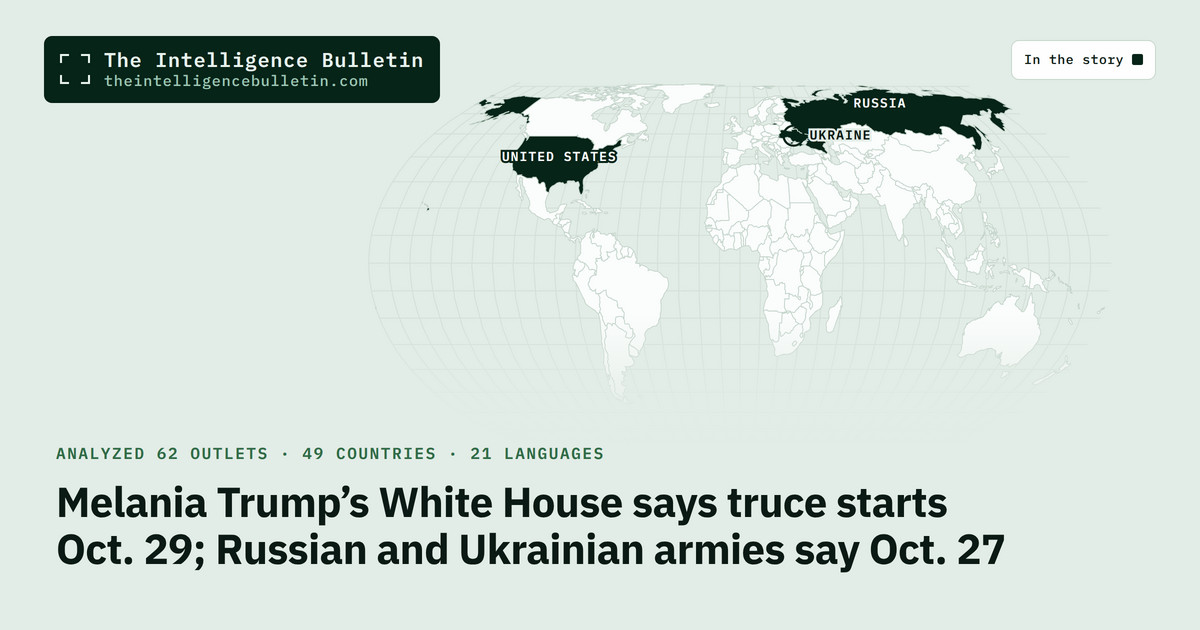
Melania Trump’s office announced an Oleshky ceasefire for aid and evacuation. The White House says it starts Oct. 29, but Russia’s Gerasimov and Ukraine’s General Staff both set Oct. 27; CBS says the countries have not commented.
Across the press: CBS News reports only the White House’s Oct. 29 start and says Russia and Ukraine have not commented; Anadolu quotes their military statements setting Oct. 27.
Source base: 5 outlets read in full (Ukraine, United States, Netherlands, Poland, Turkey), selected from 62 analyzed.
- DisputedThe White House said the localized ceasefire is scheduled to begin Thursday, Oct. 29.Source: First lady’s office/White House announcement reported by US and international outlets.
- DisputedRussian Chief of General Staff Valery Gerasimov announced that Russia will cease fire in the Oleshky direction at 4 a.m. Moscow time on Oct. 27.Source: Russian Defense Ministry statement carried by Ukrainian, Polish and Turkish outlets.
- DisputedUkraine’s General Staff said it will introduce the ceasefire regime in the Oleshky area at 3 a.m. Kyiv time on Oct. 27.Source: General Staff of the Armed Forces of Ukraine, quoted on Telegram.
- 5 of 5 · reported separatelyRussia and Ukraine agreed to a temporary, localized ceasefire in Oleshky to allow humanitarian aid to enter and to prepare civilian evacuation.White House/first lady office announcement, corroborated by Russian and Ukrainian official statements in the same reporting window.
- 5 of 5 · reported separatelyMelania Trump’s office says she personally brokered the ceasefire as ‘Exclusive Intermediary’, a role publicly credited by the White House, Donald Trump and the Kremlin.First lady’s office statement; Trump’s Fox News remarks; Peskov’s statement reported by multiple outlets.
- Oct. 27, 2026Russian and Ukrainian ceasefires are set to take effect in Oleshky; watch whether fighting pauses and the first humanitarian convoy moves.
- Days after Oct. 27Peskov said the operation could last at least several days; evacuation of residents and visits by civilian leaders will show whether the truce holds.
- Oct. 29, 2026The White House’s stated start date arrives; if the operation is already underway, the discrepancy may be publicly resolved or reframed.
- Around Nov. 10TIB reported Putin ready for trilateral talks; whether the Oleshky truce holds will affect that diplomacy.
- Still openWill Kyiv agree to send negotiators to Abu Dhabi in mid-November on Moscow s stated security-system agenda, and has any Ukrainian official responded to the offer? · Does Washington read Putin s readiness to resume expert-level talks as acceptance of the Oslo package s partial ceasefire or Article 5-style guarantees, or as a Kremlin attempt to set its own security-system agenda?
- 22 Oct · A Russian missile barrage hits Kyiv as Zelensky offers the frontline freeze Washington wanted
- 22 Oct · Putin Accepts Trilateral Ukraine Talks Around November 10, but Kremlin Transcript Omits Abu Dhabi Venue Others Report
- 21 Oct · Witkoff leaves Oslo with a peace package; Glavred calls it a plan for Putin, Lenta.ru waits on Moscow s terms
Full analysis
What happened Why it matters How each country tells it Where accounts conflict Room for disagreement Our assessment Sources and evidence
What happened
Melania Trump’s office announced on Friday, Oct. 23, 2026, that Russia and Ukraine had agreed to a temporary, localized ceasefire in the Russian-occupied town of Oleshky, across the Dnipro River from Ukrainian-held Kherson, to allow humanitarian aid to enter and to prepare civilian evacuations. Her office described her as having worked “directly with Russian and Ukrainian leadership to define the terms of the localized ceasefire” and as acting in a formal role titled “Exclusive Intermediary.” Melania Trump’s own statement called Oleshky “a front-line war city on the brink of disaster,” with a remaining population of mostly elderly residents who need medical attention, medicine, food and clean water while living with limited electricity and mined roads. She said non-military civilian leaders from both countries would visit residents in their homes to assess needs, and that those who chose to leave would receive coordinated transport to their preferred destination. “I anticipate some will want to go to Russia, and some to Ukraine,” she said.
The Kremlin confirmed the arrangement. Spokesman Dmitry Peskov described it as an extensive and complex humanitarian operation, welcomed Melania Trump’s “significant contribution,” and said the issue had been raised in a recent phone call between Vladimir Putin and Donald Trump. He said those who wished to leave Oleshky would be able to do so, that the operation could last at least several days, and that evacuation routes would be given only if cleared for release. He added that Washington and Moscow had been able to reach agreement on “complex details,” and expressed gratitude to the American side.
Ukraine’s confirmation came from two channels. Human rights ombudsman Dmytro Lubinets said in a Telegram video that the agreement provided for a ceasefire, aid delivery and safe passage for civilians wishing to leave, and that the operation was extremely complex and would be carried out in stages. Ukraine’s General Staff said it would introduce the ceasefire regime in the Oleshky area at 3 a.m. Kyiv time on Oct. 27, that orders would be delivered to troops, and that it expected humanitarian access to be guaranteed.
Russia’s armed forces named the same day. Chief of General Staff Valery Gerasimov announced a ceasefire in the Oleshky direction from 4 a.m. Moscow time on Oct. 27 and said engineering reconnaissance would be conducted to allow safe movement of a humanitarian convoy. The White House and first lady’s office, however, had announced the ceasefire would begin on Thursday, Oct. 29.
The human stakes were concrete. An estimated 2,000 residents remained in Oleshky, most elderly and around 50 children, cut off from reliable food and water. Pope Leo XIV had telephoned Putin on Oct. 16 to press the town’s plight. The first lady’s office said an American media organization, Newsmax, would document the Russian and Ukrainian teams.
Why it matters
This is the first localized truce to emerge from the current US-led peace push, and its broker is unusual enough to be the story’s second plot. President Trump told Fox News his wife had done “very hard work” and “a good job,” while Peskov’s praise gave the credit line a Kremlin endorsement. NaTemat, the only outlet in the set to openly interrogate the laurels, noted that the first lady had written to Putin about deported children in August 2025 and has so far helped reunite 34 children with their families, and that Pope Leo had intervened before she did.
For the people of Oleshky, the start date is not a minor detail: two days’ difference can decide whether an elderly resident receives medicine before winter or whether the first convoy moves under artillery cover. For Ukraine, the General Staff’s framing — introducing the ceasefire autonomously to carry out a humanitarian mission — signals that Kyiv wants the operation controlled by its military, not by a US first lady or the Kremlin. For Russia, a localized truce in a town it has occupied since early 2022 offers a low-cost way to appear cooperative while the front remains active, a point NaTemat underscored by recalling that Russia has broken earlier truces, including 147 combat clashes in May despite a formally binding ceasefire.
The ceasefire also arrives amid Washington’s broader push to freeze the front and resume trilateral talks around Nov. 10, as TIB reported this week.
How each country tells it
- UNIAN · Ukraine · original reportingFrames the ceasefire as Kyiv’s own military measure — the Ukrainian General Staff ‘introducing’ a ceasefire regime in the Oleshky area from Oct. 27 — rather than a diplomatic achievement announced by Washington.
- CBS News · United States · original reportingPresents the truce as a first-lady diplomatic achievement, emphasizing her self-described ‘Exclusive Intermediary’ role and the White House’s Oct. 29 start date.
- The Moscow Times · Netherlands · original reportingStarts from Moscow’s position that Oleshky is Russian-controlled and centres the Kremlin’s confirmation of the ceasefire and Peskov’s praise, while also noting that the militaries are working to determine dates.
- NaTemat · Poland · opinionInterrogates who deserves credit for the truce, weighing Melania Trump’s claimed role against Pope Leo XIV’s intervention and explicitly warning that Kremlin declarations must be treated with distance.
- Anadolu Agency · Turkey · original reportingPresents the ceasefire as jointly confirmed by Russia and Ukraine, with Gerasimov, Peskov, Ukrainian Ombudsman Lubinets and Ukraine’s General Staff all on record within one report.
Where accounts conflict
The central dispute is the start date. CBS News, reporting from the first lady’s office, gave only the White House’s Oct. 29 and stated that Russia and Ukraine had “not commented” on the announcement. Yet Anadolu Agency and UNIAN both carried on-the-record statements from the two armed forces setting Oct. 27: Gerasimov’s 4 a.m. Moscow time silence and Ukraine’s General Staff order for 3 a.m. Kyiv time. The exiled Moscow Times reported the White House’s Oct. 29 date while also quoting the Kremlin as saying the two militaries were still working to determine implementation dates, which may explain why the later date circulated at all. NaTemat was the only source to state plainly that the truce was to begin Oct. 29 while the Russians spoke of Oct. 27.
A second contradiction is narrower: CBS’s assertion that Russia and Ukraine had not commented sits against the same-day confirmations from Peskov, Gerasimov, Lubinets and Ukraine’s General Staff reported by Anadolu and UNIAN. This is a difference in what each newsroom had on hand at the time of publication, not a disagreement about whether the truce exists.
Room for disagreement
The strongest case that the truce is real and likely to begin on Oct. 27 is that both armies, not merely politicians, issued operational orders with specific times and tasks. Gerasimov’s announcement included engineering reconnaissance for a humanitarian convoy; Ukraine’s General Staff said orders would be delivered to troops. Peskov said those who want to leave will be able to do so, and Lubinets confirmed the agreement in detail. The convergence of the two military commands on the same morning suggests the Oct. 27 date reflects coordinated planning between field commands, with the White House announcement lagging behind operational reality. On this reading, the two-day discrepancy is a bureaucratic artifact, not a sign of failure.
Our assessment
It is likely that a localized ceasefire begins around Oleshky on the morning of Oct. 27, as the Russian and Ukrainian general staffs have separately announced, rather than on the White House’s Oct. 29 date. The operational specificity from both armed forces, carried independently by Anadolu and UNIAN, is stronger evidence of what will happen on the ground than a first lady’s office release. But the truce’s durability is doubtful: Russia’s record of breaking previous arrangements, cited by NaTemat, and the mutual accusations over blocking supplies to Oleshky make the corridor fragile. The parties also have interests in the story itself — Washington wants a reservoir of diplomatic credit, Moscow wants to appear cooperative in an occupied town, and Ukraine wants to present the rescue as its own.
What would change this: a verified breach by either side before the first humanitarian convoy reaches Oleshky would likely collapse the Oct. 27 timetable and shift any renewed attempt toward the White House’s Oct. 29 date.
Sources and evidence
Press quoted
- Which start date governs the operation — the White House’s Oct. 29 or the two militaries’ Oct. 27 — and do they denote different phases such as a shooting halt versus civilian visits and evacuation?
- Did Kyiv formally accept the White House’s ‘preferred destination’ clause allowing evacuees to choose Russia, and what safe-passage or de-mining guarantees did Moscow give?
- Will the truce hold given Russia’s record of breaking past ceasefires, and who beyond Newsmax will monitor or verify it?
That’s how the world told the story.
Get our daily open-source intelligence on world events in your inbox — one email a day, up to six stories.
Subscribe freeNo spam. One-click unsubscribe. See the latest email →