 AI-generated analysis published under the editorial responsibility of Rohit Sinnas. How it works →
See the 53 countries
Afghanistan, Armenia, Australia, Austria, Azerbaijan, Bangladesh, Bosnia and Herzegovina, Brunei, Bulgaria, Canada, China, Colombia, Croatia, Cuba, Czech Republic, Egypt, Finland, France, Georgia, Germany, Greece, India, Indonesia, Iraq, Ireland, Israel, Kyrgyzstan, Latvia, Lithuania, Luxembourg, Mexico, Moldova, Pakistan, Poland, Qatar, Romania, Russia, Serbia, Slovakia, Slovenia, Somalia, South Korea, Sri Lanka, Sweden, Switzerland, Syria, Turkey, Tuvalu, Ukraine, United Arab Emirates, United Kingdom, United States, Vietnam
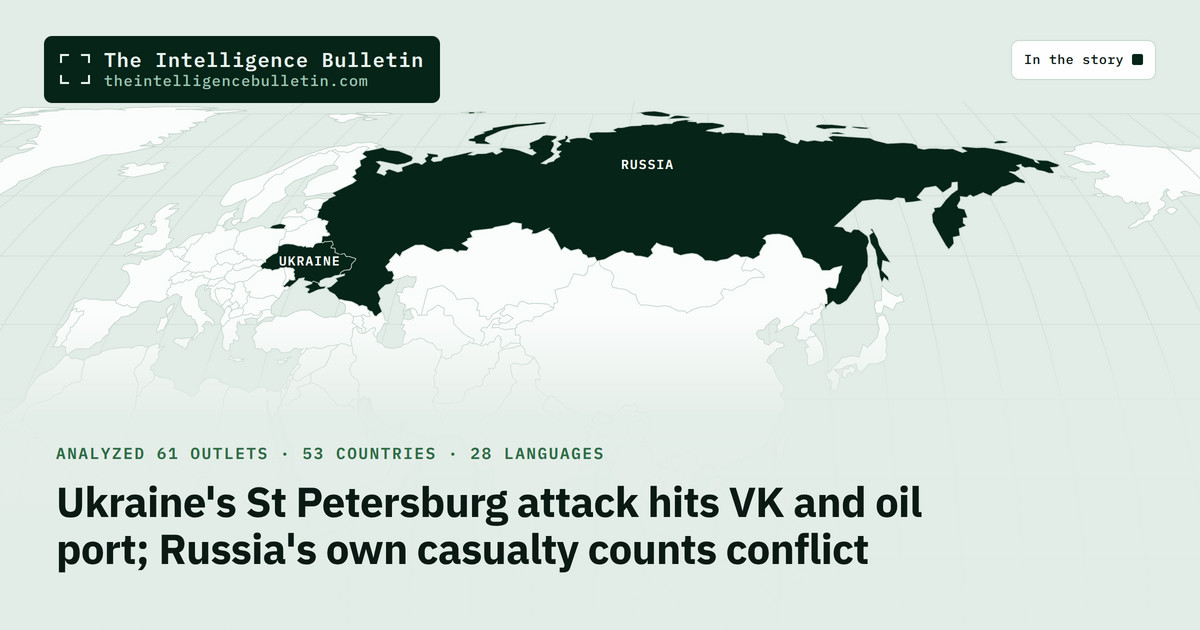
Ukraine struck St Petersburg’s oil terminal and VK data centre in a mass drone attack Sunday. Russian casualty accounts conflict—news.de reports no deaths, Dân Trí and The Irish Times report one dead—and the Kremlin promises systematic retaliation.
Across the press: news.de says Russian authorities reported no deaths; Dân Trí and The Irish Times report one death from St Petersburg officials.
Source base: 5 outlets read in full (Ukraine, Germany, Turkey, Ireland, Vietnam), selected from 61 analyzed.
- DisputedAt least one person died and several were injured in St Petersburg, but Russian official accounts conflict on the toll.Source: news.de reports Russian authorities said no one was killed; Dân Trí cites governor Alexander Beglov on one dead and five injured; The Irish Times cites Russian air-defence forces on one dead and nine injured.
- 5 of 5 · reported separatelyUkraine launched a mass drone attack on St Petersburg at the weekend.All five selected outlets report the attack; Dân Trí and The Irish Times also describe it as the largest against the city since 2022.
- 4 of 5 · reported separatelyThe attack hit an oil terminal or oil depot in St Petersburg’s port area, causing fires.news.de and The Irish Times cite St Petersburg governor Alexander Beglov; Dân Trí also reports a fire at the St Petersburg oil station; Hürriyet reports a Ukrainian attack on a St Petersburg port.
- 3 of 5 · reported separatelyVK’s data centre in St Petersburg was hit.news.de and Dân Trí report that VK’s data centre was attacked; The Irish Times adds that VK itself said the centre had been hit.
- 4 of 5 · reported separatelyRussia struck Ukrainian energy and logistics targets and vowed further systematic attacks.Hürriyet relays Russian Defence Ministry claims on strikes against Ukrainian port and logistics targets; news.de cites Zelensky on attacks on more than 15 energy facilities; Dân Trí quotes Dmitry Peskov promising systematic retaliation.
- Within daysThe Kremlin says Russia will continue systematic strikes; watch for new Russian missile and drone attacks on Ukrainian energy infrastructure.
- Next weekKyiv is seeking US-Ukraine talks, though unconfirmed; the US response to the strike and the Starlink dispute is likely to surface.
- Before winterZelensky warns Russia is planning widespread blackouts in Ukraine; watch for further damage to the energy grid and power outages.
- Still openWhat specific physical damage, if any, occurred to servers or supercomputing equipment at the Balakovo site?
- 20 Oct · New York Post reads a diesel feud, LB.ua reads capitulation, Taipei Times alone reports the withheld missile warning
- 19 Oct · Zelenskyy says US intel sharing resumed; Rubio says no pause, and Epoch Times leaves the denial out
- 17 Oct · Trump denies cutting Ukraine s Starlink access as Zelensky details the food, water and drone failures it caused
- 14 Oct · Ukrainian drones hit Sberbank data center as Russia signals security talks with firms
Full analysis
What happened Why it matters How each country tells it Where accounts conflict Room for disagreement Our assessment Sources and evidence
What happened
On the night of Saturday, October 17, Ukraine sent waves of drones at St Petersburg in what Dân Trí, citing Russian media, and The Irish Times both describe as the largest attack on the city since Russia invaded in 2022. A fire broke out at an oil terminal in the port, sending black smoke over the city, according to governor Alexander Beglov, whose account is carried by The Irish Times and news.de. Dân Trí adds fires at the St Petersburg oil station, the Ruchyi oil depot and industrial warehouses, and damage to more than ten apartment buildings. VK said one of its data centres had been hit, The Irish Times reports, and the online marketplace Ozon said a drone strike set a warehouse alight — the first Ukrainian strike on logistics infrastructure since mid-September. Parts of the city lost power for several hours after a drone hit an electricity substation, the online outlet Astra reported, and a resident of the Nevsky district told the Financial Times she heard explosions from 3am until 6am.
The raid came after Kyiv paused refinery strikes at Donald Trump’s announcement last Sunday of an "energy ceasefire" and a diesel deal with Moscow, and resumed them when the ceasefire failed to stop Russian attacks — Zelensky counted more than 76 recorded attacks on Ukrainian energy, oil and gas facilities in the past week, The Irish Times reports. A Russian air strike killed one person and injured two in Kyiv on Sunday night, mayor Vitali Klitschko said. Kyiv’s relationship with Washington has soured since the Oval Office confrontation of February 2025, and the raid sits inside that fracture: a senior Ukrainian official told the Financial Times that Starlink remains throttled against military use above 160km/h, while US treasury secretary Scott Bessent called Zelensky "reckless" for alleging the slowdown was intentional. Zelensky spoke Sunday with Trump’s envoys Steve Witkoff and Jared Kushner, and Kyiv is seeking talks with Washington next week, The Irish Times says.
The interception counts do not reconcile. Tass reported 126 drones downed near St Petersburg and 195 approaching Moscow, more than 320 in all, news.de writes; Alexander Drozdenko, head of the Leningrad region, put the local figure at 144, Dân Trí reports; and St Petersburg’s air-defence forces claimed 146, The Irish Times writes. Russia’s defence ministry claimed 1,015 drones destroyed across the country on Sunday, including 512 in the Moscow area, The Irish Times reports. Flight operations in St Petersburg halted entirely and Moscow’s Domodedovo and Vnukovo airports suspended takeoffs and landings, news.de reports, with airports closed for several hours and hundreds of flights cancelled over the past two weeks.
Whether anyone died is contested. Russian authorities told news.de there were no deaths; Dân Trí, citing governor Beglov, reports one dead and five injured in the October 17 attack; and The Irish Times, citing the city’s air-defence forces, reports one killed and nine injured.
Russia struck before and after. Moscow had hit more than fifteen Ukrainian energy facilities the night before the raid, Zelensky said, news.de reports, and overnight to Sunday it launched 180 drones, one ballistic missile and several "Banderol" cruise missiles, with Ukraine’s air force claiming 152 downed, The Irish Times writes. The Russian defence ministry, quoted by Hürriyet, claimed strikes on the Grand Import logistics centre in Khmelnytsky, the Vindor Trans Servis transport hub in Kovel, three dry-cargo ships at Reni port near Odessa and a fourth at sea. Kremlin spokesman Dmitry Peskov called the attack "the final expressions of desperation" and promised Russia would keep answering with large-scale, systematic strikes, Dân Trí reports.
Why it matters
The attack matters on three fronts. Physically, it hit the port, the power grid, VK’s data centre and Ozon’s warehouse in one night, reaching energy supply, freight and the civilian internet; 24 Kanal’s military analyst Taras Berezovets argues Russia’s drive for a "sovereign internet" concentrated its servers at home and turned each data-centre hit into a problem lasting "not for months, but for years." Politically, it is Kyiv’s public answer to Washington’s demand to stop energy strikes, and with it a test of whether Trump’s ceasefire and diesel diplomacy hold; The Irish Times leads its report with "Ukraine defies Trump" precisely because the raid resumed a campaign Kyiv had paused at US request. Militarily, the cost is not just the fire lit in the port but the answer it invites — Peskov has already named Russia’s response as systematic, and Hürriyet carries the defence ministry’s fresh catalogue of strikes on Ukrainian ports and ships. The raid chose escalation in the same week Washington was pressing for de-escalation.
How each country tells it
- 24 Kanal · Ukraine · opinionUses military analyst Taras Berezovets to frame the strike as a strategic success against Russia’s centralised ‘sovereign internet’ and data centres.
- news.de · Germany · original reportingEmphasises the symbolic shock of hitting Putin’s home city, naming the oil port and VK data centre and describing halted air traffic.
- Hürriyet · Turkey · carries Russian Defence MinistryFrames the St Petersburg strike as a Ukrainian retaliation and foregrounds Russia’s claimed strikes on Ukrainian port and logistics infrastructure.
- The Irish Times · Ireland · original reportingLeads with Ukraine defying Trump’s demand to halt energy strikes, and ties the attack to the US diesel deal, intelligence sharing and Starlink throttling.
- Dân Trí · Vietnam · original reportingLeads with Peskov calling the strikes an expression of desperation and warning of Russia’s systematic response, then reports damage and casualties.
Where accounts conflict
The central conflict is the human toll, and it sits inside the Russian state, not between governments. One version says no one died: that is what Russian authorities told news.de. A second, from governor Alexander Beglov, says one person died and five were injured, as Dân Trí reports. A third, from the city’s air-defence forces, says one was killed and nine were injured, as The Irish Times reports. These are not different moods of one account; they are three counts that cannot all be true. Two versions rest on named sources — Beglov and the air-defence forces — and both report a death while disagreeing on the wounded; the zero-death version is attributed to unnamed authorities. None of the five outlets checked the figure it published. A reader trying to establish the toll faces a choice among Russian statements, not a fact. The interception figures show the same pattern in miniature: 126 for the area by Tass, 144 by the Leningrad regional head, 146 by city air defence — same battle, three numbers, none verified.
Room for disagreement
The strongest case against reading the raid as a turning point is the Kremlin’s own, carried by Dân Trí: Peskov calls the attack "the final expressions of desperation" that will not change "the course of history." If desperation is the correct read, the raid signals Kyiv’s narrowing options rather than a shift in the war, and Russia’s energy campaign — already under way, already counted by Zelensky at more than fifteen facilities in a single night and already aimed, in his words, at blackouts before winter — rolls on unchanged. The interception figures point the same way: hundreds of drones claimed destroyed, with the damage received limited to fires, a data centre and power cuts, and casualty figures themselves inconsistent even among Russian sources. On that reading, St Petersburg was a demonstration of reach rather than military weight, and its largest consequence — Russian retaliation — was certain before any drone crossed the border.
Our assessment
Russia’s retaliation against Ukrainian energy infrastructure is very likely to be larger and more systematic than the St Petersburg raid itself. The warrant is on-record and corroborated across independent reporting chains: the defence ministry has already published its own catalogue of strikes on Ukrainian logistics and shipping, and Peskov’s promised systematic attacks sit alongside Zelensky’s warning that Russia is preparing widespread blackouts before winter. Neither capital is neutral about how this reads — Moscow needs the raid to look desperate and answerable, Kyiv needs it to look like proof the Russian homeland is now vulnerable — but the direction of travel is not in real dispute. On the toll, governor Beglov and the city’s air-defence forces both report a death, against the zero-death version from authorities cited by news.de; the published record points to at least one death, but the number of wounded is unresolvable from what has been published.
What would change this: a public White House decision to brand the St Petersburg strike a breach of the ceasefire and condition military or Starlink support on halting it would change Kyiv’s calculus and with it the trajectory of the escalation.
Sources and evidence
Press quoted
- What is the exact casualty count in St Petersburg, and why do Russian official accounts differ on whether anyone died?
- What physical damage occurred at the VK data centre and oil terminal, and how long will disruptions last?
- How will Washington respond to a strike that The Irish Times frames as direct defiance of its demand to halt energy attacks?
That’s how the world told the story.
Get our daily open-source intelligence on world events in your inbox — one email a day, up to six stories.
Subscribe freeNo spam. One-click unsubscribe. See the latest email →