 AI-generated analysis published under the editorial responsibility of Rohit Sinnas. How it works →
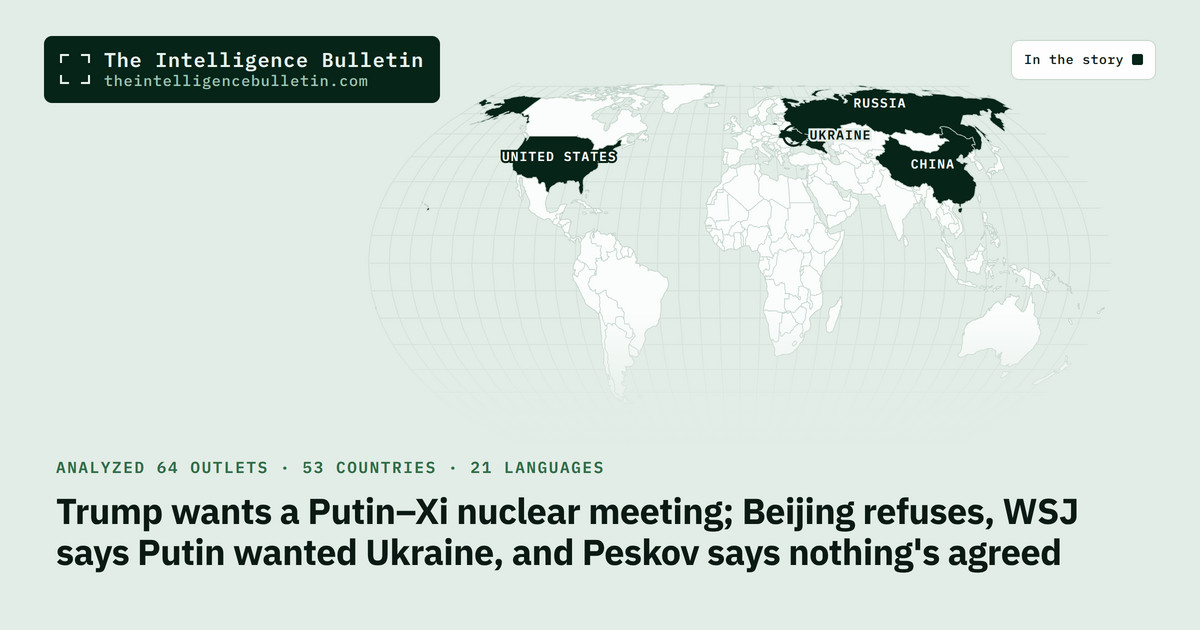
See the 53 countries
Afghanistan, Australia, Austria, Azerbaijan, Bangladesh, Bosnia and Herzegovina, Brazil, Bulgaria, Canada, China, Croatia, Czech Republic, Denmark, Egypt, Estonia, Finland, Georgia, Germany, Greece, Hungary, India, Ireland, Israel, Italy, Luxembourg, Moldova, Montenegro, Nepal, Nigeria, Oman, Pakistan, Poland, Qatar, Romania, Russia, Saudi Arabia, Serbia, Singapore, Slovakia, Slovenia, Somalia, South Korea, Spain, Sri Lanka, Sweden, Switzerland, Turkey, Tuvalu, Ukraine, United Arab Emirates, United Kingdom, United States, Uruguay
Donald Trump says he would meet Putin and Xi to discuss denuclearization, not Ukraine. The Irish Times reports Beijing’s refusal to join such talks; WSJ-sourced reporting says Putin proposed a Ukraine-focused meeting without Zelensky, and Peskov says nothing is agreed.
Across the press: Trump’s nuclear agenda, the WSJ-sourced Putin war-end proposal and Beijing’s on-record refusal of nuclear talks are three different meetings in five outlets.
Source base: 5 outlets quoted (Russia, Ukraine, Ireland, South Korea, India), selected from 64 analyzed. 4 read in full, 1 by its headline only.
- Denied on the recordBeijing refuses to join trilateral nuclear-disarmament talks, calling them neither fair, reasonable nor realistic, citing its far smaller arsenal.Source: Chinese foreign ministry spokeswoman Mao Ning, on the record, quoted by The Irish Times and paraphrased by Mid-Day via IANS.
- 4 of 5 · one shared reportPutin proposed the trilateral at the APEC summit in Shenzhen to discuss ending the Ukraine war without Zelensky, according to Wall Street Journal sources described as former Russian intelligence officials.The Wall Street Journal, relayed by Tvoemisto and The Financial News; Mid-Day and The Irish Times reference the report.
- 4 of 5 · reported separatelyTrump said Monday he is open to meeting Putin and Xi, and would prefer the meeting to be about nuclear weapons and denuclearization rather than Ukraine.Vesti and The Irish Times quote Trump directly; Mid-Day via IANS and Tvoemisto via CNBC carry the same remarks.
- 3 of 5 · reported separatelyNo concrete agreement exists on the meeting or its agenda; Peskov says no specific proposals or agreements have been discussed or voiced.Kremlin spokesman Dmitry Peskov, on the record, carried by Vesti, The Irish Times and The Financial News.
- 4 of 5 · reported separatelyThe proposed meeting would take place on the margins of the APEC summit in Shenzhen, China, on November 18-19, where all three leaders may attend.The Wall Street Journal chain via Tvoemisto and The Financial News; The Irish Times independently says the meeting would be on the margins of next month’s APEC summit.
- In the weeks before November 18-19, 2026Any on-record confirmation from Washington, Moscow or Beijing that a trilateral meeting will happen, and on whose agenda.
- November 18-19, 2026The APEC summit in Shenzhen, where the three leaders could meet and Trump’s nuclear agenda would collide with Beijing’s refusal and the WSJ-sourced Ukraine proposal.
- November 3, 2026US midterm elections, which The Financial News says Trump is maneuvering around for a Ukraine breakthrough and which may shape his push for the summit.
- AnsweredNo: Beijing’s foreign ministry refused trilateral nuclear-disarmament talks as ‘neither fair, reasonable nor realistic’ (The Irish Times; paraphrased by Mid-Day via IANS), and Peskov said no specific proposals or agreements have been discussed or voiced (Vesti, The Irish Times, The Financial News).
- Still openWhat framework could replace the expired New START, given KBS reports China has no public position and Epoch carries only an old Peskov call for a wider treaty? · Will a trilateral US-China-Russia meeting occur at APEC next month, and will nuclear disarmament be formally on the agenda?
Full analysis
What happened Why it matters How each country tells it Where accounts conflict Room for disagreement Our assessment Sources and evidence
What happened
On Monday, October 19, President Donald Trump told reporters he would sit down with Vladimir Putin and Xi Jinping, and that he would do it "not so much for Ukraine" but "to talk about nuclear weapons, denuclearisation." The Irish Times and Vesti quote those words directly; India’s Mid-Day via IANS and Ukraine’s Tvoemisto via CNBC carry the same remarks, Tvoemisto adding that Trump said the meeting could happen without Volodymyr Zelensky.
The meeting Trump was responding to had been reported a day earlier by the Wall Street Journal: that Putin proposed the trilateral on the sidelines of the APEC summit in Shenzhen on November 18-19 to discuss ending the Ukraine war without Zelensky, according to people described as former Russian intelligence officials. That account reached readers through Tvoemisto and South Korea’s The Financial News; The Irish Times and Mid-Day reference it without adopting its sourcing.
Kremlin spokesman Dmitry Peskov kept the proposal at arm’s length. "No specific proposals or agreements have been discussed or voiced by anyone, neither on the meeting itself, nor on a potential agenda or the content of this meeting," he said, a line carried by Vesti, The Irish Times and The Financial News. The Financial News adds the mechanics: Kremlin foreign-policy adviser Yuri Ushakov announced on October 1 that Putin would hold meetings with Xi during APEC; Xi invited Trump to the summit during his September 25 visit to Washington and Trump said he would go; and Putin said of a trilateral that "we are all for it."
Beijing moved against the nuclear half before any meeting was agreed. Foreign ministry spokeswoman Mao Ning, reaffirming the position on Friday, said it is "neither fair, reasonable nor realistic" to ask China to join trilateral disarmament talks because "China’s nuclear strength is by no means at the same level with that of the US and Russia." The Irish Times gives the inventory from the Stockholm International Peace Research Institute: Moscow holds 4,400 warheads, Washington 3,700, China 620, of which only 34 are deployed and ready to launch at short notice against Russia’s 1,796 and the US’s 1,770. The Financial News, carrying the Journal chain, reports a different signal — that Chinese interlocutors told Russia they "will not oppose" the meeting if Trump agrees — though no official in Beijing has said so publicly.
Trump’s own framing cut across the Journal’s Ukraine story. "Russia, frankly, has been fine on Ukraine. They have not been doing much," he said, in wording The Irish Times and Tvoemisto carry. Tvoemisto, which labels Putin a "Russian dictator," leads with the prospect of Kyiv’s exclusion and Trump’s renewed criticism of Zelensky. Peskov, however, said a final settlement is impossible "without the participation of someone from Kyiv who is willing to take responsibility" — a line only The Irish Times carries.
Why it matters
Three of the world’s nuclear arsenals are being drawn — or reportedly drawn — into one conversation, and the attempt itself reorders how other security relationships are read. For Kyiv, the stakes are existential: Tvoemisto foregrounds Trump’s statement that the meeting could proceed without Zelensky and his claim that Russia "has been fine on Ukraine." For arms control, Mid-Day stresses that the New START treaty expired earlier this year, leaving Washington and Moscow without legal limits, and quotes Arms Control Association director Daryl Kimball insisting meaningful talks would need "detailed proposals and sustained diplomatic engagement." Vesti, a Russian state broadcaster, presents Moscow as courted — Trump’s readiness first, Peskov’s non-commitment second — and never reaches the Ukraine agenda in the text available. The Financial News reads the summit as Putin’s initiative to end the war and a platform for China’s mediator ambitions, citing Stimson Center China program director Yun Sun. The Irish Times calls Xi’s acceptance of the nuclear agenda "almost unthinkable," then closes with Peskov’s Kyiv caveat, which quietly undercuts the exclusion its Ukrainian counterpart fears.
How each country tells it
- Vesti · Russia · original reportingLeads with Trump’s readiness for a meeting and his nuclear-disarmament framing, then adds Peskov’s line that no concrete agreement exists.
- Tvoemisto · Ukraine · carries CNBCReads the meeting through Kyiv’s possible exclusion, quoting Trump’s readiness to meet without Zelensky and his criticism of Zelensky, while labelling Putin a ‘Russian dictator’.
- The Irish Times · Ireland · original reportingAnchors the nuclear-disarmament dimension and Beijing’s refusal, with SIPRI warhead counts and Mao Ning’s full quote, and closes with Peskov’s caveat that any settlement needs someone from Kyiv.
- The Financial News · South Korea · carries The Wall Street JournalCasts the summit as Putin’s initiative to end the Ukraine war, via Wall Street Journal sources, and adds Ushakov’s APEC preview, Xi’s invitation to Trump and a Stimson Center read on China’s mediation ambitions.
- Mid-Day · India · wire copyHolds the nuclear-arms-reductions line, stressing New START’s expiry, the absence of a successor and the Arms Control Association’s demand for detailed proposals.
Where accounts conflict
Three points of genuine disagreement run through the reporting.
First, what the meeting is for. Trump’s own Monday words — "not so much for Ukraine," "to talk about nuclear weapons, denuclearisation," Russia "has been fine on Ukraine" — are carried by Vesti, The Irish Times, Mid-Day and Tvoemisto. Against that stands the Wall Street Journal’s account, relayed by Tvoemisto and The Financial News, that Putin proposed the meeting to end the war without Zelensky, sourced to anonymous former Russian intelligence officials. Both cannot be the operative agenda, and Peskov names neither: he says nothing has been discussed on "a potential agenda or the content of this meeting."
Second, whether Beijing would attend. On the record, Mao Ning has refused to join trilateral nuclear-disarmament talks, The Irish Times quoting her in full and Mid-Day paraphrasing. But the Journal chain, via The Financial News, reports that China told Russian officials it will not oppose the meeting if Trump agrees. The two are compatible only if Beijing attends while refusing the meeting’s nuclear substance — and The Irish Times notes Beijing "had nothing to say" about any trilateral meeting.
Third, whether Kyiv is being cut out. Tvoemisto, via CNBC, reports Trump saying the meeting could occur without Zelensky, and the Journal chain has Putin proposing it without him. Peskov counters on the record that no final settlement is possible "without the participation of someone from Kyiv who is willing to take responsibility," a line only The Irish Times carries.
Room for disagreement
The strongest case that no trilateral happens at all is carried by the record itself. Peskov says no specific proposals or agreements exist; a US senior official told the Journal that Trump has not yet agreed (The Financial News); and Beijing has never confirmed attendance, which The Irish Times says it seldom does until the last minute. The Journal’s Putin proposal rests on one anonymous chain, and Trump’s response does not constitute acceptance. The three leaders appear to want three different meetings: Putin a war-end summit, Trump a denuclearisation summit, Beijing no nuclear summit. The Irish Times’s verdict, "it’s unlikely to amount to much," states the case in a sentence. If Xi stays silent until November 18-19, the trilateral frame may prove to be a story about a meeting that was never really proposed.
Our assessment
The three leaders are likely to sit down at Shenzhen, but the nuclear-disarmament conversation Trump wants is already foreclosed. The warrant is corroboration across independent chains: Trump’s openness is quoted directly by Vesti and The Irish Times and carried by Mid-Day and Tvoemisto; Xi invited Trump to APEC and Putin said "we are all for it" (The Financial News); and Peskov’s "no specific proposals" is the language of a side keeping its options open. Against that, Mao Ning’s on-record refusal — "neither fair, reasonable nor realistic" — is a public stance Beijing would have to reverse within weeks, a reversal The Irish Times calls "almost unthinkable" given the 620-to-4,400-to-3,700 warhead arithmetic Beijing invokes. What holds a meeting together is negative space: none of the three wants to be seen blocking a summit at which all are present. Kyiv has the clearest interest in the reader seeing exclusion, Moscow in appearing courted, Beijing in avoiding an arms-control yoke while harvesting mediator credit.
What would change this: an on-record confirmation from Beijing that Xi will join a trilateral whose agenda is Ukraine-centered rather than nuclear, converting today’s refusal into the meeting’s actual subject.
Sources and evidence
Press quoted
- Has Trump actually agreed to a trilateral meeting, and would he accept Putin’s Ukraine-war agenda over his own stated denuclearization preference?
- Will Putin and Xi attend APEC in Shenzhen in person, and would any meeting occur without Zelensky as the WSJ-sourced proposal envisages?
- Does Beijing’s refusal of trilateral nuclear-disarmament talks close the door to any meeting, or only to the nuclear agenda?
That’s how the world told the story.
Get our daily open-source intelligence on world events in your inbox — one email a day, up to six stories.
Subscribe freeNo spam. One-click unsubscribe. See the latest email →