 AI-generated analysis published under the editorial responsibility of Rohit Sinnas. How it works →
See the 55 countries
Afghanistan, Azerbaijan, Bangladesh, Belgium, Bosnia and Herzegovina, Bulgaria, Canada, China, Croatia, Cuba, Cyprus, Czech Republic, Denmark, Egypt, Estonia, Finland, Georgia, Germany, Ghana, Greece, Hungary, India, Iran, Ireland, Israel, Jamaica, Japan, Lebanon, Malaysia, Netherlands, New Zealand, Nigeria, Oman, Pakistan, Poland, Qatar, Romania, Russia, Samoa, Saudi Arabia, Serbia, Singapore, Somalia, South Africa, South Korea, Spain, Sri Lanka, Sweden, Taiwan, Turkey, Tuvalu, Ukraine, United Arab Emirates, United Kingdom, United States
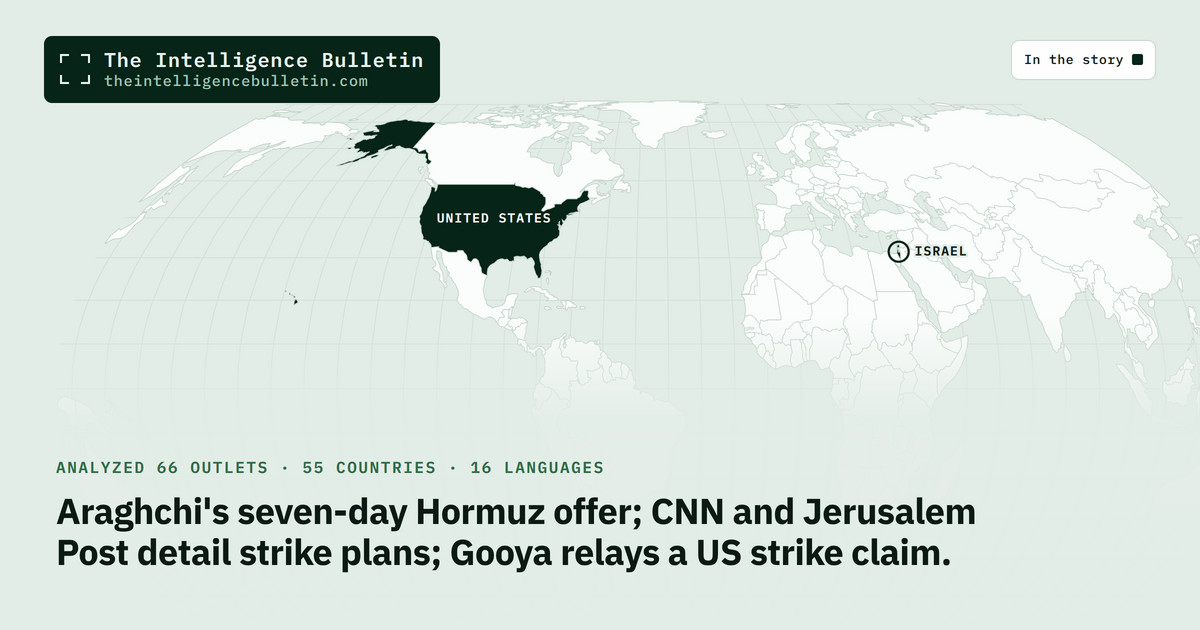
Iran’s foreign minister says the seven-day Hormuz reopening offer still stands if Washington lifts its blockade and sanctions; Gooya reports an unconfirmed US strike on Konarak, while CNN and the Jerusalem Post detail war preparations and a third US carrier.
Across the press: Navbharat Times leads with Iran’s seven-day Hormuz offer while CNN-via-KOMU 8 and Jerusalem Post lead with strike plans, and Gooya alone relays an overnight strike.
Source base: 5 outlets read in full (United States, Canada, Israel, United Arab Emirates, India), selected from 66 analyzed.
- 1 of 5 · KOMU 8 onlyIranian commanders are publicly threatening to widen a resumed war to new targets, including undersea cables, data centers, AI facilities and energy infrastructure.CNN, carried by KOMU 8, quoting Islamic Revolutionary Guard Corps spokesperson Hossein Mohebbi and Iran’s Supreme National Security Council head Mohsen Rezaei.
- 1 of 5 · The Jerusalem Post onlyA third US aircraft carrier is expected to arrive in the Middle East soon.The Jerusalem Post’s own reporting.
- 1 of 5 · Navbharat Times onlyIran’s seven-day proposal to reopen the Strait of Hormuz remains on the table, conditional on the US lifting its naval blockade and oil sanctions and guaranteeing no future attack.Navbharat Times, quoting Iranian Foreign Minister Abbas Araghchi speaking Sunday in Baghdad.
- 1 of 5 · Gooya News onlyUS aircraft struck the Konarak naval base in southeastern Iran overnight Sunday, wounding or killing two personnel.Gooya News, relaying military analyst Babak Taghvaei and the Dezh X account; accounts conflict on which Iranian force was hit and whether two were wounded or killed, and the portal said no independent confirmation existed at filing.
- 2 of 5 · reported separatelyUS military planners have prepared strike options against Iran’s energy infrastructure, nuclear sites and missile/drone arsenal.CNN, carried by KOMU 8, citing multiple US officials; the New York Times and The Atlantic, as relayed by the Jerusalem Post, report related strike options.
- October 27Israel’s parliamentary election — whether Netanyahu’s re-election or defeat changes the US-Israeli calculus on resuming the war.
- November 3US midterm elections — whether Trump sticks to his public pledge not to strike before election day or rescinds it, as his advisers told CNN could happen.
- Still openWill Netanyahu consider military action against Iran after the Oct 27 election? · What specific recent discussions occurred between Netanyahu and Washington on Iran?
- 15 Oct · Netanyahu s radio interview rules out Iran strike before election while warning Tehran
- 17 Oct · UKMTO counts a record 12 ship attacks as CENTCOM claims Hormuz control and the IRGC blames mines
- 18 Oct · Trump waives Graham Act sanctions as Kremlin s historic boast leads Delhi and Warsaw but not Moscow s Vedomosti
- 19 Oct · Trump endorses Netanyahu; Ynet ties it to settler sanctions, Al Jazeera to US midterms
Full analysis
What happened Why it matters How each country tells it Where accounts conflict Room for disagreement Our assessment Sources and evidence
What happened
On Sunday in Baghdad, where he was attending a meeting of the Organization of Islamic Cooperation, Iranian Foreign Minister Abbas Araghchi said the seven-day plan Tehran first put to Washington through mediators in September is still on the table, Navbharat Times reported. Iran would reopen the Strait of Hormuz within a week if the United States lifts its naval blockade of Iranian ports, ends oil sanctions, ends hostilities on all regional fronts and guarantees no future attack; negotiations to end the war permanently would resume the day after the strait opens. Araghchi, quoted by the Hindi daily, said Tehran had received American comments which it was considering, and that with even a little US sincerity the path to reopening Hormuz is "absolutely clear, but Washington’s intentions are not clean." He has tied the plan to the June 17 memorandum of understanding and said no broad peace talks will begin while the blockade remains.
The same day carried a radically different report. The Persian-language diaspora portal Gooya News, published outside Iran for Iranians abroad, relayed social-media claims of an overnight US strike on the naval base at Konarak in Sistan and Baluchestan province. Military and aviation analyst Babak Taghvaei claimed that US Navy F/A-18 Super Hornets from the carrier USS George H.W. Bush bombed Islamic Revolutionary Guard Corps naval positions after the IRGC tried to target an Arleigh Burke-class destroyer in the northern Arabian Sea. A separate account, from the Dezh account on X, said two light missiles hit a base of the regular Army Navy around 1 a.m. and two personnel were wounded. Taghvaei also relayed a claim that an MQ-9A Reaper drone destroyed an Iranian Navy 35 mm Oerlikon anti-aircraft cannon with an AGM-114 Hellfire after its operators fired on the drone, with both operators believed killed. Gooya said at filing time that no independent confirmation existed of the details, the attacking force or the casualty count.
CNN, carried by KOMU 8, reported that Iranian commanders have spent the past month escalating threats to widen any resumed war beyond February’s battlefield. Revolutionary Guards spokesperson Hossein Mohebbi said "the world will be amazed" and that Iran has "new targets that have not yet been attacked." Supreme National Security Council head Mohsen Rezaei warned that "numerous undersea cables, data centers, AI facilities and other infrastructure across the region could be destroyed." CNN also reported, citing multiple US officials, that the US military has drawn up strike plans that could include the MOAB against Iranian energy infrastructure and nuclear sites, and that White House advisers have met on Iran options. Trump has said he will not act before the November 3 midterms, but several advisers told CNN privately they did not know if that pledge was definitive.
The Jerusalem Post added that a third US aircraft carrier is expected in the Middle East soon, and that oil has risen 46% since the February 28 attacks to $104 a barrel, gasoline to $4.36 a gallon. It carried Benjamin Netanyahu’s warning that if Iran attacks Israel "it will simply make the mistake of its life," and Trump’s Atlanta remark, "Wait til you see what we do to Iran." The paper relayed The New York Times’s account of a possible three-day US campaign against Iran’s missile and drone arsenal, and The Atlantic’s report that the White House asked the Pentagon for strike options usable before the midterms.
Why it matters
The day’s reporting puts the de-escalation channel and the escalation machinery side by side. Navbharat Times, aimed at Indian readers who import Gulf crude through Hormuz, detailed the seven-day offer and its conditions, because lifting the blockade matters directly to India’s energy costs. Gooya’s audience, Iranians abroad, instead received the unconfirmed claim of a new American attack on Iranian soil. CNN’s piece, through KOMU 8, spelled out what a resumed war would target: cables, data centers, energy infrastructure, and possibly the largest conventional bomb in the US arsenal. The Jerusalem Post tied every scenario to Israel’s October 27 election, when no absentee voting means a war restart would be uniquely costly for Netanyahu; its analysts call escalation "very high" without a settlement. Gulf News framed the day around Trump’s "Complete and Total Endorsement" of Netanyahu and the prime minister’s promise to "eliminate the Iranian threat over the next two years, or even sooner."
The political calendar is doing real work. TIB reported on October 19 that Ynet read the endorsement as tied to settler sanctions, while Al Jazeera read it as aimed at the US midterms; on October 18 TIB reported Trump waived nearly all sanctions and tariffs under the Graham Act. Iran’s offer demands sanctions relief and a no-attack guarantee, exactly what the domestic electoral clock discourages either leader from granting. Hormuz carries 20% of the world’s oil, and TIB’s October 17 edition counted a record 12 ship attacks in the week ending October 16. Iran’s offer would end that disruption in seven days; the US strike plans would instead risk reopening the full war.
How each country tells it
- KOMU 8 · United States · carries CNNCarries CNN’s report that Iran is preparing for a wider war, with commanders threatening new targets and the US readying strike plans that could include the MOAB.
- Gooya News · CanadaRelays social-media reports that US Navy F-18s from the USS George H.W. Bush struck the Konarak naval base overnight after Iran tried to hit a US destroyer, with analysts split on whether IRGC or Army positions were hit.
- The Jerusalem Post · Israel · original reportingReports Trump’s and Netanyahu’s joint warnings to Iran as a third US aircraft carrier heads to the region, with Israeli analysts weighing the odds of renewed war around the October 27 election.
- Gulf News · United Arab Emirates · original reportingA live round-up built around Trump’s ‘Complete and Total Endorsement’ of Netanyahu and Netanyahu’s vow to ‘eliminate the Iranian threat,’ against a backdrop of Saudi-Houthi clashes.
- Navbharat Times · India · original reportingLeads with Foreign Minister Araghchi’s statement that Iran’s seven-day proposal to reopen the Strait of Hormuz still stands, listing Iran’s conditions for lifting the blockade and sanctions.
Where accounts conflict
The sharpest conflict sits inside the only report of new fighting. Gooya’s relayed accounts cannot all be true as stated: Taghvaei says the target was IRGC naval positions hit by carrier-based F/A-18s; the Dezh account says the regular Army Navy was hit with two light missiles; and a third relayed claim has an MQ-9 Reaper drone destroying an anti-aircraft cannon with two operators believed killed. Gooya says it is unclear whether these describe one operation or separate events. Among the five articles TIB read, nothing else mentions Konarak: CNN’s report, which contained the Pentagon-sourced strike plans, carries no such claim, and the Jerusalem Post, Gulf News and Navbharat Times do not report one. The only point on which the set agrees is that no confirmation exists, as Gooya said directly.
Room for disagreement
The strongest case against reading this as a slide into wider war is that it is deterrence theater working as designed. CNN’s Ali Vaez of the International Crisis Group said Tehran’s threats are meant to show Washington the costs of an attack, and warned that deterrence could be read as provocation; former senior Israeli security official Avner Vilan said Trump "has good reasons to hold off" before the midterms; and Gil Murciano of Mitvim cited a Pew poll finding 64% of Americans disapprove of Trump’s handling of the conflict. Araghchi’s decision to restate the seven-day offer, rather than withdraw it, is itself evidence that Tehran is leaving the diplomatic door open. If the offer gains traction, the oil-price pressure behind the Jerusalem Post’s $104 figure would favor deferral, not escalation.
Our assessment
It is likely that the standoff tips back into open fighting once the October 27 and November 3 elections pass and remove the political shield for restraint, unless the seven-day Hormuz offer becomes the off-ramp. The strike planning is corroborated across independent reporting chains, CNN’s multiple US officials and the New York Times and Atlantic accounts carried by the Jerusalem Post, and a third carrier’s expected arrival shortens the decision loop. Iran’s public threats are on-record from named commanders, but they commit Tehran to a wider battlefield if it is struck, which makes miscalculation easier. The Konarak claim is too unconfirmed to be the opening shot, but it is the raw nerve: a verified US strike on Iranian soil would close much of the diplomatic space Araghchi says remains open.
What would change this: independent confirmation of a US strike at Konarak, or Washington’s formal acceptance of the seven-day Hormuz offer.
Sources and evidence
Press quoted
- Did US forces actually strike Konarak overnight, and was the target the IRGC navy or the Iranian Army?
- Will Washington respond to Iran’s seven-day Hormuz proposal, and on what terms, given Araghchi says the US has sent comments Iran is reviewing?
- Will the third US carrier’s arrival and Trump’s strike options translate into resumed hostilities before or after the November 3 midterms?
That’s how the world told the story.
Get our daily open-source intelligence on world events in your inbox — one email a day, up to six stories.
Subscribe freeNo spam. One-click unsubscribe. See the latest email →