 AI-generated analysis published under the editorial responsibility of Rohit Sinnas. How it works →
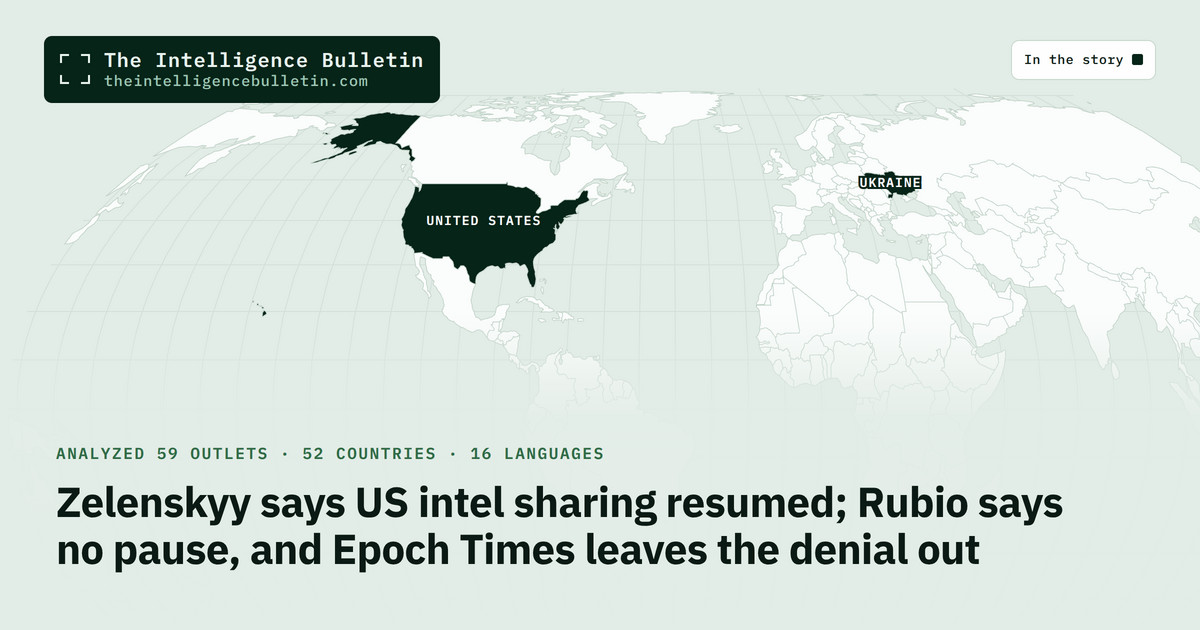
See the 52 countries
Afghanistan, Albania, Armenia, Australia, Austria, Bangladesh, Belarus, Bulgaria, Canada, China, Croatia, Cuba, Denmark, Egypt, Estonia, Finland, France, Georgia, Germany, Greece, Iran, Ireland, Israel, Italy, Jamaica, Japan, Kazakhstan, Kyrgyzstan, Malaysia, Mexico, Nigeria, Pakistan, Philippines, Poland, Qatar, Romania, Russia, Serbia, Slovakia, Somalia, South Africa, South Korea, Sri Lanka, Sweden, Switzerland, Syria, Thailand, Tuvalu, Ukraine, United Arab Emirates, United Kingdom, United States
Zelenskyy says US intelligence sharing resumed after a three-day pause that left Kyiv unwarned of Russian missile launches; Rubio says there was never a pause. The dispute matters because Washington has tied the sharing to Ukraine halting refinery strikes.
Across the press: Kontrakty and The News lead with Zelenskyy’s ‘now it works’; SANA leads with Rubio’s ‘no pause’ and Epoch Times omits the denial.
Source base: 5 outlets read in full (Ukraine, United States, United Kingdom, Syria, Pakistan), selected from 59 analyzed.
- DisputedUS intelligence sharing with Ukraine lapsed for three days and has now resumed.Source: Volodymyr Zelenskyy in NBC’s Meet the Press, carried by The Epoch Times and The News International, relayed by Kontrakty via RBK-Ukraine/Bloomberg, and noted by SANA via Reuters.
- DisputedStarlink/Starshield restrictions disrupted Ukrainian drone and logistics operations, and US officials deny ordering them.Source: Zelenskyy and Serhiy Beskrestnov via The Epoch Times; Bessent, Musk, and Reuters as carried by The Independent.
- 1 of 5 · SANA onlyThere was never any pause in US intelligence sharing with Ukraine.Marco Rubio on NBC’s Meet the Press, relayed by SANA from Reuters.
- 1 of 5 · The Epoch Times onlyUkrainian drones struck Russia’s Petersburg region and the Petersburg Oil Terminal on Sunday, killing one and injuring five.St. Petersburg governor Alexander Beglov’s report, carried by The Epoch Times.
- 3 of 5 · reported separatelyTrump has linked Ukrainian strikes on Russian diesel refineries to rising global diesel prices and to warnings over intelligence sharing.The Epoch Times reporting Trump’s public remarks and diesel price data; SANA via Reuters; Kontrakty via RBK-Ukraine/Bloomberg carrying Zelenskyy’s account of the US warning.
- Still openDid the White House, the Pentagon, or Musk initiate the slowdown, and on whose authority? · Will Starlink/Starshield speeds fully return to pre-restriction levels for Ukrainian forces?
- 17 Oct · Trump denies cutting Ukraine s Starlink access as Zelensky details the food, water and drone failures it caused
- 16 Oct · House lawmakers demand Trump revoke Russia diesel license as Novak says deliveries take weeks
- 19 Oct · Putin proposes APEC summit with Trump and Xi; Kyiv s RBC leads with Zelensky s exclusion
Full analysis
What happened Why it matters How each country tells it Where accounts conflict Room for disagreement Our assessment Sources and evidence
What happened
Ukrainian President Volodymyr Zelenskyy told NBC’s "Meet the Press" — an interview The Epoch Times dates to Sunday and SANA’s relay of Reuters dates to Monday — that the United States has resumed sharing the ballistic-missile warning intelligence Kyiv depends on, after a three-day interruption. "We are very thankful for this," he said. "Now it works." His account, carried by The Epoch Times, The News International and Kontrakty and noted by SANA, describes the restoration of a lifeline: Ukraine relies on American intelligence to locate the fast-moving ballistic missiles Russia has fired at its cities in successive waves.
US Secretary of State Marco Rubio, speaking to the same program, denied any lapse: "There was no pause. What we want Moscow and Kyiv to focus on is ending this war." The denial reaches this edition through a single chain — SANA relaying Reuters — and appears in none of the other articles assembled here. So the two men agree on the present tense: sharing is working. They disagree on whether it ever stopped.
The dispute sits inside President Donald Trump’s public anger. Three of the five articles — The Epoch Times, SANA and Kontrakty — carry his complaint that Ukrainian drone strikes on Russian diesel refineries are driving up world fuel prices. "He has to stop knocking out diesel fuel in Russia," Trump told reporters at the Irish Open, The Epoch Times reports. "Don’t hit diesel fuel, because that’s hurting the world." The same outlet adds AAA data showing US diesel climbing from $3.63 a gallon a year ago to $6.32 on average as of October 18. Kontrakty reports that Washington had warned Kyiv the intelligence exchange could be halted if the refinery strikes continued, and that US officials later attributed the absence of warning about ballistic launches on Kyiv on October 12 to "bad weather" — a competing explanation for the silence Zelenskyy calls a pause.
St. Petersburg governor Alexander Beglov reported Sunday that Ukrainian drones struck his region, killing one and injuring five, damaging 12 apartment buildings and two homes, and hitting the Petersburg Oil Terminal, the Ruchyi oil depot and industrial warehouses in Kolpino; fires burned at the terminal. Only The Epoch Times carries Beglov’s report, and it supplies the concrete event behind Trump’s refinery fury.
Trump’s anger is tied to a deal. After a telephone conversation with Vladimir Putin, The Epoch Times reports, Russia plans to ship more than 300,000 tons of diesel immediately, another 500,000 in November, a million in December, and possibly 3 million more next year. TIB reported on October 16 that the US Treasury’s General License 135 authorizes Russian-origin diesel transactions through April 7, 2027. Zelenskyy called the arrangement a "very bad surprise" he learned about from the media.
The Epoch Times also carries Zelenskyy’s claim that a Starlink/Starshield restriction, which he says disrupted combat missions without advance notice, was a "message" from America’s government, and analyst Serhiy Beskrestnov’s account that the limits affected frontline logistics and the interceptor drones used against Russian Shahed aircraft. The Independent’s text centers on the US response: Treasury Secretary Scott Bessent called the accusation "very reckless," said Trump and Rubio had "categorically" denied ordering restrictions, while Elon Musk said Starshield’s limits were "ultimately decided by the US government" and Reuters reported the White House ordered them. TIB reported on October 17 that the terminals slowed from October 14 while Trump denied any White House role.
The preview for this edition said the unannounced strikes on Kyiv killed one and injured eight; that figure appears in none of the five articles TIB read and is not repeated here. The only casualty figures any of these articles names belong to the St. Petersburg strike. Zelenskyy says a new meeting with Trump’s team could come next week, and raised the possibility that Ukraine, the United States and Russia could meet during a G20 summit.
Why it matters
What the story shows is how discretionary the lifeline has become. Intelligence sharing is not presented here as an alliance constant; it is something Washington can condition on refinery targets and tie to global diesel prices. The resumption puts a capability back in Kyiv’s hands, but the dispute over whether a pause happened leaves the arrangement’s status ambiguous: if US officials deny a pause, then nothing on the record commits them against a next one. The Starlink fight doubles the exposure — a second American-controlled dependency, with officials denying orders while Musk and Reuters place control inside the US government. The Russian diesel deal gives Trump a commercial motive to keep Russian refining capacity intact, and Kontrakty’s report that Washington explicitly tied the intelligence warning to refinery strikes makes the connection operational: the same leverage that restored the warnings can withhold them again.
How each country tells it
- Kontrakty · Ukraine · carries RBK-UkrainePresents Zelenskyy’s announcement as the restoration of a security lifeline and compiles surrounding US, CIA and EU warnings and denials.
- The Epoch Times · United States · original reportingStates the resumption as settled US policy around Zelenskyy’s gratitude, then adds Trump’s refinery anger, Starlink restrictions and the St. Petersburg drone strike as context.
- The Independent · United Kingdom · original reportingLeads with Kyiv’s purported 1,000-drone attack and the Starlink-restriction blame fight, with the intelligence resumption only in the headline.
- SANA · Syria · carries ReutersCarries Rubio’s denial as the headline, then Trump’s accusations against Zelenskyy over refinery strikes, treating the US official contradiction as the lead.
- The News International · Pakistan · original reportingLeads with Zelenskyy’s own ‘Now it works’ verdict and frames the resumption as a restored lifeline, adding prospects for a G20 meeting and Trump’s earlier claim that sharing never stopped.
Where accounts conflict
The central conflict is the pause itself. Zelenskyy’s claim — carried by The Epoch Times, The News International and Kontrakty, and noted by SANA — rests on Ukraine’s operational experience: strikes that came unannounced, and the October 12 launches on Kyiv that US officials later explained as bad weather. Rubio’s denial, present only in SANA’s relay of Reuters, rests on his position as the senior US diplomat and reframes the question as a distraction from ending the war. The coverage is asymmetric: The Epoch Times reports the resumption as settled and never mentions Rubio’s denial; Kontrakty and The News International also omit it, though The News International includes Trump’s earlier statement that sharing never stopped. A reader confined to those outlets would see no dispute at all.
A second conflict runs through the Starlink fight. Zelenskyy and Beskrestnov describe disruptions and a political "message"; Bessent, Trump and Rubio deny ordering them and call the accusation reckless. But the denial is not uniform even on the American side: Musk says Starshield’s limits were ultimately decided by the US government, and Reuters reported the White House ordered the restrictions. So who, if anyone, authorized the slowdown is contested within the US account itself.
Room for disagreement
The strongest case that this dispute dissolves quietly is that "no pause" and "three days without warnings" could both be accurate descriptions of the same interval. Rubio’s denial is categorical; the bad-weather explanation for October 12 is the US account of the silence; and the European Commission says it sees no signs of a halt, according to Kontrakty. On that reading, nothing was ever suspended — Kyiv experienced a technical or weather-related gap, and the resumption Zelenskyy announced is simply the gap closing. Intelligence is flowing now on every account, so the practical stakes may be nil, and the story could be a miscommunication amplified by Zelenskyy’s need to show dependence and Trump’s need to defend a refinery deal.
Our assessment
Likely the intelligence arrangement has become a discretionary lever, and the pause dispute will not be resolved on the public record. The warrant is the corroboration across independent reporting chains on the refinery linkage — The Epoch Times, SANA and Kontrakty all carry Trump’s complaint and the warning tying intelligence to refinery strikes — plus the on-record statements pulling in opposite directions. Each side has an interest: Washington wants the refinery strikes stopped without admitting a cutoff that would look like coercion; Kyiv wants the resumption stated clearly so the flow is harder to withdraw again. That the denial appears in a single outlet means most readers of the assembled coverage see a restored lifeline and no counterclaim.
What would change this: a documented cutoff order or a renewed interruption that recurs despite the denials would move the call from likely to settled fact.
Sources and evidence
Press quoted
- Did US early-warning sharing actually stop for three days, as Zelenskyy says, or was there no pause as Rubio insists?
- What conditions, if any, did Washington attach to restoring or continuing intelligence sharing on Ukrainian refinery strikes?
- Will next week’s reported US-Ukraine meeting produce an on-record account of what happened during the supposed pause?
That’s how the world told the story.
Get our daily open-source intelligence on world events in your inbox — one email a day, up to six stories.
Subscribe freeNo spam. One-click unsubscribe. See the latest email →