 AI-generated analysis published under the editorial responsibility of Rohit Sinnas. How it works →
See the 50 countries
Argentina, Australia, Austria, Azerbaijan, Brazil, Bulgaria, Croatia, Cyprus, Denmark, Egypt, Finland, France, Georgia, Germany, Greece, India, Ireland, Israel, Italy, Japan, Latvia, Lebanon, Lithuania, Macedonia, Morocco, New Zealand, Nigeria, Norway, Oman, Pakistan, Philippines, Poland, Qatar, Romania, Russia, Saudi Arabia, Serbia, Slovenia, Somalia, South Africa, South Korea, Sri Lanka, Sweden, Switzerland, Syria, Trinidad and Tobago, Uganda, Ukraine, United Kingdom, United States
Trump’s Oct 16 order waived the Graham Act sanctions two days before they took effect, suspending 500% tariffs on Russian imports and 100% on top oil buyers. Zelensky called it a retreat, Dmitriev historic, Congress is moving to stop it, and the justification remains unpublished.
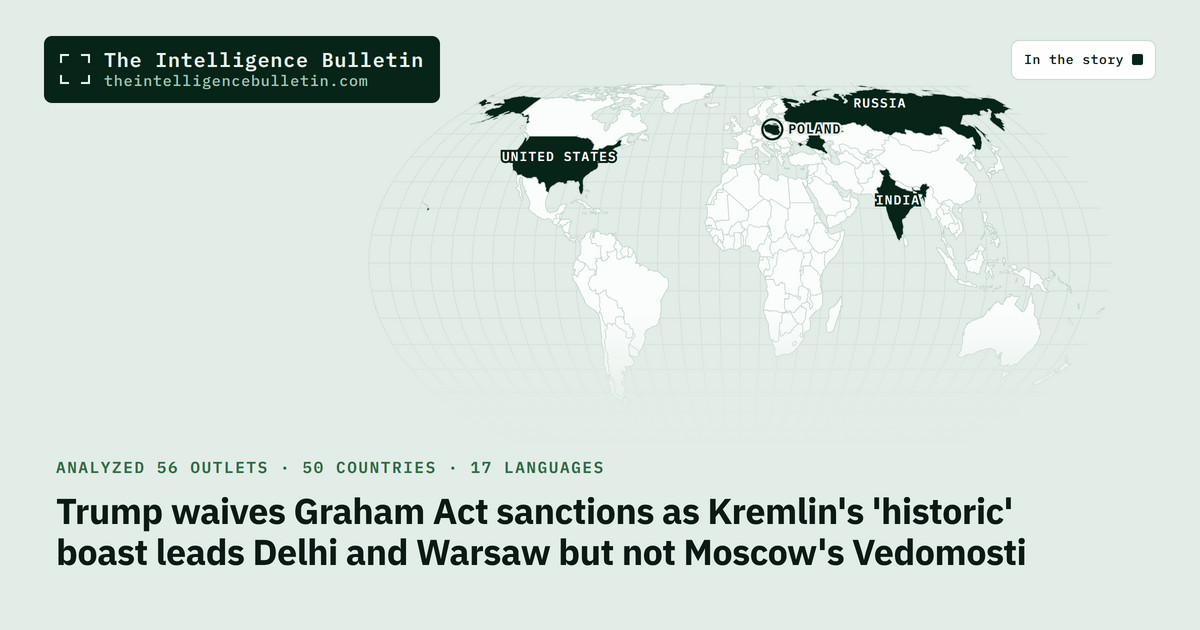
Across the press: The Kremlin’s ‘historic moment’ line is absent from Vedomosti, the Russian outlet, but leads both Times of India and Rzeczpospolita.
Source base: 5 outlets read in full (United States, Russia, Ukraine, India, Poland), selected from 56 analyzed.
- 1 of 5 · Eurasia Review onlyZelensky called the decision unfortunate and said it completely disregarded the Graham Act, warning it financially rewards Putin and only encourages attacks on Ukraine’s energy grid before winter.Eurasia Review quotes Zelensky’s October 17 post on X in full.
- 5 of 5 · reported separatelyTrump’s October 16 executive order waived the major sanctions and tariffs in the Graham Act before their October 18 start date.Eurasia Review, Vedomosti, Kyiv Post, The Times of India and Rzeczpospolita all report the order and its timing from the White House publication.
- 3 of 5 · reported separatelyThe waiver suspends a 500 percent tariff on Russian goods and 100 percent duties on the five largest buyers of Russian oil and gas, including China and India.Vedomosti names Articles 112 and 113; Kyiv Post and Rzeczpospolita confirm the 500 and 100 percent figures, and the top-five buyer scope.
- 2 of 5 · reported separatelyPutin’s investment envoy Kirill Dmitriev called the suspension an important and truly historic moment, saying US-Russia economic cooperation serves both nations and global stability.The Times of India and Rzeczpospolita both quote Dmitriev’s X post, independently of one another.
- 2 of 5 · reported separatelyRepresentative Gregory Meeks introduced the bipartisan ‘Prohibit Corrupt Russia Oil Deals Act’ on October 16 to revoke OFAC licenses, bar DFC investment in Russian energy, and block Trump’s diesel deal.Kyiv Post reports the bill and its terms from the House Foreign Affairs Committee announcement; Eurasia Review separately confirms the introduction.
- October 18, 2026The date the Graham Act penalties were due to take effect; watch whether Congress moves formal disapproval or the administration releases its required justification.
- On release of the certification reportThe unclassified report explaining the national-interest basis; its reasoning will frame the congressional fight and any veto calculus.
- November 2026 midtermsTrump’s fuel-price justification meets voters as control of Congress hangs in the balance, testing whether the Russia deal hurts or helps.
- April 7, 2027Expiry of the OFAC general license authorizing Russian diesel transactions; watch whether the arrangement is renewed or revoked.
- AnsweredThe administration defended the arrangement: rather than revoking the license, Trump’s Oct 16 order waived the Graham Act sanctions, and the revocation push shifted to Congress with Meeks’s Oct 16 bill, as Kyiv Post and Eurasia Review report.
- Still openHow will the administration reconcile the license with the statutory ban on Russian energy imports, as the 22 lawmakers demand? · Did the Commission and Council heads cancel their end-of-day press conference as URA.Ru reports, and why?
Full analysis
What happened Why it matters How each country tells it Where accounts conflict Room for disagreement Our assessment Sources and evidence
What happened
Late on October 16, two days before the Lindsey O. Graham Sanctioning Russia and Iran Act of 2026 was due to take effect, President Donald Trump signed an executive order waiving nearly all of its substantive sanctions and tariffs. Published on the White House site Friday evening, the order suspended the law’s central mechanisms: a 500 percent tariff on Russian goods and 100 percent duties on the five largest buyers of Russian oil and gas, a list that includes China and India. Vedomosti names the suspended provisions as Articles 112 and 113; Kyiv Post and Rzeczpospolita confirm the two tariff levels and the top-five scope. Trump certified to Congress that the waiver served the US national interest. The law itself was one he had signed on September 18, by Kyiv Post’s dating, and was named for Lindsey Graham, the South Carolina senator and Ukraine advocate who died July 11.
The reaction divided along the same fault line as the law. Kirill Dmitriev, Putin’s investment envoy, wrote on X on Saturday that the suspension was "an important and truly historic moment" — the quote that leads The Times of India and supplies the headline for Rzeczpospolita. Dmitriev argued that the legislation, altered after Graham’s death, "could have effectively brought all economic cooperation between Russia and the United States to a complete halt," and that economic cooperation "serves the interests of both nations, contributes to global economic stability, and lays the foundation for building trust and achieving lasting peace."
That boast is missing from the one Russian outlet in the set. Vedomosti reports the order and the tariffs, then presents what it explicitly calls a roundup of how foreign media judged the decision, quoting Virginia Democrat Don Beyer accusing Trump of a "surrender" to Putin, Graham’s sister Darlene defending the law, and Texas Republican Michael McCaul warning that lifting the oil measures would finance Russia’s military. The outlet’s own editorial note identifies Graham as on Russia’s list of extremists and terrorists. Moscow’s business daily reported a Russian win through foreign criticism; Delhi and Warsaw printed the triumph.
Ukraine’s president read the same order from the other side. Volodymyr Zelensky’s full October 17 response appears only in Eurasia Review: an "unfortunate decision" to "completely disregard the Lindsey Graham Act" just as "Russia is trying to cause a blackout in Ukraine — right before winter." "A U.S. sanctions blackout, easing pressure on the aggressor, financial rewards for Putin — all of this only encourages him to keep attacking," he wrote. The week before the waiver, the same outlet reports, Russia launched more than 700 drones and ballistic and cruise missiles at Ukrainian cities and power plants.
The fight moved immediately to Capitol Hill. Representative Gregory Meeks, top Democrat on the House Foreign Affairs Committee, introduced the bipartisan "Prohibit Corrupt Russia Oil Deals Act" on October 16, hours after the order: a measure to revoke OFAC licenses, bar the Development Finance Corporation from investing in Russian energy, and restrict future executive exemptions. Kyiv Post, which leads with the bill, and Eurasia Review both report it. "At a time when the United States should be increasing pressure on the Kremlin, Donald Trump is cozying up to Putin and striking self-enriching deals instead of standing with Ukraine," Meeks said. Republicans Brian Fitzpatrick and Don Bacon were already drafting a companion ban on Russian oil and hydrocarbon imports.
The waiver extends the arrangement begun after the October 9 Trump–Putin call, under which Russia is to ship commercial diesel through 2027 on a Treasury license running to April 7, 2027. The administration’s reasoning remains the story’s open seam: the law requires an unclassified report explaining the national-interest certification, the White House has not made one public, and sources familiar with the matter told RFE/RL, cited by Eurasia Review, that the administration had missed an October 8 deadline tied to the tariff justification. Razom for Ukraine’s Mykola Murskyj observed that the waivers "don’t even have an expiration date."
Why it matters
The waiver’s first consequence lands in Ukrainian energy infrastructure, where it removes the financial pressure the law was designed to apply in the season Russian strikes aim to leave millions without heat. Zelensky’s statement ties the two together: the week Russia escalated its long-range campaign, Washington set aside the lever the law had put in the president’s hands. McCaul’s worry, carried by Vedomosti, names the mechanism directly — the oil waiver feeds the war’s financing.
The buyers’ stake is equally concrete. The 100 percent duties would have fallen on China and India, the largest purchasers of Russian crude; The Times of India records Beijing calling the provision "long-arm jurisdiction that lacks a basis in international law" and New Delhi warning the tariffs could damage bilateral ties. For India the removal is a direct tax lifted from its energy supply.
For the United States, the decision is explicitly electoral. Multiple accounts tie the waiver to fuel prices ahead of November’s midterms, with Republicans defending control of both chambers, and Vedomosti’s digest notes analysts attribute rising American costs to the US war against Iran. Yet the public has seen no reasoning beyond the certification itself: the report that would give Congress the national-interest basis has not been released, and the October 8 deadline stands unanswered. What the law requires and what the public has seen are two different things, and that gap is where the congressional fight now lives. Read together, the five accounts make the point plainly: from Kyiv, Warsaw, Delhi and Moscow, the same order is four different events — a retreat, a threat, a reprieve and a triumph.
How each country tells it
- Eurasia Review · United States · opinionA US-published analysis treating the waiver as a strategic shift, with the fullest account of the order’s mechanics, Zelensky’s response, and bipartisan congressional blowback, several quotes sourced to RFE/RL.
- Vedomosti · Russia · original reportingThe Russian business daily leads not with Moscow’s own reaction but with a roundup of how foreign media judged Trump’s decision, quoting US critics such as Don Beyer and Michael McCaul while omitting Dmitriev’s ‘historic moment’ claim.
- Kyiv Post · Ukraine · original reportingUkraine’s English daily leads with the congressional counter-attack, Meeks’s ‘Prohibit Corrupt Russia Oil Deals Act’, and frames the waiver as the latest turn in a US-Ukraine legislative fight over Trump’s diesel deal.
- The Times of India · India · original reportingIndia’s broadsheet leads with Kremlin envoy Kirill Dmitriev’s ‘truly historic moment’ claim and adds China’s and India’s own recorded objections to the buyer-side tariffs.
- Rzeczpospolita · Poland · carries Polish Press AgencyA frontline NATO member’s daily leads with Trump’s rollback and the Kremlin’s ‘historic moment’ reaction, reading the waiver as an immediate European security and energy-risk event and linking it to the 4.8-million-ton Russian diesel deal.
Where accounts conflict
The diesel deal’s size is reported two ways that do not reconcile on the page. Eurasia Review, relaying Trump’s announcement from last week, gives the staged figures — 300,000 tons immediately, 500,000 in November, then 1 million "immediately thereafter" — which sum to 1.8 million tons. Rzeczpospolita, on Polish Press Agency copy, gives the total as 4.8 million tons of Russian diesel over the coming months. A reader holding either count alone holds a different scale of what the Treasury license now permits, and neither account explains the gap.
Room for disagreement
The strongest case that the waiver holds and should is on the record from the late senator’s own sister. Darlene Graham, quoted in Vedomosti’s roundup, said the law gives the president "tools he can use, if he wishes, to end the conflict through economic sanctions," and that it depends on him. Dmitriev’s post makes the broader version of the same case: economic cooperation, not sanctions and confrontation, "lays the foundation for building trust and achieving lasting peace." The order’s own structure lends that argument force. The certification has already been submitted, the waiver carries no expiration date, and the only public compulsion — the required report — has not surfaced, without consequence so far. The buyer-side duties carry no international constituency to restore them, since the two largest purchasers of Russian oil oppose them. If the fuel-price justification carries through November, reversing the waiver after the midterms would require forcing on a president the very policy he has now declined twice.
Our assessment
The waiver is likely to stand through the November midterms and the diesel license through its April 2027 expiry, with the congressional fight becoming the story’s lasting arena rather than its reversal. The warrant sits in what the reporting converges on: the certification has been submitted and the order has no termination date, while every challenge runs through Congress — Meeks’s bill, the Fitzpatrick–Bacon draft, the 86-vote Senate groundwork Rzeczpospolita records. No account suggests the administration has either a path or an interest in reversing itself before an election in which fuel prices are its stated justification, and the Kremlin has already priced the waiver as the opening of a broader normalization. Congress holds the leverage — the overdue report, the missed October 8 deadline, a veto calculus that shifts with the midterms — but the administration holds the order, and the order is the thing being disputed. The Graham Act has become a pressure reserve the White House keeps without deploying: signed for leverage, waived for prices, left to Capitol Hill to enforce.
What would change this: the administration’s required justification report surfacing with reasoning thin enough to consolidate a veto-proof majority behind Meeks’s bill after the midterms.
Sources and evidence
Press quoted
- What substantive justification did Trump’s administration give Congress in the required certification and accompanying report, and will it be released unclassified?
- Do the waivers carry an expiration date, and how long will the suspension of the Graham Act provisions last?
- Will Meeks’s Prohibit Corrupt Russia Oil Deals Act or the Fitzpatrick-Bacon Reagan Act attract enough votes to pass, and would Trump veto either?
That’s how the world told the story.
Get our daily open-source intelligence on world events in your inbox — one email a day, up to six stories.
Subscribe freeNo spam. One-click unsubscribe. See the latest email →