 AI-generated analysis published under the editorial responsibility of Rohit Sinnas. How it works →
| Press analyzed | 64 outlets · 50 countries · 20 languages |
| Press quoted | 5 sources, each independently reported |
See the 50 countries
Albania, Algeria, Argentina, Azerbaijan, Bosnia and Herzegovina, Bulgaria, Canada, China, Colombia, Croatia, Cyprus, Czech Republic, Dominican Republic, Egypt, France, Germany, Greece, Haiti, India, Indonesia, Iraq, Israel, Italy, Jordan, Luxembourg, Mexico, Netherlands, Panama, Paraguay, Qatar, Romania, Russia, Saudi Arabia, Serbia, Slovenia, Spain, Sudan, Sweden, Switzerland, Syria, Taiwan, Tunisia, Turkey, Ukraine, United Arab Emirates, United Kingdom, United States, Uruguay, Venezuela, Yemen
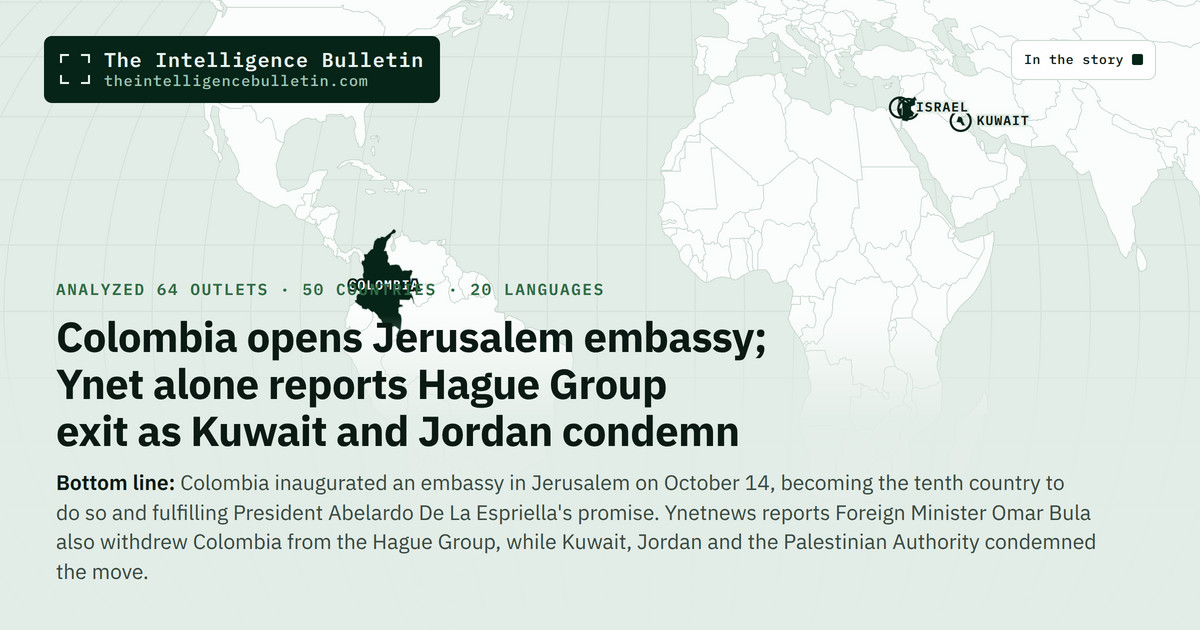
Colombia inaugurated an embassy in Jerusalem on October 14, becoming the tenth country to do so and fulfilling President Abelardo De La Espriella’s promise. Ynetnews reports Foreign Minister Omar Bula also withdrew Colombia from the Hague Group, while Kuwait, Jordan and the Palestinian Authority condemned the move.
Across the press: Israeli outlet Ynet reports Colombia’s Hague Group withdrawal; Colombia’s El Tiempo and AFP omit it while Kuwait and Jordan condemn.
- Single sourceForeign Minister Omar Bula announced Colombia’s withdrawal from the Hague Group at the Israeli Foreign Ministry reception.Source: Ynetnews, quoting Bula Escobar at the event.
- Independently reportedColombia inaugurated an embassy in Jerusalem on October 14, becoming the tenth country with a diplomatic mission there.Source: El Tiempo and Ynetnews independently report the opening and the tenth-country tally; AFP via El País Uruguay corroborates the opening.
- Independently reportedThe embassy move restores ties severed by Gustavo Petro’s government in 2024 and fulfils a promise by President Abelardo De La Espriella.Source: El Tiempo, Ynetnews and AFP via El País Uruguay all report the reversal of Petro’s break and the promise.
- Independently reportedKuwait, Jordan and the Palestinian Authority condemned the opening as altering Jerusalem’s status, with Kuwait framing it as an attack on Palestinian rights.Source: Wafa citing Kuwait’s foreign ministry and the Times Kuwait; Jo24 for Jordan; AFP via El País Uruguay for the Palestinian Authority.
- Did Colombia’s embassy in West Jerusalem come with a formal position on East Jerusalem, and does Bogotá still recognize a future Palestinian capital there?
- Has any other Hague Group member confirmed Colombia’s withdrawal, and what practical effect does it have on the group’s legal campaign against Israel?
- Which country will become the twelfth to open an embassy in Jerusalem, after the Democratic Republic of the Congo, as Saar hinted?
Press quoted
Full analysis
On the afternoon of October 14, Colombia’s foreign minister Omar Bula and his Israeli counterpart Gideon Saar stood on Rabí Akiva Street and pulled the covering from the plaques of a new embassy. The building El Tiempo described as sitting “en la parte occidental” — in the western half of Jerusalem — made Colombia the tenth country to keep a diplomatic mission in the city. Bula called it “un paso decisivo para estrechar la hermandad y los vínculos entre nuestros pueblos”; Saar called the day “un día de fiesta” and “una victoria de la lucha diplomática por nuestra historia.”
The opening fulfilled a promise President Abelardo De La Espriella had made to Saar in Buenos Aires before his election: “Si soy elegido presidente de la República, trasladaré de inmediato la embajada de Colombia a Jerusalén.” El Tiempo reports that pledge; Ynetnews and the AFP copy carried by El País Uruguay both place his taking office in August, and all three accounts agree the move reverses Gustavo Petro’s 2024 break in relations over the war in Gaza. El Tiempo lists the nine countries that preceded Colombia: the United States, Guatemala, Honduras, Kosovo, Papua New Guinea, Paraguay, Fiji, Nauru and Somaliland.
But a second announcement made at the same gathering appears in only one of the five accounts assembled here. At a reception at Israel’s Foreign Ministry after the inauguration, Ynetnews reports, Bula announced that Colombia is withdrawing from the Hague Group, which the outlet describes as a coalition of countries seeking diplomatic, legal and economic measures against Israel over the war in Gaza. “Today I announce Colombia’s withdrawal from the Hague Group, a group of countries that attacked Israel and worked to isolate it. We oppose that approach,” Ynetnews quotes him saying in the presence of Netanyahu and Saar. The same report has Bula condemning the October 7 attack as “a barbaric attack carried out by despicable murderers from a culture of death,” and recounting a meeting the day before with former hostage Elkana Bohbot, to whom he said he presented a Colombian passport. That defection is the headline of the Israeli account. Colombia’s own largest daily does not carry it.
Netanyahu used the day to cast the move as part of a continental shift. “Algo extraordinario ocurre en Latinoamérica,” AFP quotes him saying at the evening gala at the Foreign Ministry; the same piece notes his glancing reference to the October 25 Brazilian runoff, where Flávio Bolsonaro leads. Ynetnews records him recalling that no Israeli prime minister in 70 years had traveled south of Texas before he did, and floating another such trip.
The Arab and Palestinian reaction arrived the same day and inverted the frame entirely. Kuwait’s foreign ministry condemned Colombia’s decision, reaffirming its “categorical rejection” of all practices aimed at altering “the existing legal and historical status of occupied Jerusalem,” in a statement Wafa carried from the Times Kuwait. Kuwait called on the international community and the UN Security Council to confront attempts to impose “a new reality” in the occupied Palestinian Territory, and reiterated support for a Palestinian state along the June 4, 1967 borders, with East Jerusalem as its capital. Jordan’s condemnation appears in the headline of the Amman outlet Jo24; the article’s text could not be retrieved, so only the headline-level fact is available here. The Palestinian Authority’s foreign ministry, through AFP, called the opening “una violación flagrante del derecho internacional” and UN resolutions, and “un ataque al pueblo palestino y a sus derechos nacionales justos y legítimos.”
None of that reaction engages with the day’s single most precise geographic marker. El Tiempo’s report is the only one that places the embassy on Rabí Akiva Street, explicitly in the western part of the city. Saar, in the Ynetnews account, declared that Jerusalem “will remain Israel’s united capital.” Kuwait, in the Wafa text, spoke of “occupied Jerusalem.” No account in the set asks whether stationing a mission in the western half amounts to recognizing the whole city or only that part. The question was already live before the ceremony. TIB reported on October 9 that Israel had just forced the closure of the British consulate in East Jerusalem, with signage removed and the consul general required to leave — the same contest over the city’s status, staged days earlier on its eastern side.
A reader of any single outlet comes away with a different event, and the divergence is not a matter of emphasis but of substance. El Tiempo, working with EFE material, gives the fullest choreography: the tenth-country tally, the plaques, Saar’s statement that an eleventh embassy, from the Democratic Republic of the Congo, is “ya está en camino” and that a twelfth is decided but not yet named, the ambassador inviting the guests to celebrate over “un cafecito, el mejor del mundo.” But its full published text contains no Hague Group withdrawal, no October 7 condemnation, no hostage anecdote. A Colombian reader of the country’s leading daily would know only of restoration; the defection from a legal coalition directed at Israel, announced at the same gathering, is not part of that account.
Ynetnews, by contrast, leads with the defection, so an Israeli reader gets the part most useful to the host’s argument — that Colombia quit the coalition and stood, in Bula’s quoted words, “with the truth and with Israel.” But that piece contains no Arab or Palestinian voice; the same-day condemnations are absent from it.
Wafa’s text makes no mention of the Hague Group withdrawal, nor of the western-half location; its story is the Kuwaiti rejection. Jo24’s available record is a headline only, so nothing beyond Jordan’s condemnation can be asserted from it. A reader of the Arab and Palestinian record would not learn that the building sits in the western half of the city, or that the visiting foreign minister used the occasion to leave a coalition confronting Israel.
The AFP copy under the El País Uruguay masthead is the only piece in the set that contains both Netanyahu’s enthusiasm and the Palestinian Authority’s rejection, and it adds the broadest regional frame: Javier Milei’s promised embassy move, the Brazilian runoff, and the August decision by the De La Espriella government to recognize Israeli sovereignty over the Golan Heights, which AFP reports made Colombia only the second country after the United States to take that step. But it, too, lacks the Hague Group withdrawal and the western-half detail.
Read together, the five accounts show that two things happened on October 14, and no single one carries both: an embassy opened in the western half of Jerusalem, and Colombia’s foreign minister — on Ynetnews’s account alone — announced his country’s departure from the Hague Group. The corroborated spine is solid across independent reporting chains: the opening, the tenth-country tally, the reversal of Petro’s break, and the Arab and Palestinian condemnations all appear in multiple accounts. The Hague Group exit rests on a single Israeli outlet’s detailed, on-scene report, and its absence from El Tiempo is best read not as a test of whether it happened but as a measure of what Bogotá chose to tell its domestic audience that day.
What to Watch
On geography, El Tiempo’s description is the most reliable anchor in the set precisely because it is the least interested claim there: it says where the building is, in the western half, without resolving the recognition question. Israel’s “united capital” and Kuwait’s “occupied Jerusalem” are both arguments, and both outrun that marker. The battle that follows will be fought on the question no source answered: whether placing an embassy on Rabí Akiva Street constitutes recognition of the whole city. Saar has already said an eleventh embassy is on the way and a twelfth is decided; Netanyahu is openly courting the Brazilian runoff; Kuwait has called for a Security Council confrontation. The unresolved distinction between the western half and the whole city is where the legal and diplomatic fight over Jerusalem’s status will now move.
That’s how the world told the story.
Get our daily open-source intelligence on world events in your inbox — one email a day, up to six stories.
Subscribe freeNo spam. One-click unsubscribe. See the latest email →