 AI-generated analysis published under the editorial responsibility of Rohit Sinnas. How it works →
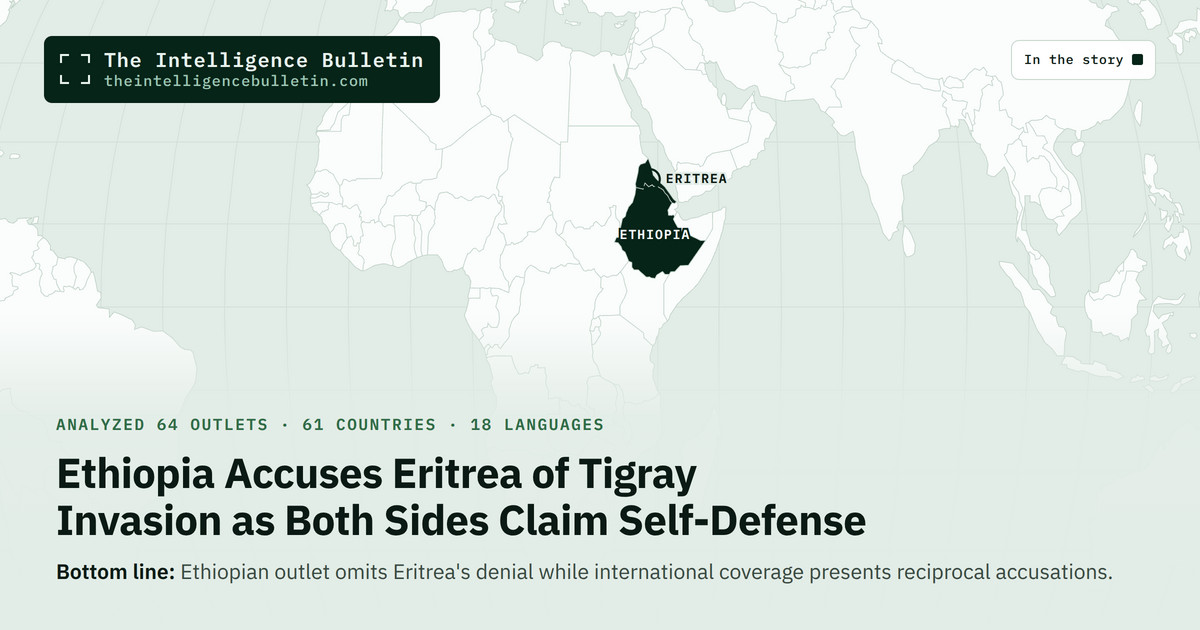
| Press analyzed | 64 outlets · 61 countries · 18 languages |
| Press quoted | 5 sources · 4 independent accounts |
See the 61 countries
Algeria, Argentina, Australia, Austria, Azerbaijan, Bangladesh, Belgium, Brazil, Brunei, Burundi, Cambodia, Cameroon, Canada, China, Czech Republic, Egypt, Ethiopia, France, Germany, Greece, Guinea, Hungary, India, Israel, Italy, Jordan, Kenya, Liberia, Lithuania, Malaysia, Mauritania, Mauritius, Morocco, Netherlands, Nigeria, Norway, Pakistan, Portugal, Qatar, Republic of the Congo, Romania, Saudi Arabia, Senegal, Serbia, Slovakia, South Africa, South Sudan, Sri Lanka, Sudan, Sweden, Switzerland, Taiwan, Tanzania, Togo, Tunisia, Turkey, Uganda, United Arab Emirates, United Kingdom, United States, Zimbabwe
Ethiopian outlet omits Eritrea’s denial while international coverage presents reciprocal accusations.
- Single sourceEritrea accuses Ethiopia of an unprovoked war of aggression aimed at seizing the Assab port.Source: Eritrean Minister of Information Yemane Gebremeskel reported by Al Jazeera and DW
- Independently reportedEritrean troops have advanced up to 60 km into three Tigray zones including Badme-Sheraro-Shimelba Rama-Adwa and Zalambessa-Adigrat.Source: Ethiopian Foreign Minister Gedion Timothewos in letter to UNSC reported by The Reporter Al Jazeera Anadolu and DW
- Independently reportedEthiopia told the UN Security Council it has no choice but to defend itself against Eritrean aggression.Source: Ethiopian Foreign Minister in October 8 2026 letter reported across all five outlets
- Independently reportedWitnesses report Eritrean troops in Tigray towns such as Adigrat followed by Ethiopian drone strikes.Source: AFP via Al Jazeera and DW
- What is the exact current number and position of Eritrean troops inside Tigray?
- Have any direct negotiations or third-party mediation efforts between Ethiopia and Eritrea occurred since ties were severed?
- What specific evidence did Ethiopia submit to the UNSC to support its incursion claims?
Press quoted
Full analysis
Ethiopia’s foreign minister wrote to the United Nations Security Council on October 8 that Eritrean forces had crossed into three zones of Tigray and advanced as far as 60 kilometers inside Ethiopian territory. The letter named the Badme–Sheraro–Shimelba axis in the northwest, the central sector around Rama and Adwa, and the eastern districts near Zalambessa and Adigrat. It described the moves as an “all-out invasion” and stated that Ethiopia had “no choice but to defend itself.” An evidence dossier accompanied the letter. Ethiopian officials also reported that their drones had struck Eritrean positions after the incursions reached towns inside Tigray.
Eritrea’s minister of information rejected the account outright. He wrote that Ethiopia had pursued an unprovoked war of aggression against Eritrea for more than three years and that Asmara had shown restraint despite repeated Ethiopian statements about the need for sea access. The Eritrean statement accused Addis Ababa of seeking to seize the port of Assab on the Red Sea. Eritrea also denied any support for the Tigray People’s Liberation Front in the current fighting.
Witness accounts placed Eritrean troops inside Adigrat shortly before Ethiopian drone strikes hit the area. Ethiopian government forces have been advancing against TPLF positions in recent days, recapturing the regional capital Mekelle and other towns. Diplomatic ties between the two countries collapsed the previous week when Ethiopia expelled Eritrean diplomats and closed its embassy in Asmara; Eritrea responded by severing relations. The 2018 peace agreement that ended two decades of open hostility has not prevented the return of direct confrontation.
The same October 8 letter reached the UN Security Council through multiple reporting chains. Every outlet that published the Ethiopian foreign minister’s text recorded the 60-kilometer claim and the three named sectors. The letter itself framed the presence of Eritrean units as a violation of sovereignty that left Ethiopia with an inherent right of self-defense. UN Deputy Secretary-General Amina J. Mohammed met Ethiopian officials in Addis Ababa the following day and reaffirmed the organization’s respect for Ethiopian sovereignty while calling for dialogue.
International coverage placed the Ethiopian letter alongside Eritrea’s rebuttal. Al Jazeera and Deutsche Welle carried the Eritrean minister’s statement that Ethiopia’s actions constituted aggression aimed at Red Sea ports. Both also relayed witness reports of Eritrean troops followed by Ethiopian strikes. Deutsche Welle added an estimate, drawn from a foreign security source, of between 5,000 and 8,000 Eritrean soldiers inside northern Tigray. The Reporter Ethiopia published only the Ethiopian letter and the accompanying dossier, without reference to Eritrea’s denial or the Red Sea accusation.
The BBC and Anadolu Agency centered their accounts on Ethiopia’s appeal to the Security Council and the warning that self-defense had become unavoidable. Neither outlet included the Eritrean minister’s counter-statement in the published piece. The Reporter Ethiopia went further by presenting the incursions as established fact backed by Ethiopian documentation and by describing Eritrea as the aggressor without recording Asmara’s version of events.
The 60-kilometer advance and the text of the October 8 letter therefore stand as the elements reported independently by the largest number of outlets. The Eritrean claim that Ethiopia seeks Assab rests on a narrower chain, appearing in the two outlets that carried the Eritrean minister’s words. No outlet in the set published reporting from inside Eritrea itself.
A reader who saw only the Ethiopian domestic account would conclude that Eritrea had launched a one-sided invasion and that international bodies had been asked to condemn it. A reader limited to the BBC or Anadolu pieces would see Ethiopia’s defensive posture and its UN appeal but would not encounter Eritrea’s assertion that the conflict stems from Ethiopian designs on the coast. The fuller picture available across the set shows both governments invoking self-defense while disagreeing on who moved first and why. The absence of any Eritrean-sourced reporting means the counter-narrative reaches English-language readers only through statements relayed by foreign agencies.
What to Watch
The corroborated record of the letter and the 60-kilometer claim supplies the strongest ground for treating the Ethiopian accusation as the more widely attested version of troop movements. Eritrea’s specific motive regarding Assab appears in fewer independent chains and therefore carries less weight as a settled fact. The pattern of coverage indicates that outlets closer to one government foreground that government’s framing while outlets farther away record both statements. The next development most directly tied to the reporting is the closed UN Security Council consultations scheduled for later in October; those sessions will test whether the letter produces any formal response or remains a diplomatic exchange between the two capitals.
That’s how the world told the story.
Get our daily open-source intelligence on world events in your inbox — one email a day, up to six stories.
Subscribe freeNo spam. One-click unsubscribe. See the latest email →