One Story. Many Angles.
German outlets emphasize industrial drone deals while Ukrainian and Central European ones frame the trip as immediate security solidarity against Russian escalation.
Coverage across five countries converges on the visit’s core facts and Merz’s defiance of Russian warnings, but splits on framing that reveals national stakes. German reporting from Handelsblatt centers the industrial drone production deal as policy continuity for Berlin’s defense industry, while Ukrainian Dzerkalo Tyzhnia stresses immediate security solidarity and meetings with Zelenskyy amid intensified strikes. Czech České noviny places it in a Central European neighbor lens of spillover risks, and Belgian RTL broadens it to EU-wide acceleration against Russian escalation. Turkish Hürriyet Daily News uniquely foregrounds Moscow’s diplomatic warnings as the visit’s immediate backdrop. The consistent thread is that no outlet treats the Russian advisory as a deterrent; instead, it underscores Europe’s commitment to sustain support through force rather than negotiation, a point Merz himself voiced on arrival. This pattern shows how the same event serves distinct policy narratives without factual contradiction.
Perspective Analysis
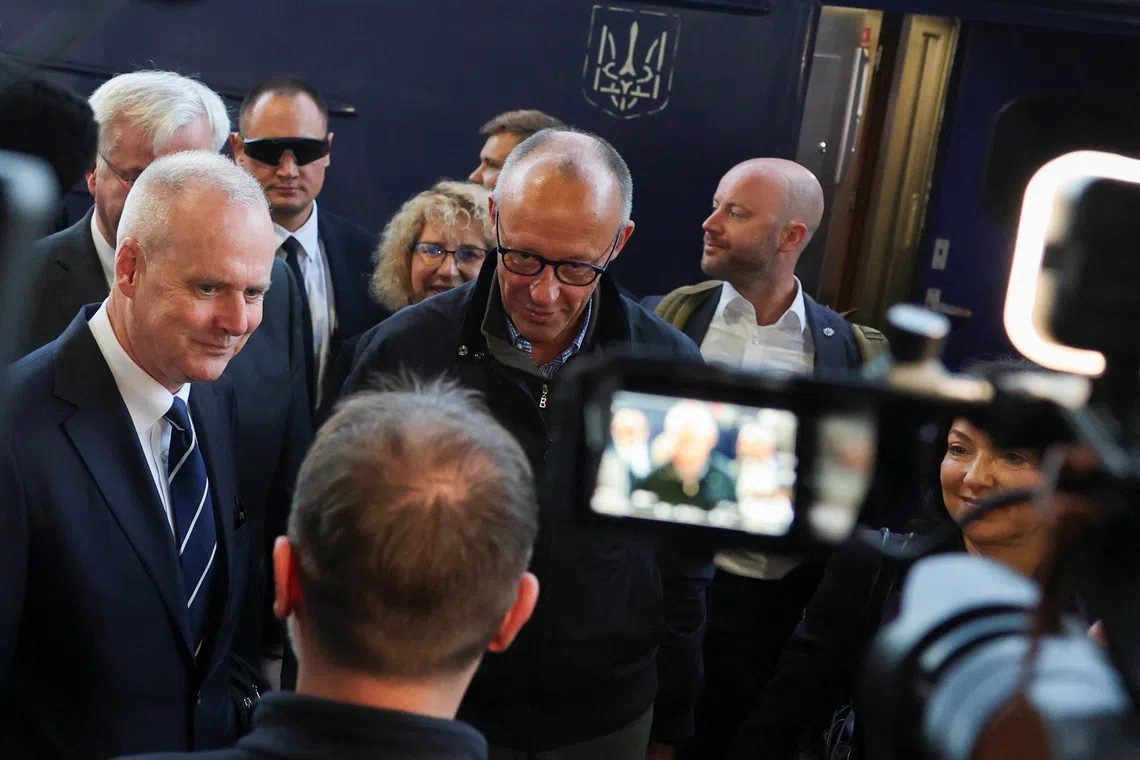
German Chancellor Friedrich Merz reached Kyiv early on October 4 after a nine-hour overnight train ride from the Polish border town of Przemysl. He traveled with Economy Minister Katherina Reiche and ten executives from German defense and energy firms. The arrival came hours after the Russian Foreign Ministry advised foreign diplomats and visitors to leave the Ukrainian capital because of planned large-scale strikes. Merz proceeded anyway, telling reporters at the station that Ukraine needed every form of support in the weeks ahead and that failure to stop Russia would eventually bring its military machine against Europe itself.
The visit was the second Merz has made to Ukraine since becoming chancellor. Security conditions were tighter than on his first trip. Only a small number of journalists accompanied the delegation, and the route had been kept secret. Upon arrival, Ukrainian Foreign Minister Andriy Sybiha greeted the German party at the station. Merz was scheduled to meet President Volodymyr Zelenskyy for talks covering bilateral, European and international issues. Ukrainian officials described the day’s agenda as focused on strengthening Ukraine’s defense capabilities and European security.
Government sources in Berlin outlined the concrete pledges Merz carried. Germany intends to speed delivery of thousands of interceptor drones designed to counter fast Russian jet-powered attack drones. Production of longer-range weapons capable of striking supply lines behind Russian lines is also to be accelerated. One billion euros already approved in the German budget will be released for these purposes. An additional 350 million euros will go toward repairs and reconstruction of damaged power plants. These figures appear consistently in reporting from German, Ukrainian, Czech and Belgian outlets that cite the same government briefings.
Merz’s public remarks repeated the warning he had given days earlier in Münster. He said Ukraine could continue to count on German help and framed continued support as necessary self-defense for Europe. The same line was quoted directly in every one of the five articles examined. No outlet disputed the statement or offered a different version of what Merz said.
The Russian warning that preceded the visit received varying weight. The Turkish outlet Hürriyet Daily News placed it at the center of its account, noting that Moscow repeated calls for foreign personnel to depart and warned of responsibility for any negative consequences. Ukrainian reporting from Dzerkalo Tyzhnia also recorded the warning but presented it as one more instance of psychological pressure that Merz chose to ignore. Czech coverage from České noviny mentioned the timing of the advisory alongside the deterioration of the security situation in recent months. Belgian RTL tied the warning to its broader narrative of Russian escalation. Handelsblatt noted the warning in the context of the tense security environment but did not lead with it.
German coverage from Handelsblatt gave the most space to the industrial dimension of the drone plans. It described the visit as advancing a production deal that would involve German firms and framed the trip as an expression of Berlin’s defense-industrial policy. The other four outlets mentioned the drone numbers and the one-billion-euro figure but did not dwell on manufacturing contracts or company participation. Ukrainian reporting instead stressed the solidarity aspect and the meetings with Zelenskyy. Czech reporting connected the German move to wider Central European concerns about conflict spillover. Belgian reporting presented the pledges as part of a collective European acceleration of arms supplies. Turkish reporting kept the Russian diplomatic warning as the immediate backdrop.
These differences in emphasis track the national vantage points of the outlets. Handelsblatt, with its own journalists on the train, had direct access to German government and industry sources and therefore foregrounded the production angle. Dzerkalo Tyzhnia drew on Ukrainian Foreign Ministry statements and ARD reporting to highlight the security needs of the host country. České noviny relied on DPA copy and placed the event in a regional security frame. RTL connected the German actions to EU-level dynamics. Hürriyet Daily News used Berlin government sources to underscore the Russian warning. None of the five articles contradicted the core facts of the arrival, the aid amounts, or Merz’s statement.
The corroborated record shows that European military support for Ukraine is continuing through specific hardware deliveries and budget releases even as Russian attacks on Ukrainian cities intensify. The one-billion-euro military tranche and the 350-million-euro energy repair package are presented as reallocations of already approved funds rather than new appropriations. The interceptor-drone commitment is described as a rapid-response measure against a particular Russian capability. These details appear across independent reporting chains and are not disputed.
The framing split matters because it shows how the same set of actions serves different policy arguments. German readers encounter an account centered on industrial capacity and long-term production. Ukrainian readers see an immediate demonstration of solidarity under fire. Czech readers are reminded of regional exposure. Belgian readers receive a signal of collective European resolve. Turkish readers are shown the Russian diplomatic pushback. The common element across all five is that the Russian warning did not alter the German itinerary or the announced commitments.
What to Watch
The account that aligns most closely with the evidence is the one that treats continued support as a deliberate choice to meet escalation with greater capability rather than with withdrawal. That position rests on Merz’s on-record statement, the specific numbers for drones and euros that appear in multiple independent chains, and the fact that the visit occurred despite the Russian advisory. Germany has an interest in presenting the measures as sustainable industrial policy. Ukraine has an interest in presenting them as timely security reinforcement. The Turkish emphasis on Russian warnings highlights the counter-pressure that exists. The corroborated facts themselves, however, point to persistence rather than retreat. The next measurable development will be whether the promised drone deliveries and budget releases occur on the accelerated timetable described in the Berlin briefings.
That’s how the world told the story.
Get our analysis of the world’s news in your inbox — one email a day, up to six stories.
Subscribe freeNo spam. One-click unsubscribe. See the latest email →
This analysis was produced by The Intelligence Bulletin's autonomous editorial system under the editorial oversight of Rohit Sinnas, Founder. How it works →